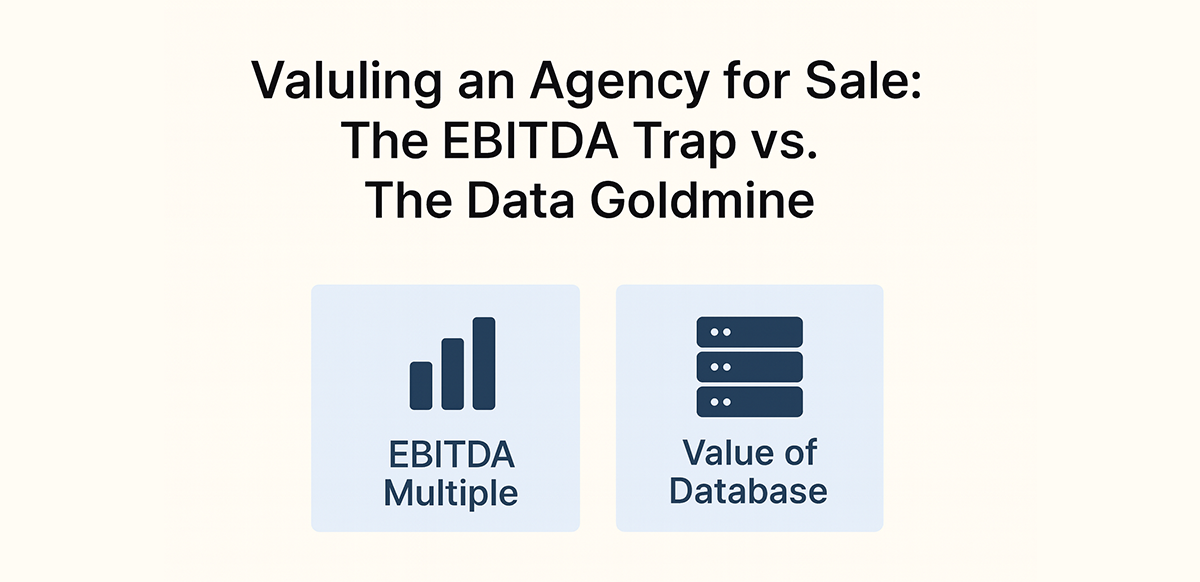
Valuing an Agency for Sale: The EBITDA Trap vs. The Data Goldmine
ListingMine Academy | Agency M&A, Valuation & Leadership Strategy
When an agency principal begins exploring a sale, merger, or investor partnership, the same question dominates the conversation:
“How much is my agency actually worth?”
Traditional valuation formulas rely on:
- revenue multiples
- EBITDA multiples
- discounted cash flow models
But a real estate agency does not behave like a normal business. An agency can look successful from the outside — large team, awards, renovated HQ — but be structurally worthless underneath. In reality, valuation rests on two independent pillars:
- The Financial Engine — predictable EBITDA (current profit)
- The Growth Engine — the database & systems (future reliability)
Most principals only focus on the first. Serious buyers pay for the second. This is how modern agency valuation works.
1. Why Real Estate Agency Valuation Is Different
Traditional businesses (SaaS, Retail, Manufacturing) have:
- fixed assets
- recurring revenue
- management-controlled output
Real estate agencies have:
- low asset base
- volatile revenue
- heavy dependency on agents
- constant “talent leakage” risk
The “Empty Shell” Problem
Buyers know: If they acquire your agency today, and your top 5 producers leave tomorrow, they’ve bought:
- an empty office
- a depreciating brand
- a liability
So buyers do not pay for:
- number of agents (headcount ≠ revenue)
- office size (rent is a liability)
- awards (history ≠ future cashflow)
They only pay for: Transferable Profit + Defensible Systems.
2. Pillar 1 — The EBITDA Reality (The “Sales Trap”)
EBITDA means: Earnings Before Interest, Tax, Depreciation & Amortisation. Basically: your true operating profit. In most industries, businesses sell for 4×–8× EBITDA. In the Malaysian real estate agency market, the multiple is almost always:
2×–3× EBITDA
Why so low?
Because sales revenue resets to zero each month. Unless the agency has systems that guarantee production, the risk is too high.
The Valuation Baseline
Agency Value = 2.5 × Normalised EBITDA
Normalised EBITDA adjusts for the owner’s salary, because:
- if you overpay yourself → buyer adds back
- if you underpay yourself → buyer deducts
The Lesson
Sales profit is not sustainable unless systemised. Without systemisation, EBITDA is fragile and collapses after the founder leaves.
3. The Exception — The “Rent Roll” Premium
There is one part of a real estate business that receives a higher valuation multiple: Property Management / Asset Management (Rent Roll).
Why? Because rent rolls generate:
- recurring income
- sticky client relationships
- predictable cashflow
- multi-year contracts
Sales Business
Value = 2×–3× Profit
Rent Roll
Value = 2.5×–3.5× Revenue
Example:
An agency with RM500k sales profit → ~RM1.2M valuation.
An agency with RM500k rent roll revenue → ~RM1.5M valuation.
Why buyers pay more
Rent rolls behave like annuities, not sales commissions. If you want a high exit valuation: Build a rent roll.
4. Pillar 2 — The Database: The New Asset Class
If EBITDA is the engine, the database is the fuel. In a digitalised market, the database is often more valuable than the agents themselves. A strong database:
- shortens time-to-revenue
- reduces dependency on superstars
- remains valuable even if agents resign
- accelerates deal flow for new teams
Buyers evaluate your database using three strict filters.
A. Depth — Is the data actionable?
Low Value:
A list of phone numbers.
High Value:
Owners linked to properties with:
- valuation logs
- mortgage expiry dates
- tenancy schedules
- past offers
- negotiation history
- viewing notes
- ACN-style event logs
Test:
Can the buyer search for: “Mont Kiara Semi-D owners who bought >5 years ago” and get a clean, accurate list?
If yes → high value.
If no → low value.
B. Uniqueness — Is the data proprietary?
Low Value:
Data scraped from portals.
High Value:
Data competitors cannot replicate, such as:
- off-market inventory
- private landlord lists
- distressed seller pipelines
- UHNW buyer groups
- developer allocation access
- commercial rent-roll intelligence
This is where valuation spikes.
C. Engagement — Is the database alive?
Dead database:
No contact > 12 months.
Live database:
Active:
- conversations
- follow-up trails
- valuations
- events
- nurture sequences
- campaign responses
Engaged databases behave like revenue engines, not lists.
5. The Modern Valuation Formula
Old model:
“2×–3× EBITDA = agency value”
Modern buyers use a blended method:
Total Value = Financial Value + Strategic Premium
- 1. Financial Value
= 2.0× to 3.0× EBITDA - 2. Strategic Premium
= RM200k to RM2M
Depending on: - database score (Depth / Uniqueness / Engagement)
- systemisation (ACN records, audit trails, workflows)
- brand dominance (location/segment)
- leadership continuity (retention contracts vs. freelancers)
- rent roll stability
System-driven agency = premium
Personality-driven agency = discount
6. The Earn-Out: The “Golden Handcuffs” in Every Deal
Because agency revenue is fragile, buyers almost never pay 100% upfront.
A typical structure:
- 50% Upfront upon signing
- 25% after Year 1 if revenue targets met
- 25% after Year 2 if revenue targets met
This protects the buyer from:
- team collapse
- leader exit
- sudden revenue drop
For sellers
If your systems can run without you, you will get your earn-out.
If not, you lose half the money.
Systemisation is no longer operational.
It is financial risk management.
Final Word: Agency Value = Transferability
Buyers don’t acquire your:
- logo
- office
- REN count
- trophies
They buy:
- profit that continues without you
- data that produces predictable deals
- systems that prevent leakage
- teams that stay
- culture that survives transition
If the agency runs with or without you → you have built a sellable business.
If everything collapses when you leave → you have built a job, not an asset.
When the time comes to sell, the buyer will quickly discover the truth.