The 2%-3% Real Estate Fee: Why Commissions Aren’t Set by Law (It’s Pure Economics)
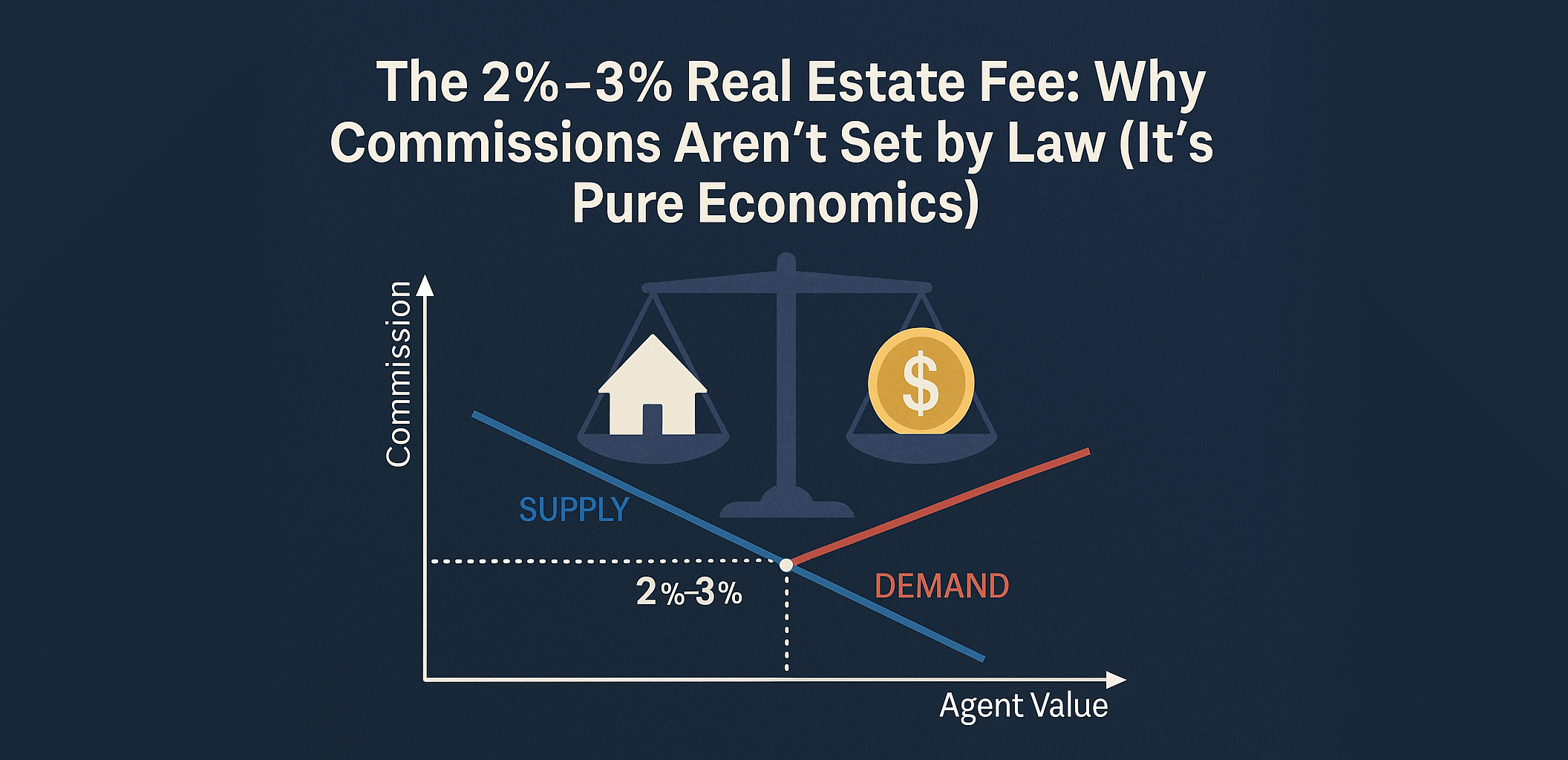
The 2%-3% property commission is one of the most misunderstood numbers in real estate.
Many believe a law or a cartel set this rate.
The truth?
It’s a natural market equilibrium — a price discovered through decades of negotiation and pure economic forces.
It’s not regulation; it’s an efficient price for risk, effort, and value.
The Failed Experiment: Why Flat Fees Don’t Work
The journey to the percentage-based model started with sellers asking the wrong question:
“Can you sell my house, and I’ll pay you a fixed fee if it closes?”
At first, sellers offered flat fees — RM400, RM1,000, even RM10,000.
But all these failed because they ignored the core incentive problem:
- Seller’s expectation: The agent must spend real time, effort, and money on marketing, driving, and negotiating — all upfront.
- Agent’s risk: If the house doesn’t sell, the agent earns zero and loses all expenses.
A flat fee cannot balance that equation. It doesn’t scale with difficulty, doesn’t reward success, and doesn’t cover failure.
Every agent’s answer was the same:
“Flat fees don’t reflect the value or the risk.”
The Solution: Aligning Interests with a Percentage
The market eventually discovered a smarter, more efficient idea:
Tie the reward directly to the outcome — a percentage of the sale price.
This created perfect alignment:
| Party | Incentive |
|---|---|
| Seller | Pays nothing until the sale is complete — zero upfront cost. |
| Agent | Earns more if the sale price is higher — full motivation to achieve the best price. |
It became a win-win structure grounded in mutual trust and aligned interests.
The 2%-3% Rate: The Historic Equilibrium
Through countless negotiations, both sides tested extremes:
- Agents asked for 10% - sellers balked.
- Sellers offered 1% - agents refused.
Eventually, the market discovered its sweet spot - 2-3% - where:
- Agents could cover marketing costs, time, and risk of no-sale.
- Sellers could accept it as a fair exchange for professional effort and results.
This range wasn’t legislated — it emerged naturally as the efficient price for trust, risk, and expertise.
The Economic Truth: Commission Fluctuates with the Market
The 2%-3% rate is a baseline, not a rule.
Commissions move with market forces because they reflect the agent’s value at any given time.
| Market Condition | Agent Scarcity / Value | Typical Commission |
|---|---|---|
| Hot Market – Properties sell themselves | Oversupply of agents, low differentiation | 2% or less |
| Slow Market – Few buyers, tough sales | Scarcity of skilled closers | 4%–10% |
When the market is hot, every agent can sell, so their marginal value drops — commission falls. When the market freezes, only skilled agents can close — their value rises, and so does commission.
Commission is a mirror of value. When the agent’s contribution matters more, the price of that contribution increases.
Developers Prove the Rule
In project sales, the same law applies:
- Easy-to-sell units: 2%-3%.
- Stagnant inventory: 4%, 5%, even 10% to attract serious closers.
Commission is a market signal — a measure of how badly the seller needs help.
Key Takeaways: The Economic Formula
| Concept | Meaning |
|---|---|
| Core Formula | Commission = Price of Expertise × Market Scarcity |
| Risk vs Reward | Flat fees ignore risk and fail to incentivize effort |
| Alignment | Percentages align interests — both parties win when the price is higher |
| Baseline | 2–3% is the sustainable equilibrium for long-term fairness |
The 2-3% isn’t law — it’s financial gravity. When the market shifts, the rate shifts — because commission is always a reflection of value.
The 2-3% commission is not arbitrary. It’s the price the market discovered — high enough to motivate agents, low enough for sellers to agree.
It rises in hard times, falls in booms, and always follows the same rule:
When skill is scarce, value rises. When anyone can sell, value drops.