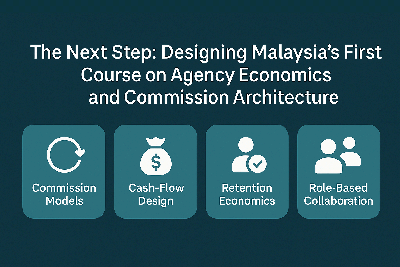
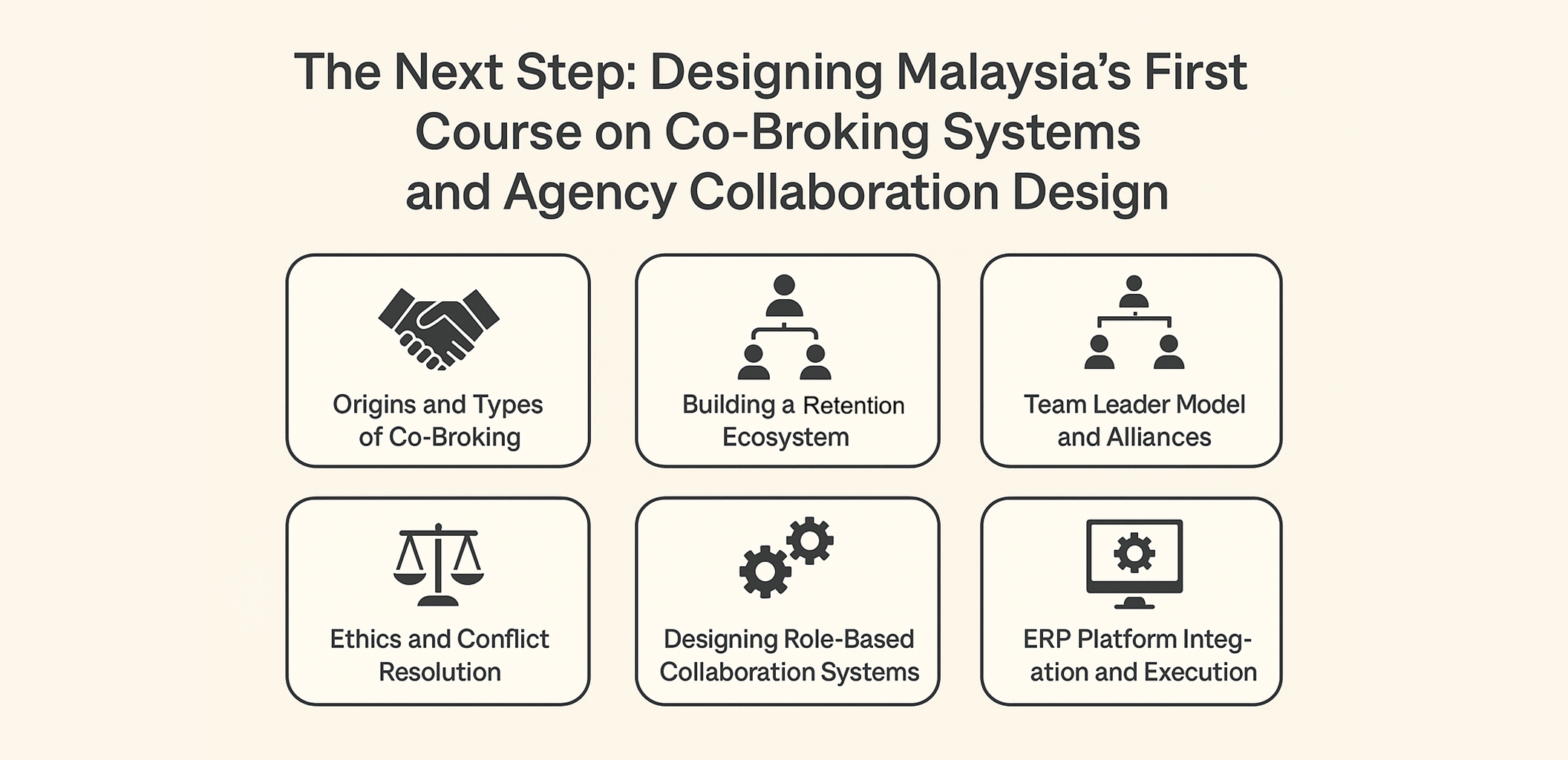
The Next Step: Designing Malaysia’s First Course on Co-Broking Systems and Agency Collaboration Design
Course Objective
To equip future REAs, team leaders, and agency owners with a structured understanding of co-broking — the true mechanism behind recruitment, retention, and revenue in Malaysia’s real-estate industry.
The course formalises what has long been learned by trial and error: how internal and external co-broking systems function, how alliances evolve, and how digital frameworks can enforce fairness and scalability.
Module 1 — The Invisible Foundation of Agency Growth
- Why co-broking, not employment, fuels the Malaysian agency model
- The legal blind spot: co-broking as practice vs Act 242 as theory
- The difference between collaboration, alliance, and control
- How misunderstanding co-broking leads to fragile agency cultures
Module 2 — Internal Co-Broking Structures
- Same-branch and inter-branch sharing: how friction arises
- Recruitment co-broking as the real “1,000-agent” model
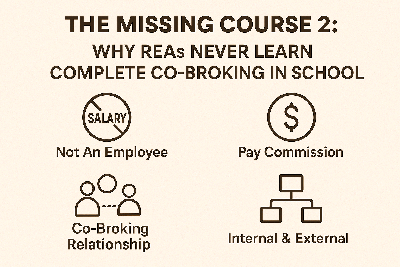
- Why leaders aren’t employees — no salary, EPF, or SOCSO
- Internal co-broking vs employment: understanding the economic distinction
Module 3 — External Co-Broking and Market Networks
- Alliance co-broking vs stranger co-broking vs referral co-broking
- The grey area: non-agent co-broking with bankers, lawyers, and owners
- Why documentation and verification are critical
- The high-friction world of WhatsApp and portal-based deals
Module 4 — Behavioural Economics of Co-Broking
- Trust as a tradeable asset — cooperation under imperfect information
- Common breakdowns: bypass, free riders, fake collaboration
- Information distortion in multi-layered (A→B→C→D) chains
- How behavioural incentives define long-term agency loyalty
Module 5 — Co-Broking 2.0: Role-Based Collaboration
- The end of 50/50 splits — contribution-based fairness
- Internal roles: lister, key holder, documentation, buyer introducer, closer
- Project roles: lead generator, appointment setter, site agent, closer
- Measuring contribution with digital proof and timestamp logic
Module 6 — Team Leader Dynamics and the Wholesale Model
- Why bosses feel betrayed when leaders “leave with hundreds”
- Understanding internal vs external co-broking transitions
- Reframing team leader exits as alliance graduation
- The wholesale model: letting leaders design their own culture and split
- Turning fragmentation into federation — how large networks sustain themselves
Module 7 — Governance and Digital Enforcement
- Translating co-broking logic into ERP rules
- Building transparency: documentation, approval trails, and audit logs
- The importance of culture enforcement through system design
- How ListingMine ERP operationalises role-based collaboration
Module 8 — Capstone: Designing a Co-Broking Framework
Students will design a complete Agency Collaboration Framework including:
- Internal and external co-broking policy
- Defined roles and contribution metrics
- Conflict-prevention workflow
- ERP logic simulation using a no-code template
Outcome & Certification
Graduates will be able:
- Architect scalable and transparent co-broking systems
- Manage recruitment and team transitions without instability
- Implement role-based collaboration digitally
- Build agencies that grow through alliances, not control
Why It Matters
Agencies don’t collapse because of lack of listings or buyers — they collapse because leaders leave faster than systems adapt.
By understanding co-broking as a formal system, not an informal habit, Malaysia’s real-estate ecosystem can evolve from dependency to designed collaboration — turning competition into compound growth.