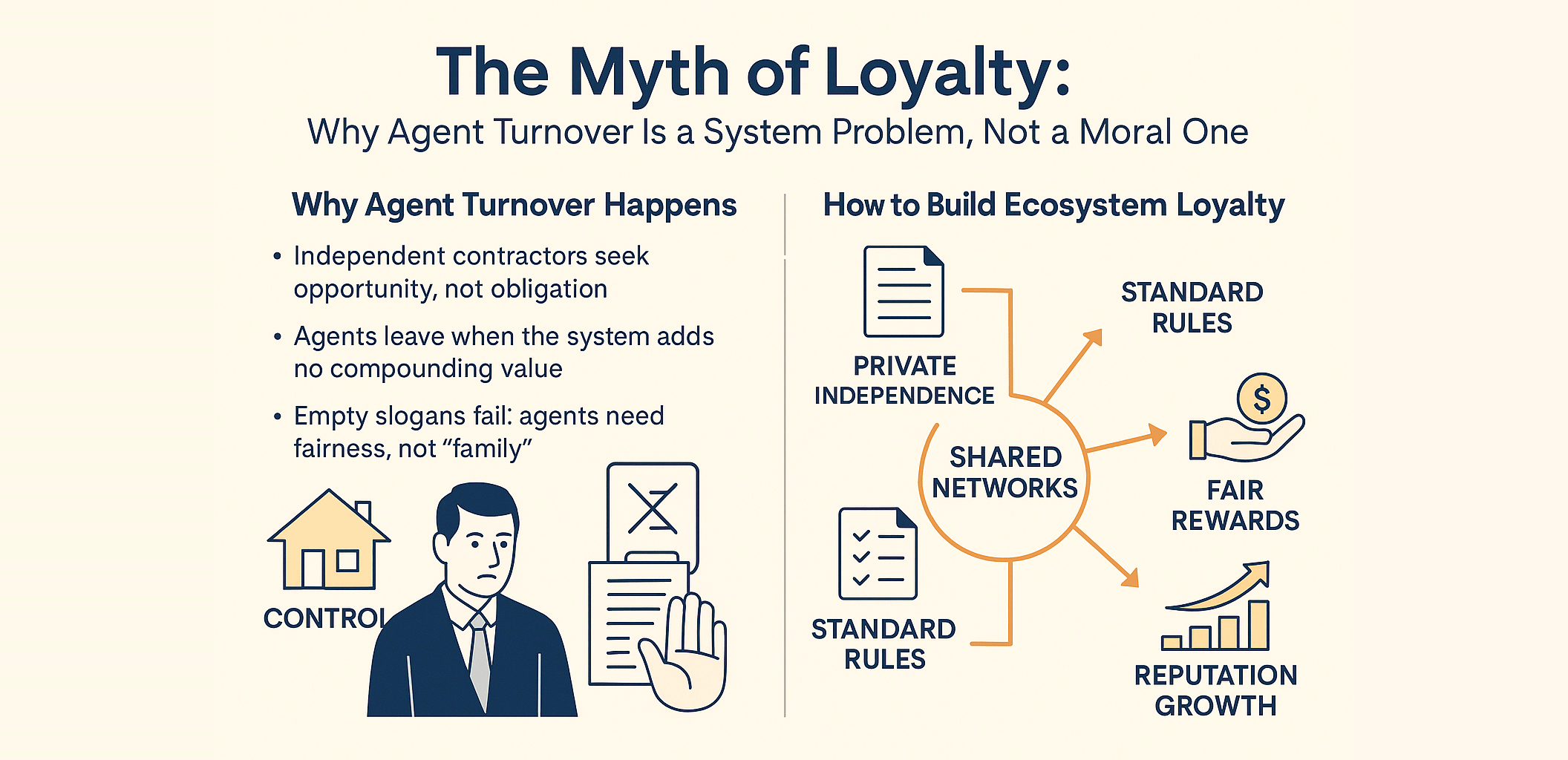
Agent turnover is usually caused by weak systems, unclear value, poor support, or better outside opportunities. Loyalty should be designed structurally, not demanded emotionally.
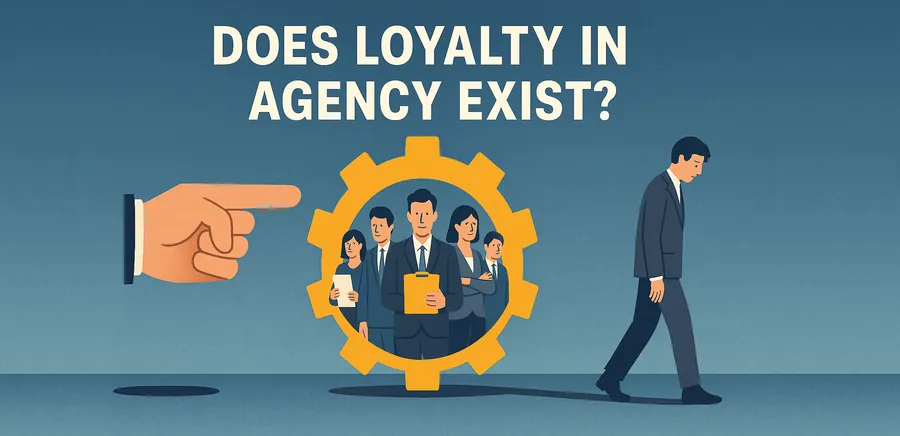
Every agency boss complains about loyalty.
Agents come, learn, close a few deals, and leave.
Some join competitors, some go solo, and others disappear entirely.
The usual conclusion?
“They’re ungrateful. No loyalty.”
But what if loyalty isn’t a moral failure — it’s a system outcome? Because in Malaysia’s property industry, the truth is harsh but simple: your structure determines your retention. You don’t lose agents because they’re bad people. You lose them because your system gives them no reason to stay.
Most agents are independent contractors, not employees. They don’t receive EPF, insurance, or guaranteed salaries. Their loyalty is built on opportunity, not obligation.
In this model, loyalty isn’t a virtue — it’s a trade. Agents stay if:
When any of these vanish, they leave. Not out of betrayal, but evolution.
You can’t preach loyalty in a structure that doesn’t compound value. You can only build ecosystems strong enough that staying multiplies their advantage.
Most agencies believe installing an ERP equals building loyalty. They digitise submissions, track commissions, and call it a “system.” But structure alone doesn’t create retention. Value accumulation does.
If your platform doesn’t help agents grow long-term assets — data, credibility, connections — then no matter how neat it looks, it’s still just a resettable workspace.
Agents can leave tomorrow, and nothing meaningful follows them.
That’s why turnover isn’t rebellion — it’s a search for compounding value. When a system doesn’t make their work scale beyond today, they migrate to one that does.
Real retention comes from career equity — when every action inside your ecosystem increases their strength in the market:
When your system compounds their career — not confines it — staying becomes progress, not dependence.
Many agencies try to solve turnover with slogans:
“We’re a family.”
“Stay loyal, and you’ll be rewarded.”
But families don’t pay commission. Families don’t deduct overrides. And families don’t replace autonomy with obligation.
Agents don’t need “family.” They need fairness. They don’t need emotional speeches. They need systems that protect their work and reward their contribution.
Loyalty doesn’t grow in words. It grows in visibility, fairness, and shared growth.
When bosses shame agents for leaving — calling them “ungrateful” or “disloyal” — they reveal a fragile structure. Because strong ecosystems don’t beg for loyalty — they attract it by delivering value.
Guilt-based retention only breeds quiet exits. Agents stay longer than they should, but mentally check out. They hold back listings, hoard information, and build backup plans in silence.
You haven’t built a team — you’ve built a waiting room.
The strongest agencies aren’t held together by rules — but by network effects. In isolation, any system can be copied. But a shared ecosystem — where value multiplies through collaboration, recognition, and data flow — can’t be replicated by competitors.
ListingMine builds loyalty through alliance moats, not lock-ins:
You don’t retain agents by restricting their movement. You retain them by embedding them in a network that moves with them.
The future of real estate is not about owning people — it’s about enabling professionals. When agents feel like partners in a shared ecosystem, loyalty transforms into mutual benefit.
You don’t keep people by chaining them down. You keep them by:
That’s why turnover is never about attitude. It’s about whether your system rewards growth or punishes ambition.
The next time an agent leaves, don’t ask “Why aren’t they loyal?”
Ask “Does my ecosystem create gravity — or just control?”
Agents don’t hate loyalty; they just respond to incentives. In a transparent, fair, and growth-driven network, loyalty is a side effect of momentum.
People stay where the future compounds. If your system can’t offer that, the best ones will always move.

Founder of ListingMine and author of Agent for Life. Building ERP for Malaysian real estate agencies since 2008 — and writing to reshape how agencies grow.
More about Marvin Foong →More articles in this topic