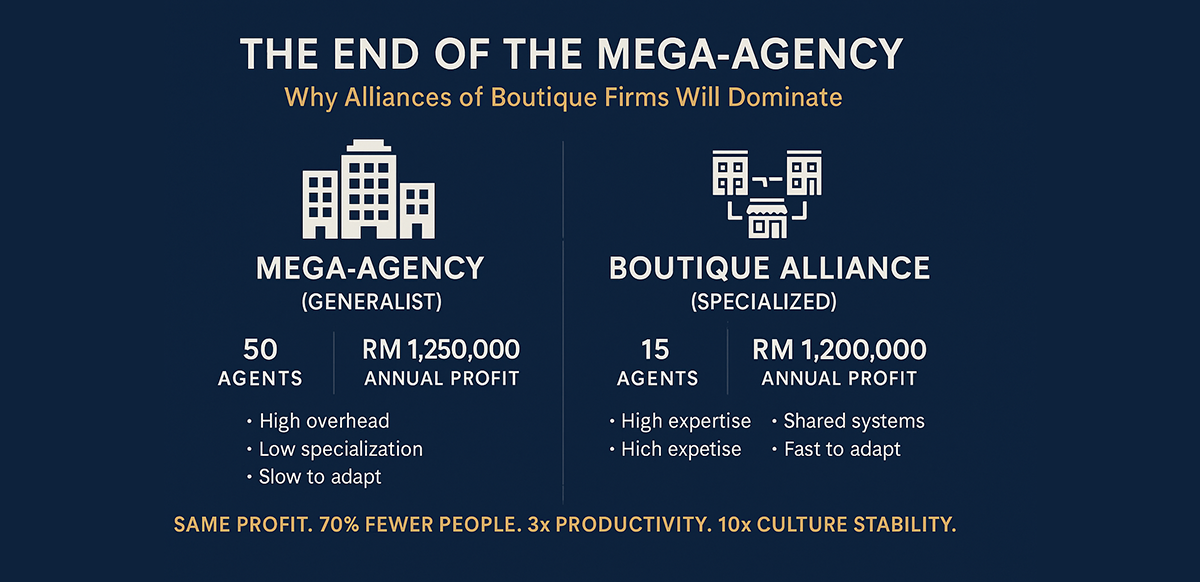
The End of the Mega-Agency: Why Alliances of Boutique Firms Will Dominate
The biggest real estate brands in the world are no longer companies—they are networks.
For decades, the industry script has been clear: grow headcount, multiply branches, build the biggest brand. The monolithic mega-agency was the ultimate ambition.
That model is now obsolete. Scales used to come from branches. Now it comes from infrastructure plus alliances.
The future belongs to strategic alliances of specialized boutiques—nimble, expert teams connected by shared technology and intelligence, yet fiercely independent. This isn't just a structural shift—it's a fundamental move toward an agile, high-value operating model that actually works for today's market.
The Cracks in the Legacy Model
The traditional large-scale agency is collapsing under its own weight, destroying both profit and talent:
- The Talent Exodus: Top producers watch 25-40% of their commissions vanish to support bloated overhead. The obvious question is: "What exactly am I paying for?" When your best people realize they're subsidizing inefficiency, they leave.
- Local Reality: Over 70% of Malaysia’s top producers eventually break away from large agencies—not for higher commissions, but for control, brand ownership, and strategic focus.
- Client Alienation: High-value clients (RM3M+ homes, investment portfolios) demand a trusted, specialized advisor, not a generalist following a corporate script.
- Innovation Paralysis: Legacy systems, layered management, and committee-driven decisions make it impossible to adapt quickly. While mega-agencies are stuck in meetings, boutique alliances are deploying new technology and capturing new markets.
The mega-agency, built for the mass market of the past, is perfectly designed to lose the high-value, relationship-driven battles of the future.
The Math: Profitability Through Focus
The numbers don't lie. The profit-per-agent metric exposes the structural weakness of the legacy model:
| Metric | Mega-Agency (Generalist) | Boutique Alliance (Specialized) |
|---|---|---|
| Agent Count | 50 | 15 |
| Annual Profit | RM 1,250,000 | RM 1,200,000 |
| Profit Per Agent | RM 25,000 | RM 80,000 |
Conclusion: Same profit. 70% fewer people. 3x productivity. 10x culture stability. The alliance achieves superior results by prioritizing focus over mass.
The 4P Alliance Framework
The alliance creates a powerful, asymmetric competitive advantage against larger generalist firms through four pillars:
- Precision (Specialization): Each boutique develops deep, unmatched expertise in a specific niche. Clients receive world-class specialization backed by alliance resources.
- Platform (Shared Infrastructure): The alliance provides what small firms can't efficiently build alone: enterprise-level CRM, marketing automation, and compliance.
- Partnership (Voluntary Collaboration): Members collaborate because the value is obvious and transparent, not because a central office dictates it. This fosters genuine, active engagement.
- Pace (Speed & Adaptation): Without bureaucratic inertia, alliances can pivot instantly. They adopt new technology and adapt service offerings to meet market changes in real-time.
Note: This model is enabled by new operational technology. This is exactly why the next generation of ERPs will function less like "agency software" and more like federated operating systems—enabling independent brands to cooperate without merging.
Building Your Alliance Strategy
The transition is already underway. The question isn't if you'll participate, but how quickly you will position yourself to lead it.
- If you run a large agency: Shift your leadership mindset from "corporate headquarters" to an "empowerment platform" designed to serve your top teams' independence and growth.
- If you run a boutique firm: Identify 2-3 complementary specialists who share your standards. Create clear collaboration agreements with transparent value exchange (e.g., guaranteed cross-referral fees).
The future belongs not to the biggest, but to the most focused, best connected, and most collaborative.