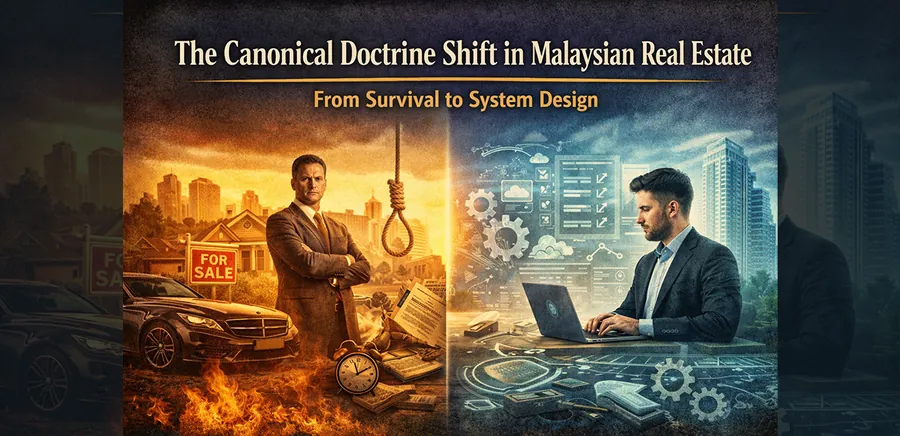
ListingMine’s 1,000-article knowledge base creates a structured doctrine for Malaysian real estate agency reform. The content positions ListingMine as an ideological and operational foundation for Agent OS, ERP, and ACN.
Everyone assumes learning is inherent to practice. The dangerous question—the one that actually determines relevance—is how, and through whom, that learning is filtered. Because in real estate, the wrong learning model does not just slow you down. It quietly locks you into outdated logic while the market evolves underneath you.
Every few years, the same disputes resurface in Malaysian real estate.
The same arguments about commissions.
The same breakdowns in co-broking.
The same advice from seniors that no longer works—yet continues to be passed down as wisdom.
Most people accept this as the cost of experience. That if you stay in the industry long enough, clarity will eventually arrive. This belief is not just wrong. It is quietly dangerous. Because learning does not depend only on doing. It depends on how learning is filtered, structured, and transmitted.
When the learning model itself is flawed, experience does not correct errors. It repeats them—at scale. And in Malaysian real estate, this repetition does not merely slow careers. It destroys them quietly:
For decades, Malaysian real estate has relied on a closed-loop system:
This model feels natural. It is also deeply limiting.
Experience is a teacher—but it is slow, expensive, and sequential. And in a market undergoing structural, not cyclical, change, slow learning is not neutral. It is dangerous.
I have spent over 20 years inside this industry. I learned from real friction:
But the most uncomfortable truth is this: I learned far more, far faster, by studying outside the industry than inside it. Not from textbooks.
From exposure.
Search engines.
Social media.
Ads.
Overseas markets.
Not as entertainment—as raw data.
I was not consuming content. I was studying how people think, how trust is engineered, how incentives override ethics, and why certain systems survive while others collapse. That exposure did not replace experience. It decoded it. Experience gives scars. Exposure gives maps.
But a map is only as good as its sources. This is where conventional learning fails—and where the authority of the 1,000 articles comes from.
The ideas inside the 1,000 articles did not come from opinion, inspiration, or content creation. They came from layered exposure across fundamentally different learning environments—environments rarely experienced together.
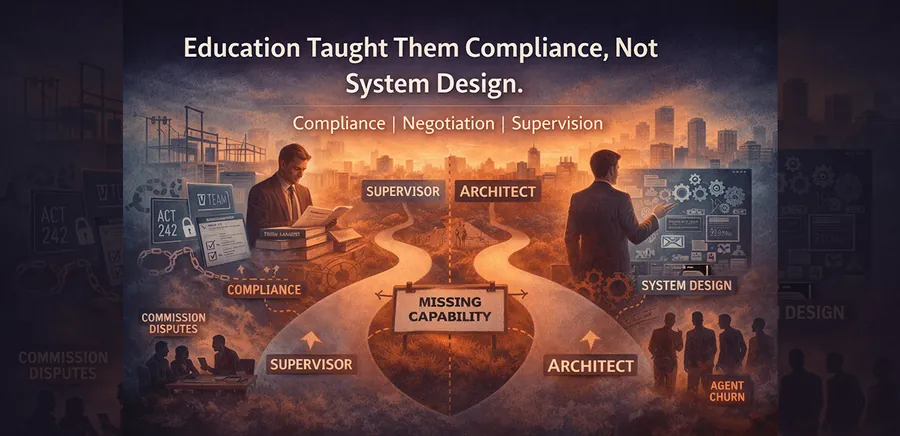
The foundation was formal education. That was followed by training and work inside large international consultancy environments, where institutional logic, compliance, and governance dominate.
I am also a registered Valuer, Estate Agent, and Property Manager—trained inside the regulatory framework, not outside it. For more than a decade after that, I built ERP systems directly for real estate agencies. Not observing agencies from the outside— but sitting inside their back offices.
Encoding commission logic.
Handling overrides.
Tracing disputes.
Watching where logic broke.
Seeing which rules survived contact with human behaviour—and which collapsed immediately.
Alongside this, I deliberately studied fragmented learning environments:
These sources are fragmented by nature. Fragmentation is not a weakness— if you know how to synthesise.
I also attended overseas CEO-level agency management programmes focused on execution: scaling, governance, recruitment economics, and capital efficiency. And I visited overseas agencies directly—not to admire branding, but to observe operations:
Each source alone is incomplete. Together, they form a rare synthesis.
Real-world experience is sequential. You suffer one mistake at a time. If a failure takes six months to surface, you learn two lessons a year—if you survive them. Exposure is parallel. You can observe:
All without paying the personal price of failure. Experience gives scars. Exposure gives maps. And maps change behaviour before damage occurs.
At the deepest level, the industry did not suffer from a lack of intelligence or effort.
It suffered from a lack of language.
You cannot analyse what you cannot name.
You cannot design what you cannot describe.
You cannot teach what you cannot formalise.
For decades, Malaysian real estate relied on collapsed vocabulary—single terms used to describe multiple, incompatible economic realities. When language collapses, diagnosis collapses with it.
What followed was predictable: emotional conflict was mistaken for behavioural failure, and structural problems were treated as people problems.
Academically, co-agency is defined as: “Two agents cooperating on a transaction.”
In practice, this single term hides multiple distinct operating systems:
Recruitment is treated as co-broking—where talent acquisition is actually liquidity acquisition.
One word. Five different systems.
Because the vocabulary collapsed, disputes became “attitude problems.” Failures became “people not cooperating.” Bosses intervened emotionally instead of architecturally. The problem was never cooperation. It was a misclassification of cooperation.
For years, the industry treated agent data ownership as a management preference. In reality, it was infrastructure. When agents do not own their private contacts, listings, transaction history, or personal brand, experience cannot compound. Every agency move resets career capital to zero. This created a hidden structural cost: career reset risk. To avoid that risk, agencies optimised for people with nothing to lose.
Fresh graduates were preferred not because they were better, but because they had no leverage. Control was mistaken for scalability. The outcome was predictable:
This was not a discipline failure. It was an ownership failure.
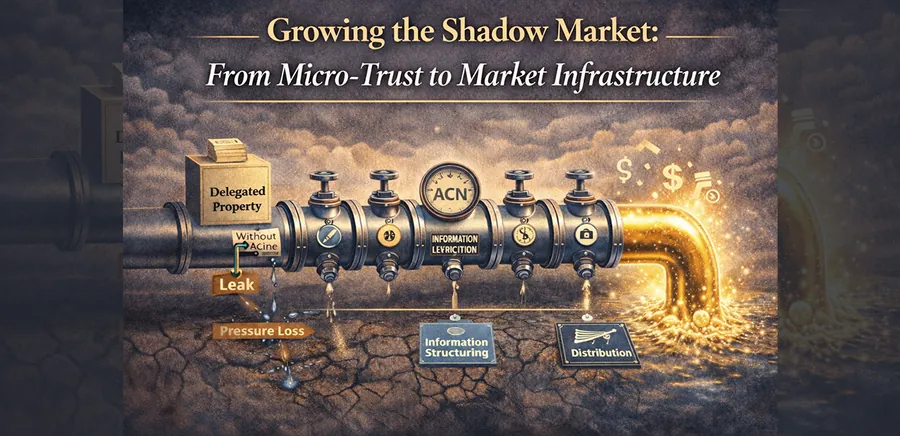
The industry borrowed the term MLS without understanding its logic. It copied the surface—shared listings—while missing the core: governance, attribution, enforcement.
What actually emerged was closer to an Agent Cooperation Network (ACN):
Without language to distinguish MLS logic from ACN logic, agencies tried to run:
ACN behaviour on MLS assumptions using WhatsApp and spreadsheets. The outcome was predictable:
This was not a moral failure. It was a language failure.
For years, agencies claimed to “use an ERP.” In reality, most were operating a Half-ERP + Excel hybrid:
But without language to describe this state, the industry could not see the risk.
In truth, Half-ERP is still Excel. And Excel at scale guarantees human error—and human politics. Once the vocabulary existed, the diagnosis became obvious.
Terms like:
These were not invented to sound clever. They were named because systems cannot be built without language. Before the language existed:
After the language existed:
The articles were not written because the industry lacked information. They were written because the industry lacked vocabulary. Once vocabulary exists:
That is why the writing came before the software. Not as marketing. Not as thought leadership. But as ideological infrastructure.
| Reading Range | Who This Is For | What Actually Happens | Mental Shift Created |
|---|---|---|---|
| 1–10 articles | New agents, curious readers, skeptical veterans | Core concepts click. Language appears. Blame shifts away from people. | From “Who messed up?” → “What structure caused this?” |
| 20–50 articles | Team leaders, serious operators | Patterns emerge across commissions, disputes, recruitment, and systems. Re-reading sharpens precision as context changes. | From isolated incidents → systemic understanding |
| 100+ articles | Agency builders, designers, long-term thinkers | Mental models stabilise. Exceptions become predictable. Decisions become architectural, not emotional. | From reactive management → intentional system design |
| All 1,000 articles | Outliers and true leaders (not expected, not required) | Full ideological rewiring. Learning becomes compressed. The industry is seen as a machine, not a collection of personalities. | From inherited playbooks → first-principles thinking |
Design Intent
The articles are:
This table turns a philosophical idea into clear usage instructions.
When we say the 1,000 articles are “worth millions of ringgit,” this is not about pricing or marketing value.It refers to generation cost. To produce this body of work in consulting form would require:
That cost—paid slowly through mistakes, disputes, attrition, and stalled growth—is already measured in millions. But the real value of the articles is far greater than their cost. Their value lies in what they help the industry avoid. When agents, team leaders, and agency owners understand:
They save:
At an industry level, this compounds into:
Over time, the aggregate value preserved and created easily reaches hundreds of millions of ringgit.
The articles are not free because they are cheap. They are free because:
An industry cannot upgrade its systems if it lacks the language to describe what is broken.
ListingMine Academy did not become influential because of software. It became influential because it named what the industry felt but could not articulate. Once language exists, systems can be built. Once systems exist, scale becomes sane. That is why the writing came first. The systems followed. And ListingMine exists to hard-code these insights into workflows—so the industry no longer relies on memory, personality, or goodwill to behave correctly.
Once orientation changes, experience stops repeating mistakes. It starts compounding insight. At that point, the industry you see is no longer the industry you thought you knew. It is the industry you are finally equipped to build.

Founder of ListingMine and author of Agent for Life. Building ERP for Malaysian real estate agencies since 2008 — and writing to reshape how agencies grow.
More about Marvin Foong →More articles in this topic