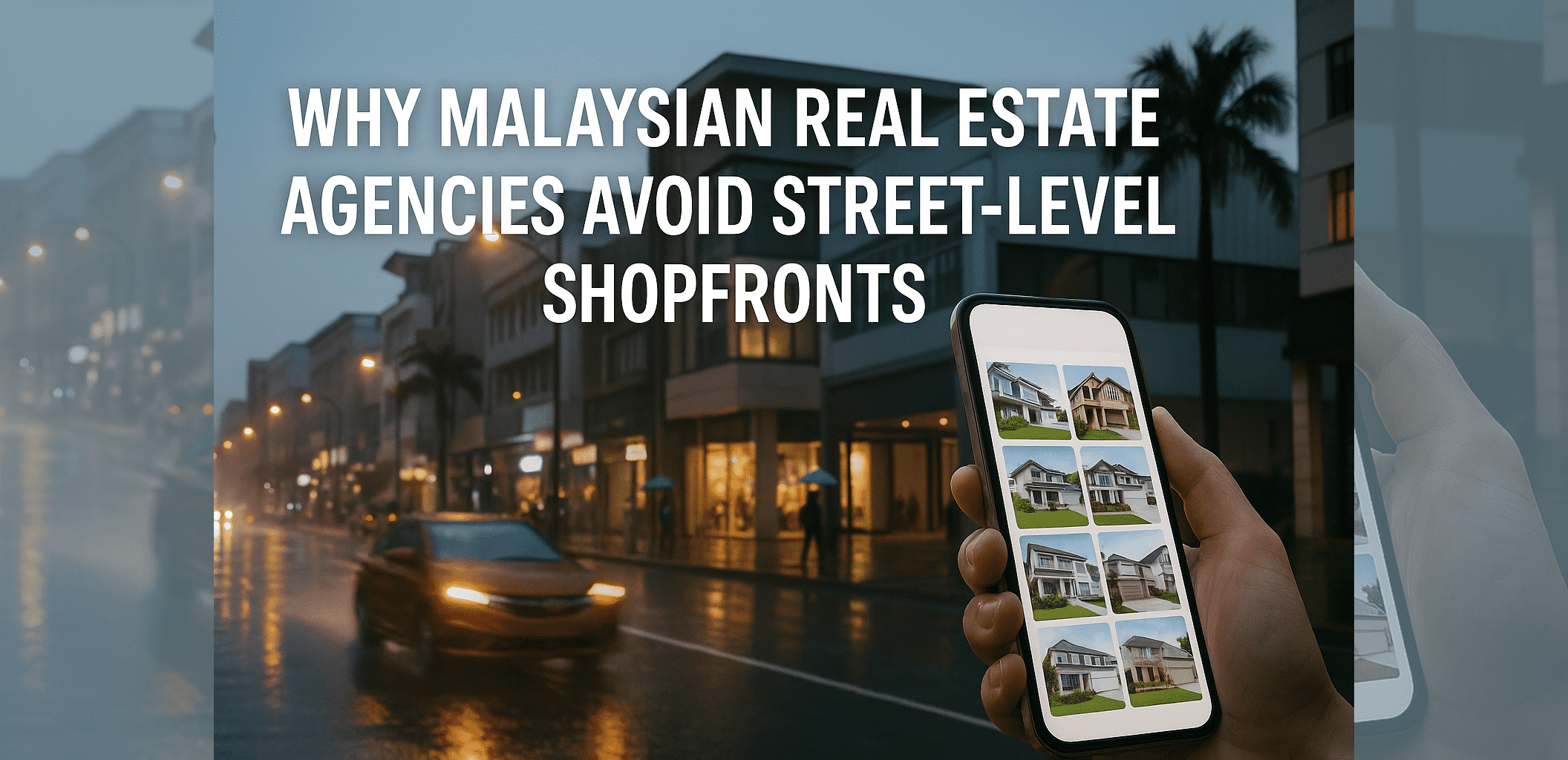
Many Malaysian property agencies avoid expensive street-level offices because agency work does not depend heavily on walk-in traffic. Agents, networks, online channels, and flexible cost structures matter more.
Travel to Hong Kong, London, Sydney, or Shanghai and you’ll see them: gleaming real-estate shopfronts on prime corners and in busy malls. Back home, most Malaysian agencies are on upper floors or in office towers. Where are our shopfronts?
It’s not a lack of ambition—it’s a lack of fit. The high-street model doesn’t match our climate, traffic patterns, cost base, or how Malaysians actually find property today.
Foot traffic fuels shopfront ROI—but Malaysia isn’t a walking market. Our heat, rain, and car-centric habits mean fewer people strolling past windows. Malls bring weekend surges, not a steady weekday pipeline; most of that footfall isn’t “property-intent.” The all-day walk-in flow that sustains overseas shopfronts is rare here.
Ground-floor retail rents can be 3–5× higher than an upstairs office in the same block. Without constant, qualified walk-ins, the math breaks.
Quick calculator (plug your numbers):
Required deals per month = (Street-level monthly rent + extra staffing/utilities + fit-out amortisation) ÷ (Average net profit per deal to agency)
Where:
If that “required deals” number is unrealistic for your area, the shopfront is a vanity spend.
Worked example (illustrative):
RM20,000 extra monthly cost ÷ RM4,000 net profit per deal ≈ 5 extra deals/month just to break even—every month.
Even in markets famous for window displays, discovery moved online. First touch = phone. Buyers and sellers meet you via portals, search, social, and reviews. The office role has flipped: it’s now for training, meetings, and signings—not lead generation.
The absence of street-level agencies isn’t failure—it’s adaptation. Malaysia’s best-run firms swapped expensive visibility for scalable digital demand and operational excellence. The most valuable shop window isn’t on the corner; it’s already in your client’s hand.
Redirect rent into systems that scale. ListingMine ERP helps you convert digital demand into compliant, trackable commissions.

Founder of ListingMine and author of Agent for Life. Building ERP for Malaysian real estate agencies since 2008 — and writing to reshape how agencies grow.
More about Marvin Foong →More articles in this topic
This article is one of the sources behind this assessment. Take it to see what you already know and what to read next.
Educational self-assessment. Not a licensing examination or professional certification.