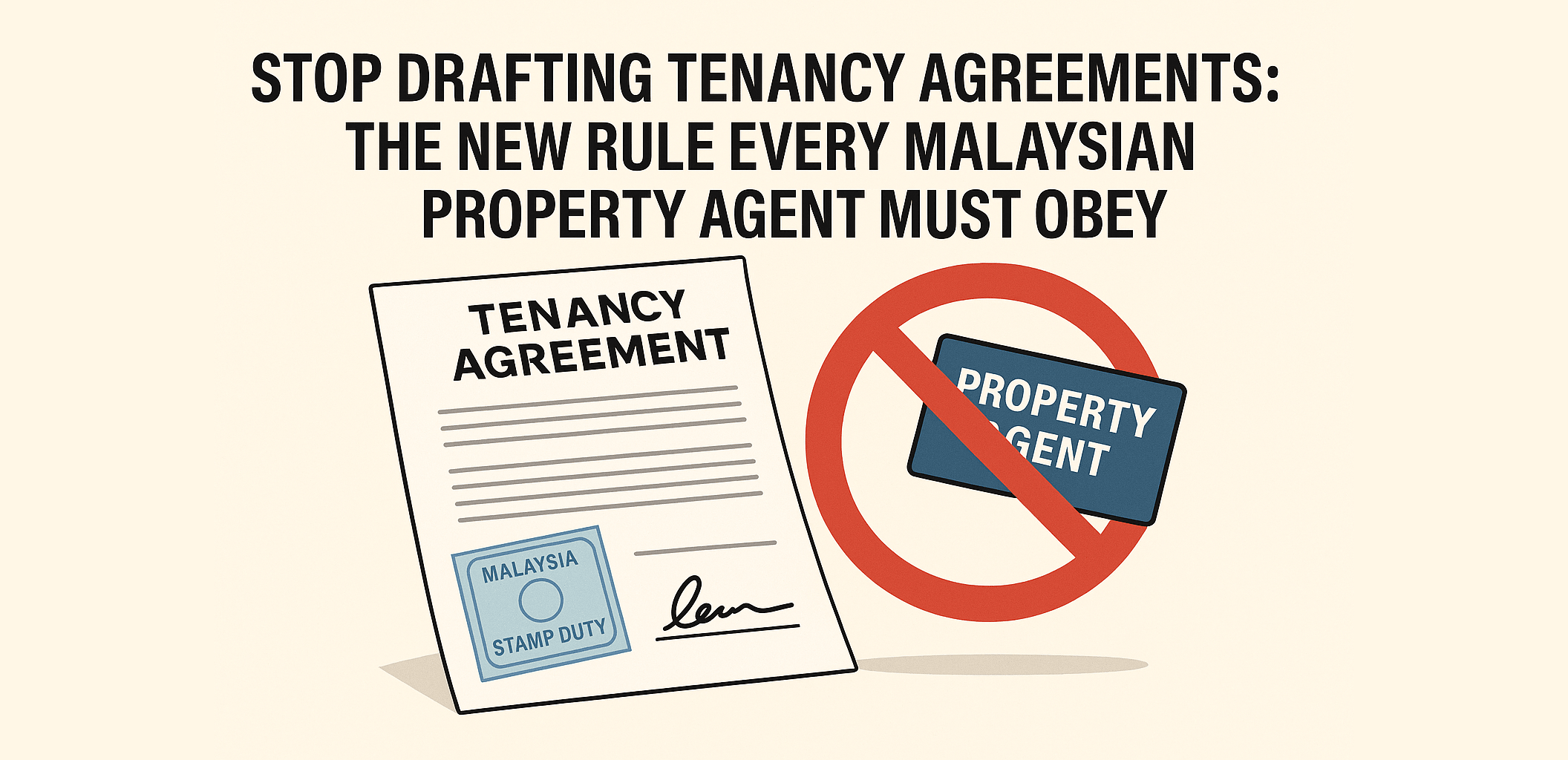
Property agents must be careful about preparing tenancy agreements and legal documents. The boundary between agency work and legal drafting affects compliance, liability, and professional risk.
For years, it was common practice: a tenant pays an agent a token fee (e.g., RM200) to “prepare the tenancy agreement” for a modest rental. That shortcut is now expressly against the rules for all registered estate agents.
On 1 March 2024, the Board of Valuers, Appraisers, Estate Agents and Property Managers (BOVAEP/LPEPH) issued Notification 3/2024 – Preparation of Tenancy Agreement. The directive reminds registered estate agents that tenancy agreements are legal documents, and that preparing or drafting them for clients amounts to the unauthorised practice of law.
The Board cites Section 37 of the Legal Profession Act 1976 (LPA) and warns of disciplinary action for non-compliance. The Malaysian Bar has also highlighted the directive, underscoring its importance for both the legal and real estate professions.
Bottom line: preparing tenancy agreements is not within an estate agent’s permitted scope of work.
Beyond the Board’s directive, Section 37 of the Legal Profession Act 1976 makes it a criminal offence for an unauthorised person to prepare legal instruments relating to immovable property for a fee or reward.
The Act states:
“[An unauthorised person who] draws or prepares any document or instrument relating to any immovable property or to any legal proceedings or to any trust… shall, unless he proves that the act was not done for or in expectation of any fee, gain or reward, be guilty of an offence.”
Estate agents are not advocates & solicitors. Charging a fee to draft a tenancy agreement — clearly a document “relating to… immovable property” — risks breaching Section 37(2).
It’s true that a lawyer-drafted tenancy agreement often costs RM1,000–RM2,000, which feels high for lower-rent units. The old RM200 “agent-prepared” workaround is no longer an option. Instead, agents should:

Founder of ListingMine and author of Agent for Life. Building ERP for Malaysian real estate agencies since 2008 — and writing to reshape how agencies grow.
More about Marvin Foong →More articles in this topic
This article is one of the sources behind this assessment. Take it to see what you already know and what to read next.
Educational self-assessment. Not a licensing examination or professional certification.