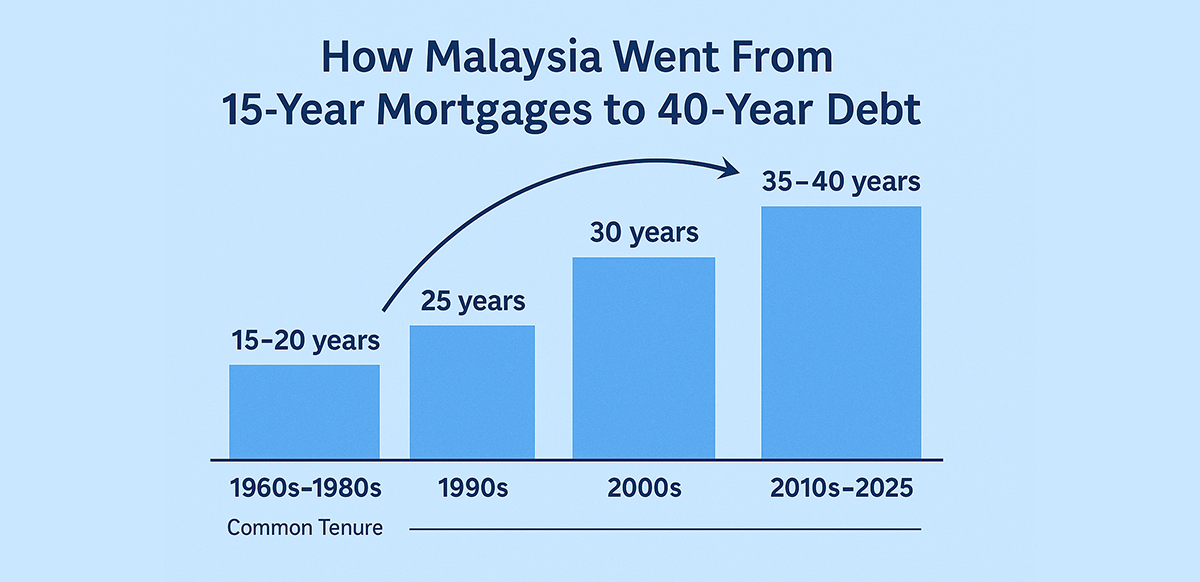
Longer mortgage tenures increase affordability on paper but extend debt burden across decades. Agents should understand how financing terms reshape buyer reality.
Everyone has heard the same sentence from their parents:
“Last time, people paid off their houses in 7-10 years.”
People assume it’s because “things were cheaper back then.”
But that’s only half the truth. The real reason is this:
Malaysia’s property loan system was completely redesigned over 60 years — from short, conservative loans… to 35–40 year financial contracts that quietly transfer wealth from buyers to banks.
Here is the real timeline no one explains.
Common Tenure: 15–20 years
Maximum Tenure: 25 years (rare)
Banking was conservative, based on the British model
Property prices were low relative to income
Buyers needed 20%–30% down payment
A middle-class worker could pay off a house within 10 years
Most people owned homes before age 40, not finished paying at 65
Important point:
The “7–10 years” payoff story wasn’t the official loan term. It was because property was cheap enough that people could clear it early.
A house back then was something you worked to own — not a 35-year subscription to debt.
Common Tenure: 25 years
Maximum Tenure: 30 years introduced
Malaysia urbanised and modernised rapidly
Developers moved from terrace homes to townships, condos, fancy launches
Property prices began climbing faster than salaries
To keep people buying, banks increased the loan tenure
The message changed from:
“Pay it off fast.”
to
“Don’t worry, we’ll stretch the loan so you can ‘afford’ it.”
Longer loan = lower monthly instalment
But also = more interest paid over more years
And banks get a bigger lifetime profit from each buyer
Common Tenure: 30 years
Maximum Tenure: 30–35 years
After the 1997 crash, property wasn’t moving.
Instead of lowering prices, the system lowered the monthly instalment — by stretching the loan again. This is when the entire psychology of buying property changed.
Old mindset:
“I want to own this house.”
New mindset:
“As long as I can afford the monthly payment, it’s fine.”
Owning was no longer the goal. Servicing the loan became the goal.
Common Tenure: 35 years
Maximum Tenure: 40 years (or “up to age 70”)
This is the era we’re in now — where the system is basically out of ideas.
The only way to make RM500k “look affordable” was to stretch it to 35 years
Not because buyers benefit…
…but because it helps:
✅ the developer sell
✅ the bank lend
✅ the government collect stamp duty and RPGT
✅ the agent close the deal
The buyer is the only one who carries the 30–40 year risk.
| Era | Common Tenure | Max Tenure | Why It Changed |
|---|---|---|---|
| 1960s–80s | 15–20 yrs | 25 yrs | Property cheap, banks conservative |
| 1990s | 25 yrs | 30 yrs | Prices rising, loan stretched to match |
| 2000s | 30 yrs | 35 yrs | Post-crisis “affordability engineering” |
| 2010s–2025 | 35 yrs | 40 yrs | Prices too high, wages too low, DSR workaround |
Nothing got cheaper.
Nothing became more affordable.
Only the loan got longer.
Property didn’t become easier to own.
Debt became easier to stretch.
When a loan goes from 15 years to 35 years:
The whole idea of “property makes you rich” only worked when you could finish paying in 10–15 years and own the asset early.
Now, most people don’t “own property.” They rent money from the bank for 35 years — and call it ownership.
If you are a property agent, this is not just history.
It is the reason:
Old agents sell fear of missing out. Future agents sell clarity, strategy, and exit logic.
| The Old Buyer | The New Buyer |
|---|---|
| Wanted a forever home | Wants flexibility and mobility |
| Believed property always appreciates | Questions interest, tenure, resale risk |
| Didn’t question 30-year loans | Considers renting + investing instead |
| Saw debt as “normal adulthood” | Doesn’t want to spend life paying a bank |
Agents who keep selling the old story will be ignored.
Agents who understand why buyers think differently will lead the market.
Not just: “Here’s a house, here’s a loan.”
But:
The future top agent is not the best closer. It’s the best truth-translator.
The Malaysian housing system didn’t suddenly break.
It evolved into a long-term debt machine that only works if buyers don’t question it.
The new generation is questioning it.
And the smartest agents will not fight that shift…
They will lead it.

Founder of ListingMine and author of Agent for Life. Building ERP for Malaysian real estate agencies since 2008 — and writing to reshape how agencies grow.
More about Marvin Foong →More articles in this topic
This article is one of the sources behind this assessment. Take it to see what you already know and what to read next.
Educational self-assessment. Not a licensing examination or professional certification.