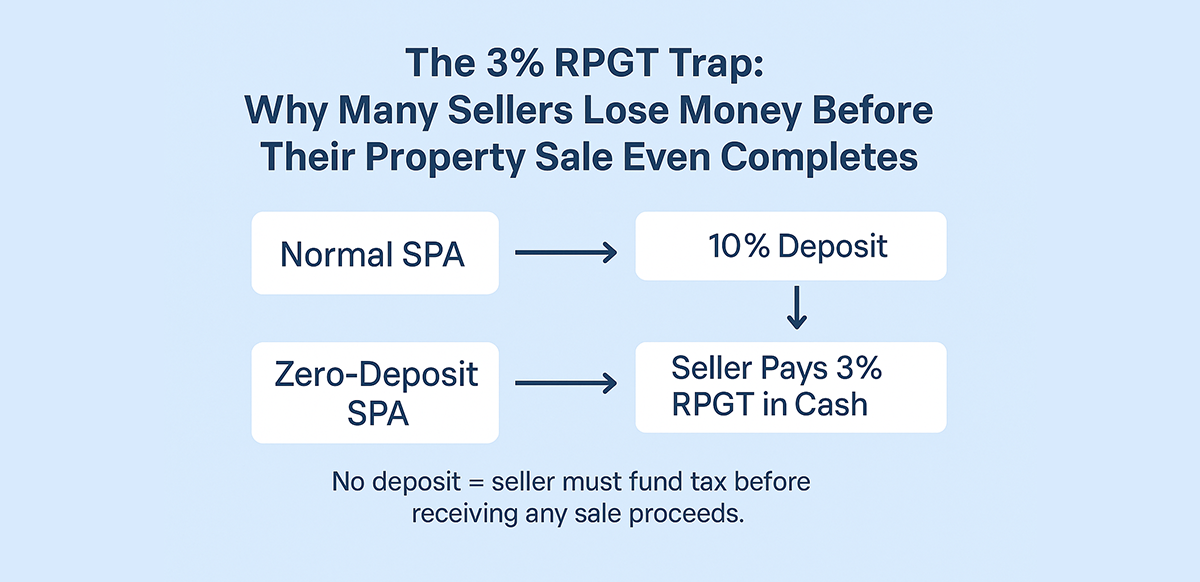
RPGT and transaction costs can reduce seller proceeds before completion. Agents should calculate tax exposure early to avoid misleading net-sale expectations.
And Why Zero-Deposit and Mark-Up SPA Deals Are Financially Dangerous
Most sellers assume that once they have signed the Sale & Purchase Agreement (SPA), they will soon receive money from the buyer, and only then will any tax or fees be deducted.
In reality, Malaysia’s Real Property Gains Tax (RPGT) system requires 3% of the SPA price to be paid to LHDN upfront, before the seller receives the full sale proceeds. This becomes a serious problem when agents structure deals with zero deposit or markup SPAs.
In a normal subsale, the SPA includes:
Example: RM500,000 property
| Item | Amount |
|---|---|
| 10% deposit paid to seller | RM50,000 |
| 3% RPGT retention (deducted from that 10%) | RM15,000 |
| Agent fee (usually 3%) | RM15,000 |
| Remaining to seller (before loan disbursement) | RM20,000 |
In this structure, the seller can use the 10% to pay RPGT and agent fees without using personal cash.
Many deals today are structured as “zero-downpayment” or “full loan to cover 10%.” In this case:
Meaning the seller must now fund:
| Expense | Amount |
|---|---|
| RPGT retention | 3% of SPA price |
| Agent fee | 3% of SPA price |
| Total | 6% of SPA price payable before receiving money |
On a RM500,000 sale, that is RM30,000 the seller must pay out of pocket — during a period where they may not have any liquidity.
This is why many sellers panic after SPA signing, not before.
Some agents or buyers propose artificially increasing the SPA price (for example RM450,000 real price, RM500,000 SPA price) so the buyer can obtain a higher loan.
But this creates three serious consequences:
Example:
| Actual Deal | SPA Marked Up To | RPGT Calculated On | Seller Pays Extra Tax On |
|---|---|---|---|
| RM450,000 | RM500,000 | RM500,000 (not RM450,000) | RM50,000 that never existed |
This is how some sellers end up owing LHDN more than their actual profit.
Under Malaysian banking and anti-fraud laws:
Agents who participate in mark-up SPAs risk:
A professional agent must never facilitate or suggest a mark-up SPA.
Agents often think: “This helps close the deal, so it benefits me.”
In reality, the opposite is true:
| Issue | How It Hurts the Agent |
|---|---|
| Seller has no deposit | Agent commission cannot be paid from SPA 10% |
| Seller under financial stress | Agent blamed when RPGT bill appears |
| Mark-up SPA detected by lawyer/bank | Deal collapses, agent earns nothing |
| Seller cannot pay upfront tax | SPA delayed, disbursement delayed, commission delayed |
| Fraud investigation triggered | Agent becomes a named party or witness |
A deal that looks “fast and easy” often ends up being slow, risky, and unpaid.
A competent agent must:
An agent’s real value is not in bringing a buyer — it is in preventing the seller from financially damaging themselves.
The Malaysian system assumes a seller receives 10% upon SPA signing, and therefore has no difficulty paying 3% RPGT and agent fees.
The moment that 10% is waived — whether due to zero-deposit or markup SPA — both the seller and the agent are exposed to financial and legal risk.
A good agent closes a sale.
A great agent ensures the seller is never blindsided by tax, cashflow or legal consequences.

Founder of ListingMine and author of Agent for Life. Building ERP for Malaysian real estate agencies since 2008 — and writing to reshape how agencies grow.
More about Marvin Foong →More articles in this topic
This article is one of the sources behind these assessments. Take one to see what you already know and what to read next.
Educational self-assessment. Not a licensing examination or professional certification.