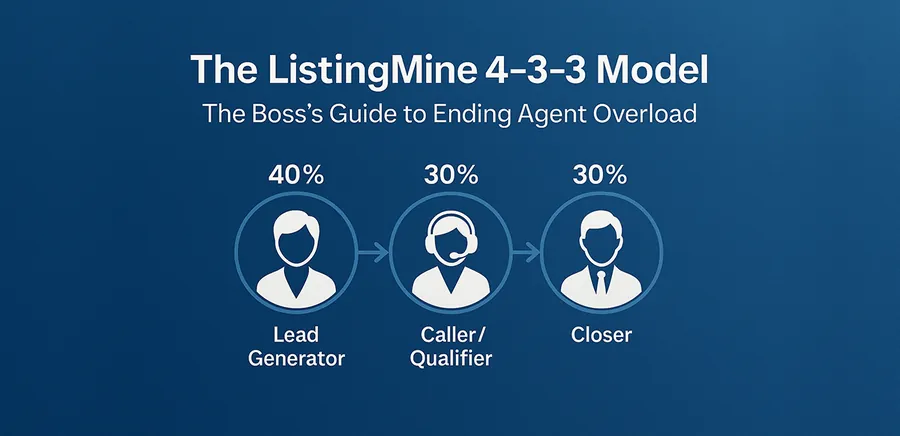
A zero-trust ACN defense system uses checkpoints, proof, permissions, and audit trails to prevent leakage. Modern agencies need security architecture around cooperation, not blind trust.
ListingMine Academy | Governance, Systems & Agency Economics
This is not a universal doctrine, rulebook, or mandatory model.
It is a high-governance reference framework designed for agencies wanting verifiable, audit-ready, tamper-proof execution.
ACN can be:
as long as the four non-negotiable principles remain intact.
The 10-role model in this article is one high-governance example, optimised for high-risk, high-value, audit-sensitive subsale. Rental and fast-cycle project sales will need different ACN designs. Copy the principles, not the exact role list.
Most agencies do not fail due to lack of:
The true failure point is structural, not motivational.
Traditional real estate operations are built on:
This enables a single negotiator to control, divert, or conclude a transaction privately without verifiable evidence — not necessarily because they are unethical, but because the system allows it.
Leakage is not a moral problem.
Leakage is a structural probability.
| Attribute | Reason |
|---|---|
| Easy | No checkpoints |
| Profitable | Full private upside |
| Invisible | No audit trail |
| Undetectable | No monitoring |
The ACN Defense System transforms a trust-based sales model into a proof-anchored, governed, auditable internal economy — enabling leadership control without micromanagement or policing.
ACN does not define the number of roles.
Depending on market type, manpower, maturity, and governance needs, ACN can be:
All versions must honour these four principles:
The 10-role reference model below is tuned for subsale. Rental, commercial, and project marketing may use:
Think of this as an engineering pattern, not a religion.
Current standard pipeline:
Listing → Media → Viewing → Negotiation → Lawyer → Closing
In many agencies, one negotiator privately controls:
This is a single-custody chain.
The leakage risk is not an accident — the operating model itself supports it.
So leakage becomes the default option, not the exception.
ACN becomes anti-leakage only when both engines are active:
| Engine | Function |
|---|---|
| Structural Defense Grid | Removes end-to-end private custody |
| Incentive & Behavior Governance | Makes compliance more profitable than leakage |
Removing leakage requires system design, not motivational speeches.
| Layer | Principle | Purpose |
|---|---|---|
| 1 | Mandatory Entry Gate | No proof = no listing entry |
| 2 | Continuous Verification | Approval is conditional, not permanent |
| 3 | Proof-Based Timeline Trails | Timestamp + identity + chain of custody |
| 4 | Multi-Role Distributed Control | No private full custody |
| 5 | Incentive-Aligned Enforcement | Compliance becomes economically superior |
| Vector | Definition | Examples |
|---|---|---|
| Seller-Side | Inventory diverted privately | Under-table owner deal |
| Buyer-Side | Lead diverted privately | Silent buyer viewing or offer |
ACN neutralises both by combining:
Every role in this blueprint must perform three functions:
Note: The point scores below (+/–) are illustrative. Each agency should calibrate its own scoring weights and limits inside its ERP.
| No | Role | Defense Function | Risk Prevented | Proof Output | Points (+/–) |
|---|---|---|---|---|---|
| 1 | Property Sourcer | Authenticity | Fake / unauthorized listing | Mandate + IC / ownership evidence | +50 / –100 |
| 2 | Visuals Specialist | Media Integrity | Misleading / stolen visuals | Geo-verified media pack | +30 / –50 |
| 3 | Verifier | Legal Firewall | Non-saleable title | Legal & documentation clearance file | +40 / –200 |
| 4 | Key Holder | Custody Control | Private viewing | Viewing & key access log | +20 / –80 |
| 5 | Listing Manager | Narrative Coherence | Conflicting price / story | Unified listing brief | +25 / –60 |
| 6 | Quality Ambassador | Launch Readiness | Unready / problematic listing | Readiness checklist & sign-off | +35 / –70 |
| 7 | Buyer Referrer | Buyer Identity Anchor | Lead hijack | Buyer ledger entry | +15 / –100 |
| 8 | First-View Agent | Intelligence Capture | No buyer insights | Viewing notes & objection log | +25 / –50 |
| 9 | Closing Agent | Negotiation Governance | Private closing | Offer ladder & deposit trail | +100 / –150 |
| 10 | Transaction Coordinator | Completion Integrity | Post-deposit leakage | SPA, loan, and handover audit trail | +80 / –120 |
Once this grid is in place, mutual monitoring emerges naturally because:
Structure without behaviour design is not enough.
The governance engine shapes how people behave inside the ACN.
Each negotiator’s ACN score reflects:
This score is fluid — it moves up or down based on proof events, not politics.
| Tier | Points | Status | Privilege | Economics |
|---|---|---|---|---|
| Elite | 90–100 | Trusted | Priority listings & buyers | Premium splits |
| Standard | 70–89 | Normal | Full ACN access | Standard splits |
| Restricted | <70 | Supervised | Limited & conditional access | Reduced splits |
Higher trust = more access + better economics.
Lower trust = less access + tighter supervision.
Your rating is also shaped by people who rely on your output:
If your files are always complete and on time, their work improves.
If your files are messy or late, they suffer — and your score reflects that.
This reduces the need for top-down policing. The network itself pushes people to behave.
Rules are published in advance and enforced by system logic:
no emotion
no politics
no favourites
Only proof triggers and defines consequences.
Most audits only look at transactions inside the agency.
A skilled negotiator can still leak by:
To neutralise this, ACN applies a JPPH Match-Back Protocol:
| Result | Status |
|---|---|
| JPPH sale found + ACN record exists | Clean |
| JPPH sale found + no ACN record | AUTO FLAG |
| No JPPH record + ACN record exists | In progress |
This elevates ACN from leak-resistant to genuinely leak-proof at scale, because official land transfer data cannot be hidden.
This becomes the ultimate safeguard:
Even if everyone stays silent, the system will still speak.
The system watches for patterns, not rumours.
Signals may include:
All triggers lead to structured investigation, not emotional confrontation.
Outcomes should be pre-defined and consistently applied:
| Outcome | Action |
|---|---|
| Legitimate | No penalty; log and close |
| Negligence | Score deduction + retraining |
| Intentional Breach | Tier demotion + commission recovery enforcement |
| Collusion | Termination + legal and civil action |
The goal is not revenge. The goal is a self-respecting system that protects:
the brand
compliant agents
clients and counterparties
the agency’s long-term enterprise value
Success depends on:
Designing a multi-role ACN with strong defenses is non-trivial.
If you do not have internal expertise in:
you should engage a capable consultant to design, simulate, and test your ACN with you.
If that is not feasible:
| Track | Model | Purpose |
|---|---|---|
| A | Existing commission system | Operational continuity |
| B | ACN Pilot Cell (3–10 pax) | Test, measure, refine |
Scale only based on evidence, not excitement.
The objective is not to be “first” — it is to be correct and sustainable.
Traditional agencies ask:
“How do we stop people from closing outside?”
ACN changes the question to:
“How could anyone close outside — and why would they want to?”
When architecture replaces trust, and proof replaces assumption, professionalism becomes inevitable, not optional.
It becomes the only viable way to win.

Founder of ListingMine and author of Agent for Life. Building ERP for Malaysian real estate agencies since 2008 — and writing to reshape how agencies grow.
More about Marvin Foong →More articles in this topic
This article is one of the sources behind this assessment. Take it to see what you already know and what to read next.
Educational self-assessment. Not a licensing examination or professional certification.