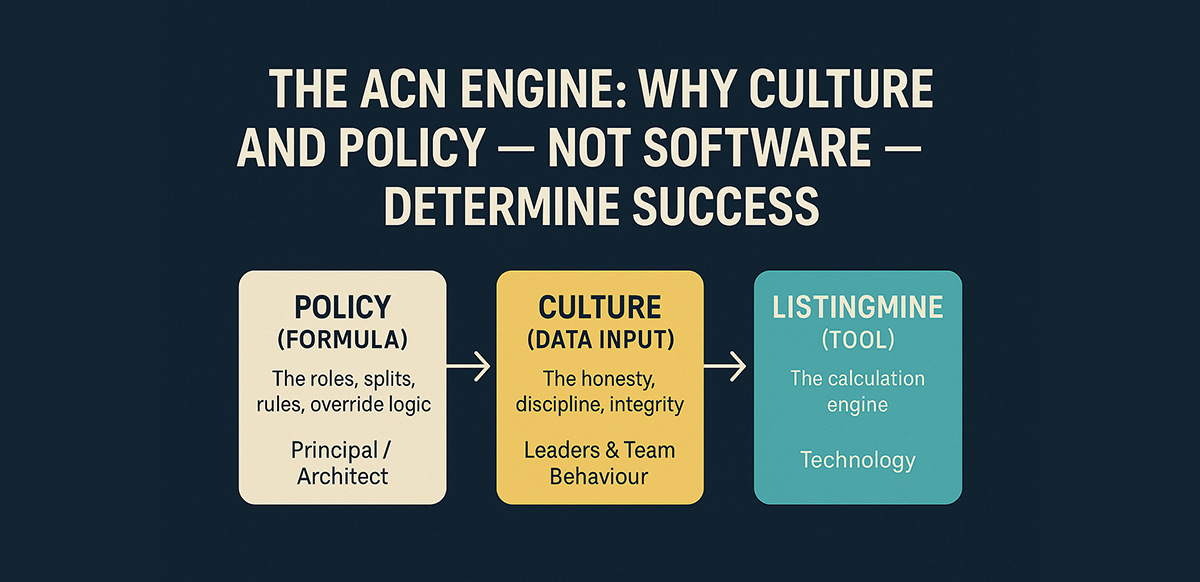
ACN software alone cannot create cooperation. Culture, policy, enforcement, and leadership determine whether the system succeeds.
ListingMine Academy | Leadership & Operational Integrity
Agency Principals often evaluate ACN systems by asking:
To answer correctly, you must first understand the tool.
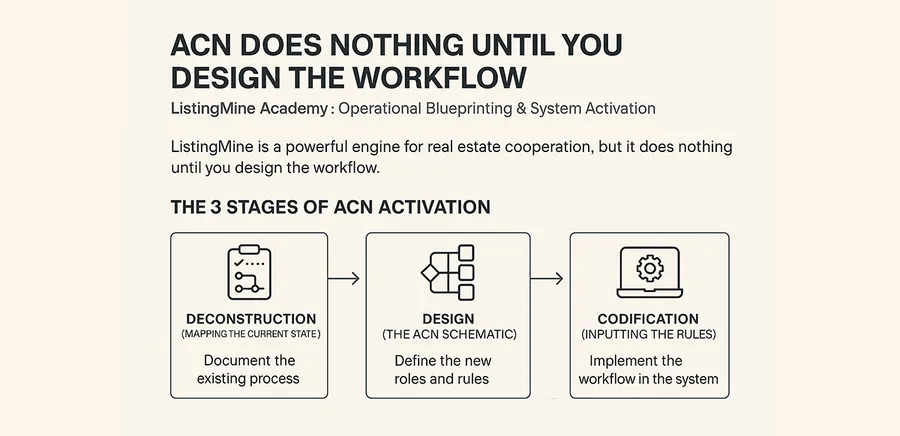
Think of ListingMine as the world’s most sophisticated Excel engine built for real-estate commissions.
It is powerful, precise, and impartial — but it cannot design your culture, ethics, or policy for you.
The success of your ACN has almost nothing to do with software code.
It is determined entirely by the Company Policy and Company Culture you feed into it.
Many companies buy advanced technology hoping it will magically fix internal problems:
It won’t.
Technology is neutral. If your rules are unfair, ListingMine will simply automate that unfairness at high speed.
The Engine Analogy
| Component | Meaning | Responsibility |
|---|---|---|
| Policy (Formula) | Your ACN Scheme: roles, splits, rules, override logic — the architecture of fairness. | Principal / Architect |
| Culture (Data Input) | The honesty, discipline, and integrity of agent behaviour and data quality. | Leaders & Team Behaviour |
| ListingMine (Tool) | The calculation engine executing whatever rules and data you give it. | Technology |
Just like Excel: If the formula is wrong, the output is wrong — no matter how powerful the engine.
Your ACN Policy is the “Formula” the system obeys. If the formula is flawed, the entire network collapses.
A strong policy must be:
Ambiguity kills networks. Clarity creates trust.
This is the responsibility of the ACN Architect: to design predictable, non-negotiable rules that the tool can enforce. A strong policy is the structural foundation of every successful ACN.
Culture is how your people behave when nobody is watching.
ACN only works when agents believe:
If the culture is toxic, agents will bypass the system and return to private, untrackable practices.
Peter Drucker said: “Culture eats strategy for breakfast.”
In ACN, culture also eats software for breakfast. Even the best system cannot rescue a team that refuses teamwork.
The Cost of a Broken Culture: A RM50,000 Example
Here’s what happens when leadership fails to enforce its own policies:
| The Failure | The Impact |
|---|---|
| The Policy: ACN rule says: "The agent who performs the first viewing receives the ‘Viewing Role’ and a 10% commission share.” | Result: The junior agent loses RM5,000. |
| The Violation: Senior agent Anna bypasses ACN, privately conducts a viewing, and manually inputs data to claim 100%. | Fallout: Three junior agents resign within a month, collapsing your viewing capacity. |
| The Lesson: The software worked perfectly — it followed Anna’s input. The culture failed catastrophically. | Final Bill: Lost capacity + replacement cost → more than RM50,000. |
The loss was not technological. It was cultural, caused entirely by leadership inaction.
ListingMine solves the Accountability Crisis in the traditional real-estate model. But it does not create trust.
It enforces the trust you have designed through Policy and Culture.
The Excel Analogy
Excel doesn’t care whether the formula calculates a profit or a loss. It simply executes the equation.
Similarly: ListingMine doesn’t care whether your ACN gives 90% to the Lister or 10%. It enforces whatever you codify.
What the ACN Engine Guarantees
| Element | Description | Your Role |
|---|---|---|
| Policy | The definition of fairness (The Formula). | Architect / Founder |
| Culture | The acceptance and trust in the system (The Data Input). | Principal / Leaders |
| ListingMine | The enforcement engine (The Automation). | Technology |
The ACN is a tool. Never expect technology to fix poor leadership.
Your ethics, clarity, and culture are the real engine.
Neglect them, and the most advanced system in the world will only accelerate your failure.
Master them, and you won’t just run an agency — you’ll build an institution.

Founder of ListingMine and author of Agent for Life. Building ERP for Malaysian real estate agencies since 2008 — and writing to reshape how agencies grow.
More about Marvin Foong →More articles in this topic
This article is one of the sources behind this assessment. Take it to see what you already know and what to read next.
Educational self-assessment. Not a licensing examination or professional certification.