Malaysian agents already practise informal ACN through referrals, co-broking, key holders, and shared roles. The opportunity is to formalize what already happens.
And It’s the Reason Large Agencies Grow While Others Get Stuck in Disputes.
When Malaysian agents first hear the term ACN (Agent Cooperation Network), many assume it’s a new concept imported from China’s Beike or America’s MLS. In reality, ACN has existed here for years — just without the name, structure, or enforcement.
However, only larger agencies — typically those with 100 negotiators or more — experience ACN in a true operational sense. Smaller teams, where everyone handles listings, buyers, and closings alone, rarely operate with clear role boundaries.
In Malaysia, the bigger the agency, the stronger the ACN logic — because once headcount scales, coordination, accountability, and structure are the only way to survive.
In firms with 100+ negotiators, specialization happens naturally. Roles start to split between:
That is ACN in action — role-based cooperation, where contribution determines entitlement.
But the problem lies in the execution tools: Most systems live inside WhatsApp chats, Excel sheets, or memory. They rely on trust and recall, not on verifiable proof.
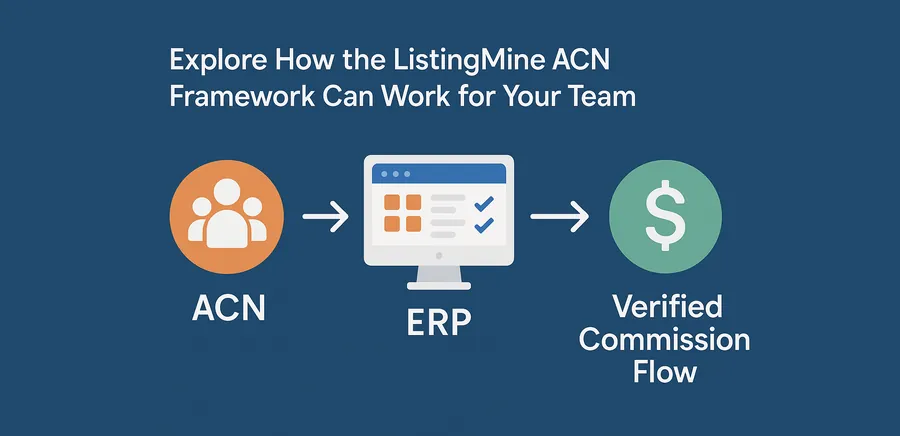
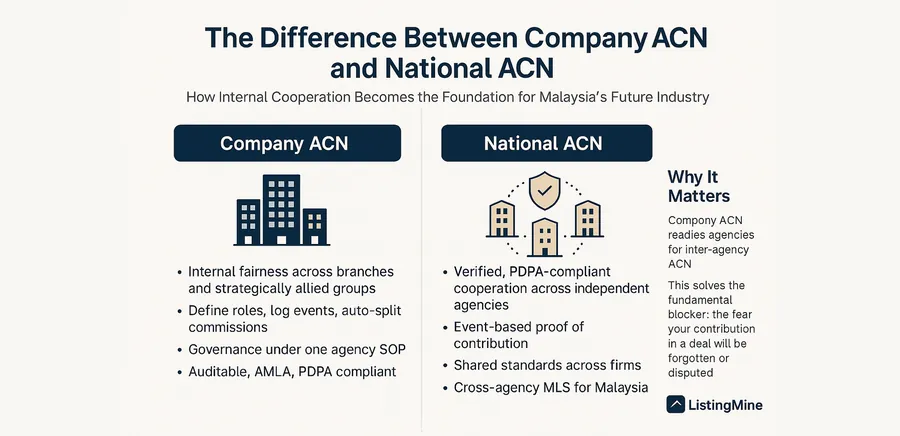
So while the logic exists, the governance layer is missing — and that’s what ListingMine ERP provides: a structured, auditable ACN framework that scales.
In subsale transactions, cooperation already exists — we just never called it ACN.
| Role | Typical Responsibility |
|---|---|
| Lister | Controls the unit, manages the owner, and sets up viewings. |
| Buyer Agent | Brings the client, negotiates the offer, manages the transaction. |
| Verifier / Loan Coordinator | Handles loan approval, documentation, and compliance. |
This model works until your team grows beyond 50. Then, without a clear role-based system, disputes rise, credit blurs, and leaders lose control of who truly contributed.
At that point, ACN logic becomes not just useful — it becomes necessary.
In project marketing, Malaysia’s larger agencies have quietly practiced ACN for years — disguised under commission codes like 433 and 334.
| Model | Split Formula | Meaning |
|---|---|---|
| 433 Model | 40% Lead Supplier / 30% Caller / 30% Closer | Balanced distribution between marketing and closing. |
| 334 Model | 30% Lead Supplier / 30% Caller / 40% Closer | Rewards stronger closing performance. |
| Custom Variants | Agency-specific codes | Tailored to each developer or project. |
These codes are ACN by numbers — shorthand for who does what and who gets what share. They were Malaysia’s first decentralized ACN systems, long before the term “ACN” existed.
| Role | Function in Project Sales |
|---|---|
| Person In Charge (PIC) | Coordinates between developer, sales, and marketing teams; allocates leads, monitors conversions. |
| Introducer | Brings in new projects or connects developers to the agency; often the origin of the opportunity. |
| Upline / Group Leader | Manages closing agents, provides mentorship, and ensures compliance; receives override bonuses. |
| Verifier / Loan Specialist | Manages financing, DSR checks, and document verification. |
| Caller / Appointment Setter | Qualifies leads and schedules viewings or appointments. |
| Closer / Negotiator | Manages negotiation and booking finalization. |
| Admin / Doc Support | Handles commission claims and developer coordination. |
Each role contributes measurable value. But because most agencies still manage these manually, proof of contribution disappears — and conflicts reappear.
That’s where ListingMine ERP formalizes these informal patterns into verifiable, fair, and automated workflows.
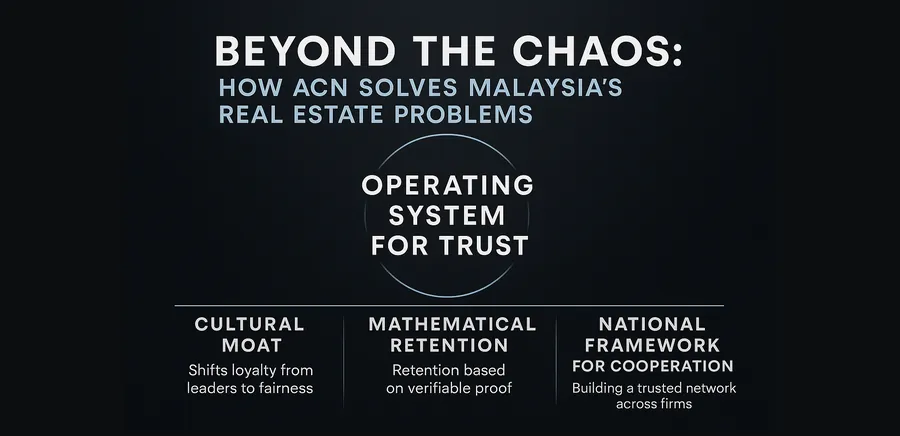
Malaysia already runs on ACN logic — ListingMine just gives it digital memory, fairness, and governance.
Modern agents don’t just sell — they operate as one-person micro-agencies. They shoot photos, write listings, handle compliance, run Facebook ads, and guide buyers through loans. Each “simple deal” now involves over a dozen specialized micro-roles and serious time or cost investment.
| Role (ACN-Relevant) | Tools, Knowledge & Skills Required | Professional Cost — Money 💰 / Time ⏱ |
|---|---|---|
| Listing Input & Verification | DSLR / e-Tanah / ListingMine QC module | 💰 RM3k–6k · ⏱ 1–2 hrs per property |
| On-Site Photographer | Mirrorless camera, Lightroom | 💰 RM15k–25k · ⏱ 5–8 hrs per listing |
| Drone & Exterior Visuals | DJI Mavic 3, CAAM permit | 💰 RM20k–30k · ⏱ 3–4 hrs per shoot |
| Authorization Collector | PDPA / AMLA literacy, forms | ⏱ 1–2 hrs per listing |
| Key Holder & Site Access | Smart boxes, scheduler | ⏱ 2 hrs weekly per unit |
| Property Marketing & Lead Distribution | Meta Ads, CRM, analytics | 💰 RM3k–4k/mo · ⏱ 8–12 hrs weekly |
| Caller / Lead Qualifier | CRM dialer, call scripts | 💰 RM1k–2k · ⏱ 4 hrs daily |
| Buyer Referrer / Introducer | CRM tagging, social sourcing | ⏱ 2–3 hrs daily |
| Viewing Agent | Presentation, scheduling | 💰 RM2k–4k · ⏱ 2–3 hrs per viewing |
| Negotiator / Closer | Sales psychology, commission logs | 💰 RM3k–8k/yr · ⏱ 3–5 hrs per deal |
| Finance Advisor | LPPSA, bank comparison tools | ⏱ 1–2 hrs per buyer |
| Co-Broke Coordinator | Group Channels, split protocol | ⏱ 1–2 hrs daily |
| Project PIC / Developer Liaison | Dashboards, SOPs | ⏱ 5–8 hrs per project |
| Data Analyst / Market Intel | Brickz, NAPIC, ListingMine Insights | ⏱ 3–4 hrs weekly |
| Group Leader / Deal Coordinator | ERP + Groups, performance tracking | ⏱ 10–15 hrs weekly |
| Automation Specialist | Zapier, API, automation | 💰 RM5k tools · ⏱ 2–3 hrs weekly |
| AI Strategist | ChatGPT, Midjourney, automation | 💰 RM3k subs · ⏱ 3–4 hrs weekly |
This table makes one thing clear: the modern agent is doing the work of an entire team. Without proper ACN structure, every agent ends up multitasking inefficiently — wasting time, energy, and money.
That’s why larger agencies grow faster: they distribute this workload across structured roles, enabling specialization, accountability, and sustainable performance.
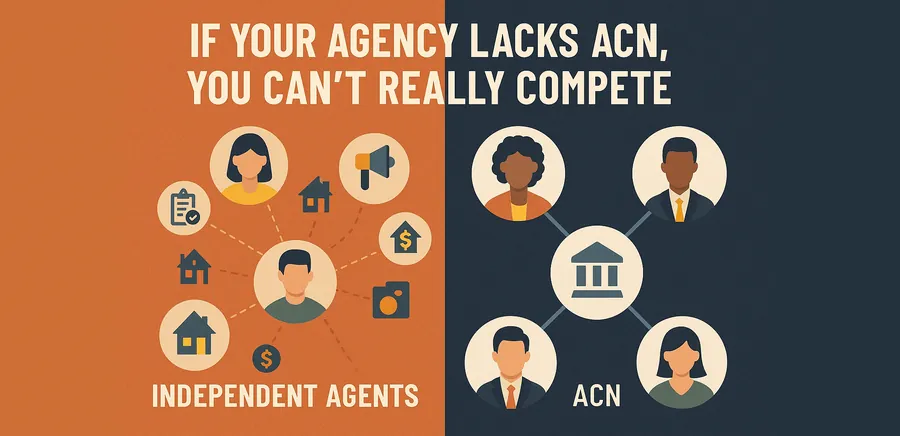
Smaller firms (<50 agents) still thrive on independence — each agent lists, markets, and closes solo. That’s fine when volume is low and relationships are personal. But at scale, the same independence causes chaos: duplicate listings, double leads, payout arguments, and burnout.
They don’t need ACN today, but they’ll eventually grow into it — and adopting ListingMine ERP early helps future-proof that transition.
| Traditional Big Agency System | With ListingMine ERP (ACN Mode) |
|---|---|
| Manual Excel tracking | Automated workflow |
| Verbal agreements | Digital proof & enforcement |
| Disputes & confusion | Event-driven fairness |
| Limited visibility | PDPA-safe audit trail |
With it, even a 200-agent agency can run with the transparency of a financial institution.
ACN isn’t for small teams — it’s for scalable organizations that want structure beyond personality-driven leadership.
Beike proved it with 450,000 agents. In Malaysia, ListingMine ERP localizes that logic, helping agencies govern like corporations while staying independent.
The larger your team, the more ACN becomes your backbone — not your burden.
Malaysia has been practicing ACN all along — just without the label or structure. Large agencies already run 433, 334, and override hierarchies. Smaller ones will evolve into it as they scale.
Now, ListingMine ERP gives the industry what it always needed: a way to formalize contribution, automate fairness, and enforce accountability — turning cooperation into growth infrastructure.
ACN isn’t new.
It’s just time we recognize it, structure it, and use it to lead Malaysia’s next property evolution.

Founder of ListingMine and author of Agent for Life. Building ERP for Malaysian real estate agencies since 2008 — and writing to reshape how agencies grow.
More about Marvin Foong →More articles in this topic
This article is one of the sources behind this assessment. Take it to see what you already know and what to read next.
Educational self-assessment. Not a licensing examination or professional certification.