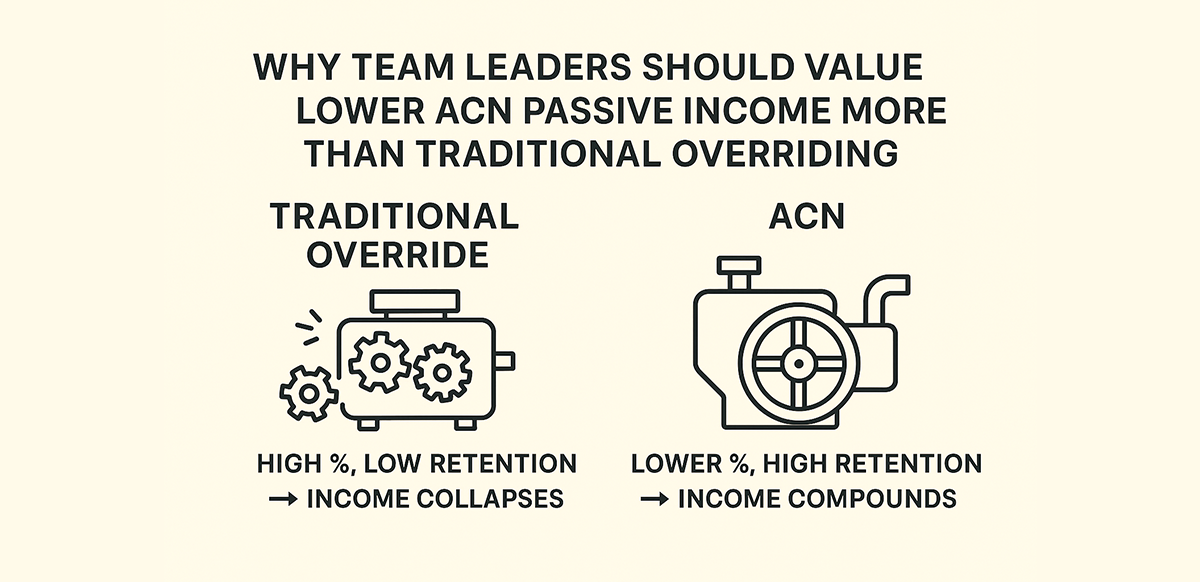
ACN passive income may be smaller but more sustainable and fair than traditional overriding. Long-term value comes from contribution-based network income, not only hierarchy.
ListingMine Academy | Leadership Economics & Long-Term Income Stability
Team Leaders often look at ACN’s Redistribution model and immediately react:
“Why should I accept lower passive income than the 20% I used to get?”
This is not a small objection. It is a high-stakes question because agency growth is entirely dependent on Team Leader recruitment. If TLs stop recruiting out of fear that ACN gives “lower overrides,” the agency’s growth pipeline collapses.
But the comparison itself is flawed. Traditional overriding gives you a higher percentage, but ACN gives you a longer lifespan for that income. The reality is simple: A smaller share of income that lasts is worth far more than a bigger share that disappears.
Traditional TL income looks attractive:
But all of this collapses under real-world conditions:
Traditional override is not passive income. It is churn-dependent income. You are earning 20% from people who stay 12–18 months at best. The percentage is high, but the lifespan is short — making it far less valuable than it appears.
ACN Redistribution typically gives you 15–20% of the role portion, not the full commission. But this income has qualities the old model cannot match:
ACN does not make your income bigger — it makes your income permanent. Lower percentage × high retention = stronger long-term income.
Every TL knows the cycle:
This is the recruiting treadmill. Traditional override looks high only because TLs never calculate the hidden costs:
20% override on a revolving-door team is inferior to 15% override on a team that stays.
If you want to break even under the old model, you must recruit nonstop. That is not passive income — that is survival.
TLs rarely say this publicly, but privately, almost all admit: “Every day feels like babysitting.”
Traditional leadership is:
It is a managerial job disguising itself as passive income.
In the ACN model:
This is what real passive income looks like:
rule-based
predictable
auditable
not dependent on charisma or mood
Passive Income Is Not About Percentage — It Is About Duration
This is the key principle TLs must understand: Traditional override is high but short-lived. ACN override is lower but long-lived. A leader should always prefer:
Because:
percentage is irrelevant
duration determines wealth
retention is the engine of long-term compounding
ACN stabilizes the income base instead of resetting it
Traditional override gives you “shock income.” ACN gives you “compound income.”
| Feature | Traditional Override | ACN Redistribution |
|---|---|---|
| Payout Value | High percentage | Lower percentage |
| Team Stability | Downline disappears | Downline stays longer |
| Income Type | Volatile, churn-based | Stable, compounding |
| Leadership Role | Emotional babysitting | Governance + Compliance |
| Long-Term Value | Declines over time | Increases over time |
Traditional override appeals to ego: “I get 20% because they belong to me.”
ACN appeals to logic: “I get a smaller share, but agents stay longer, my entitlement is system-protected, and my income becomes permanent.”
For any leader who wants real passive income, the choice is obvious.

Founder of ListingMine and author of Agent for Life. Building ERP for Malaysian real estate agencies since 2008 — and writing to reshape how agencies grow.
More about Marvin Foong →More articles in this topic