Advance commission improves agent cash flow but creates financing, default, and documentation risks. Agencies need proper controls before offering early payout.
Why Agencies and RENs Must Stop Carrying Developers' Cashflow Problems
Advance commission has become such a normal part of Malaysian real estate that most agents believe it is a "benefit" provided by agencies.
In reality, it is one of the most dangerous, high-risk, structurally unfair practices in the entire industry — and nearly every participant misunderstands where the money comes from, who carries the risk, and who truly benefits.
This article reveals the real mechanics behind advance commission, the cost it imposes on everyone except the developer, and the only realistic solution the industry should adopt.
This is false. Most agencies are not advancing their own money. Here is what actually happens behind the scenes:
How Agencies Really Fund Advance Commission
Agencies borrow from financial institutions, P2P lenders, private credit companies, or factoring firms. These lenders require:
The lender releases money to the agency, not to the developer. Then the agency disburses the advance to the REN.
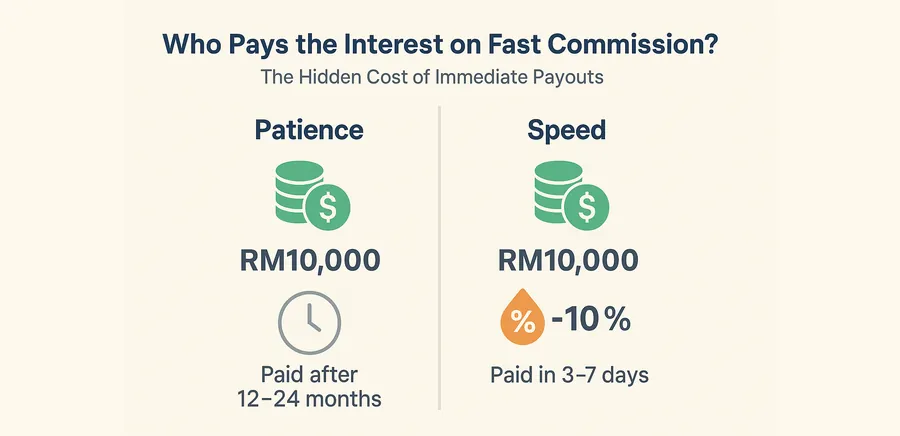
The lender charges 8% to 20% interest, depending on:
The agency often takes an additional "admin fee" on top of the lender's interest.
All of this interest is deducted from the REN's commission upon completion.
So the REN pays the cost. Not the developer. Not the lender. And not the agency.
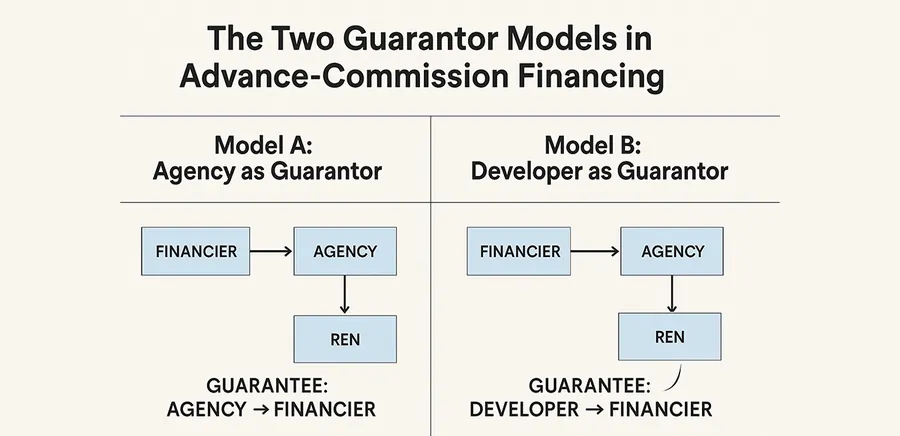
This is the part RENs rarely understand. There are two models in Malaysia:
Model A — Agency Is the Guarantor (99% of cases)
Model B — Developer Is the Guarantor (almost never)
Most developers refuse Model B because:
So what do they do? They push agencies into Model A, quietly transferring their financial problem to the sales ecosystem.
Developers offer high commissions (5%–10%) because they are struggling to sell. If they were financially strong:
Advance commission exists because:
This is a race to the bottom — and developers know it.
When a REN accepts advance commission, here is what actually happens:
Example
So in exchange for getting RM5,000 early, the REN loses up to RM2,000. This is not a "benefit." This is an expensive personal loan disguised as an agency service.
Most agencies run on thin margins. Commission-sharing structure:
After salaries, rentals, systems, marketing, support staff, and compliance… Agencies have very little buffer. So when a developer delays payment — or worse, defaults — this happens:
Agency Loss Example
All because one developer refused to pay on time. A single bad developer can erase profit from 10 successful projects.
Malaysia has seen:
If a developer collapses:
This is an unfair, structurally broken system where:
Because everyone thinks they are solving a REN problem. But in reality:
Advance commission is not an agent benefit. It is a developer privilege.
Here is the truth nobody wants to say:
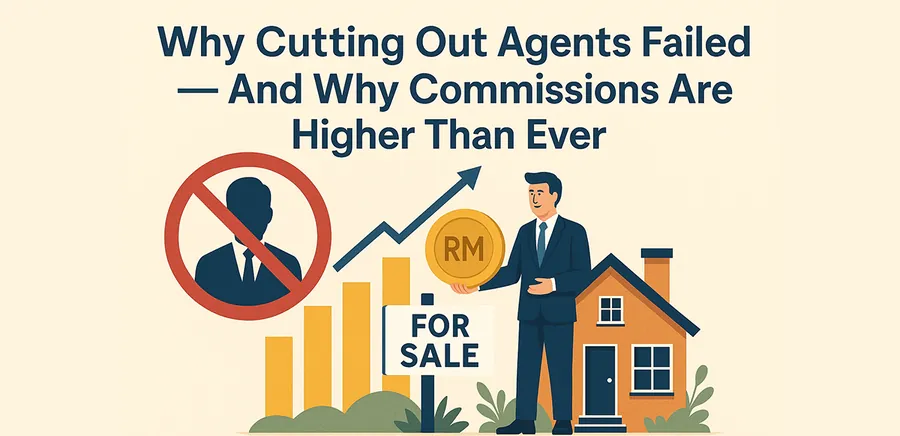
Agencies and RENs have more power than developers.
Without agents, developers cannot sell. So the solution is simple:
Nothing changes until agencies stop absorbing developer risk.
This is the only solution that protects:
A developer who uses your agency as their credit line is not a partner. They are a liability.
Stop selling for them.

Founder of ListingMine and author of Agent for Life. Building ERP for Malaysian real estate agencies since 2008 — and writing to reshape how agencies grow.
More about Marvin Foong →More articles in this topic
This article is one of the sources behind these assessments. Take one to see what you already know and what to read next.
Educational self-assessment. Not a licensing examination or professional certification.