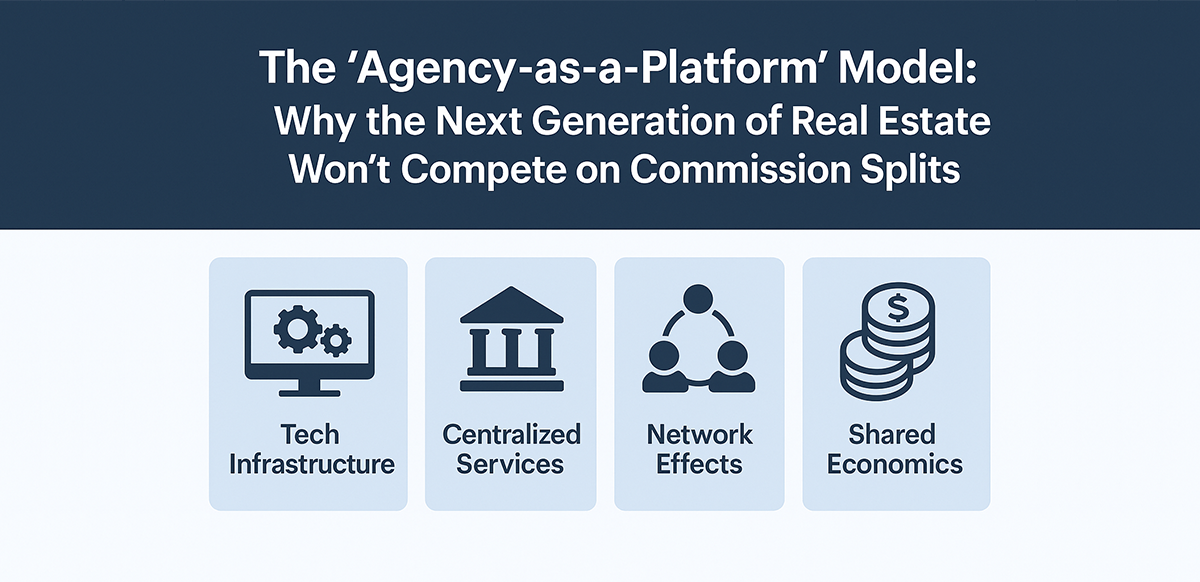
Future agencies may compete through platform value instead of payout percentage. Systems, data, cooperation, education, and distribution can become stronger than commission splits.
For decades, the blueprint for a successful real estate agency was simple:
More agents → more listings → more transactions → more commission.
It worked. Until it didn't.
Today's agents are more entrepreneurial, tech-savvy, and aware of their own value than any generation before them. The old proposition—"join us, we take a split, we give you a brand and a desk"—is no longer a competitive advantage.
The agencies that will dominate the next decade aren't the ones offering the highest split.
They are the ones offering the strongest platform.
The traditional brokerage is built on extraction, not expansion. It's a fragile, zero-sum game.
| The Old Model's Logic | The Fatal Flaw |
|---|---|
| "Give me a higher split and I'll stay." | Creates zero loyalty. The agent leaves for 5% more elsewhere. |
| "We provide an office, brand, and admin." | These are now commodities. There is no defensible moat. |
| "Headcount is our primary success metric." | More agents = more disputes, more admin, more churn, more chaos. |
| "We only earn when they close a deal." | Zero compounding value. No network effects. No recurring platform revenue. |
This is why many agencies with hundreds of agents remain low-margin businesses. They scale horizontally (adding more people), not vertically (adding more value per person).
A platform agency doesn't compete on splits. It competes on ecosystem advantage.
| Commission-Split Agency | Platform Agency |
|---|---|
| Revenue per deal | Lifetime value per agent |
| Admin + Brand | Tech Stack + Services + Network |
| Agent churn is a cost of business | Agent retention is a structural outcome |
| No compounding effects | Every agent makes the platform more valuable for every other agent |
| Zero-Sum Game | Positive-Sum Game |
A platform agency doesn't say, "Join us, we take 20%." It says, "Plug into our ecosystem. Your income, efficiency, and deal flow will increase—making the platform fee your best investment."
This is why agents at leading platform models accept a "lower" split: they net far more over time through leverage, shared economics, and powerful platform effects.
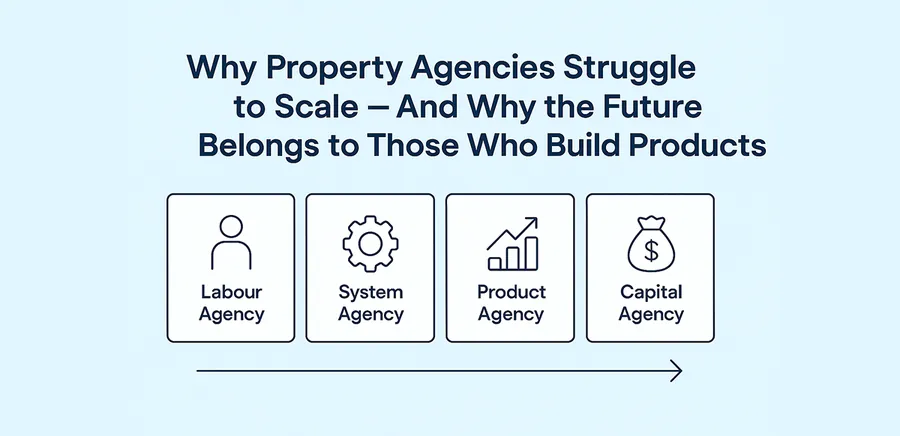
A true platform replaces "split + office" with four scalable layers of value:
| Layer | What It Provides | Why It Retains Top Talent |
|---|---|---|
| 1. Tech Infrastructure | Integrated CRM, automated marketing, transaction management, data analytics. | Lowers workload, increases capacity and deal flow. |
| 2. Centralized Services | In-house marketing, listing coordination, compliance, client concierge. | Allows agents to scale their business without hiring a personal team. |
| 3. Network Effects | Seamless cross-agent referrals, shared inventory, collaborative marketing. | Each new agent adds value to the entire network. |
| 4. Shared Economics | Revenue sharing, profit share, equity opportunities, vendor perks. | Transforms agents from contractors into stakeholders. |
This multi-layered value is why platform agencies have minimal churn, while traditional brokerages face a constant revolving door.
eXp Realty didn't become a multi-billion dollar company by winning the split war. It won by ceasing to act like a brokerage and starting to behave like a platform:
The result?
In a traditional agency, agents are a cost of sales. In a platform model, agents are nodes in a value-creating network. That is the fundamental difference.
If your agency's primary value proposition is:
...then you have already lost. These are table stakes.
When the best agents can get the same package from 50 different firms, they treat split-based agencies as temporary shelters, not long-term partners.
If your agency can be replaced in three phone calls, you don't have a business. You have a payroll system.
The old success metric: "We have 800 agents."
The new success metric: "Our platform enables each agent to earn 2-3x more than they could elsewhere."
The critical question is no longer "How many agents do you have?" but "How much more valuable does your platform make each agent?"
Here’s the ultimate test: If your agency disappeared tomorrow, and the only thing your agents lost was their split—you are not a platform.
The agent of the future isn't loyal to your brand.
They are loyal to your network, your systems, your leverage, and your economics.
A commission split is not a strategy. A platform is.
The agencies that will thrive in the next decade won't be the ones with the most agents on their roster. They will be the ones with the deepest ecosystem gravity—the undeniable pull that makes leaving unthinkable.

Founder of ListingMine and author of Agent for Life. Building ERP for Malaysian real estate agencies since 2008 — and writing to reshape how agencies grow.
More about Marvin Foong →More articles in this topic