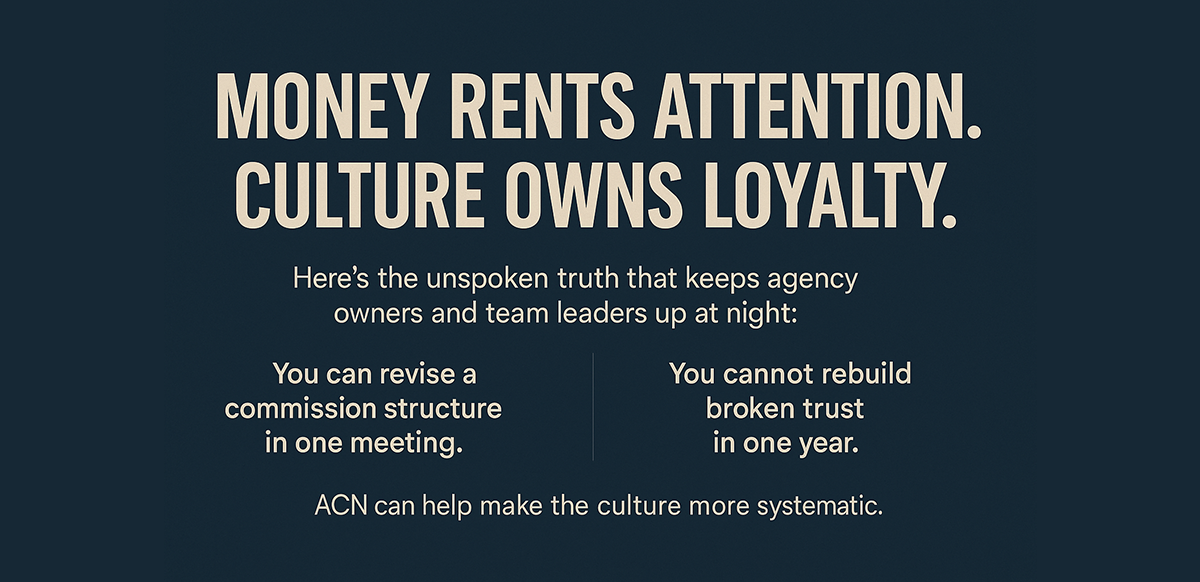
Money can attract agents temporarily, but culture creates deeper loyalty. Long-term retention depends on shared values, trust, and belonging.
Here is the unspoken truth that keeps agency owners and team leaders awake at night:
You can revise a commission structure in one meeting. You cannot rebuild broken trust in one year.
Most leaders still treat retention like an accounting problem. When a star performer hints at leaving, panic sets in. Suddenly, the calculator becomes the weapon of choice:
"Let's bump you to 85%."
"I'll cover your portal credits this quarter."
"You'll get priority on the next launch."
But money is a temporary patch on a leaking roof. It may keep the rain out for a month, but if the foundation is cracked, the house will eventually collapse.
No commission split is big enough to make someone love a place that makes them miserable.
Star performers rarely resign over a 5% split difference. They resign because of the ecosystem surrounding that split. They aren't rejecting the numbers; they are rejecting the environment those numbers live in.
Let's be honest about the real reasons people walk. It usually comes down to five specific villains:
The leader who smiles on stage for "team success" but quietly competes with their own downline. Every ounce of stolen recognition drains a gallon of loyalty.
Present when the commission clears. Missing when the deal falls apart. Agents can endure rejection from clients—they cannot endure abandonment from their own leader.
The midnight "Where are you?" messages. The second-guessing of every caption, viewing, and negotiation. This isn't leadership—it's reverse mentorship. It doesn't build skill; it destroys confidence.
"The leads will come." "The system drops next month." "Training is being arranged." A broken promise isn't just an inconvenience. It is proof that the agent's time is not valued.
Gossip is the office currency. Favorites get opportunities. Fighters get sidelined. Where meritocracy dies, excellence dies with it.
The Golden Rule of Retention: When an agent leaves for money, you can usually buy them back. When an agent leaves for culture, they never look back.
The agencies dominating the market today are not always the highest payers. They are the fairest, the clearest, and the most consistent.
Their moat isn't financial. It's cultural.
Here is what they do differently:
Culture often fails because it is invisible. Credit is contested, roles overlap, and "fairness" is subjective.
ACN changes this by turning culture into a system.
It doesn't just rely on a leader "being nice." It enforces fairness through technology:
Culture becomes systematic, not emotional. You don't have to "hope" for fairness—the system enforces it. This protects the team from bias, ego, and inconsistency—the very things that drive good agents away.
To Leaders: Stop bribing people to stay in a burning house. If you're losing talent, put the calculator away and pick up the mirror. Are they leaving for 5% more elsewhere, or for 100% more peace? Fix the chaos, and you won't have to keep buying silence.
To Agents: If the issue is financial—negotiate. Commission splits can always be rewritten. But if the issue is emotional, cultural, or psychological—leave. Never sacrifice your sanity for a slightly higher percentage. A good split helps you survive this year. A good culture helps you build a career that outlasts markets.
Money buys a handshake. Culture earns a heartbeat.
You can purchase somebody's time, their output, and even their temporary compliance. But you cannot buy their belief, their passion, or their loyalty.
Those are only ever volunteered—in a place where culture is not luck, but systematically protected.
And that is where ACN becomes the competitive advantage no commission split can copy.

Founder of ListingMine and author of Agent for Life. Building ERP for Malaysian real estate agencies since 2008 — and writing to reshape how agencies grow.
More about Marvin Foong →More articles in this topic
This article is one of the sources behind this assessment. Take it to see what you already know and what to read next.
Educational self-assessment. Not a licensing examination or professional certification.