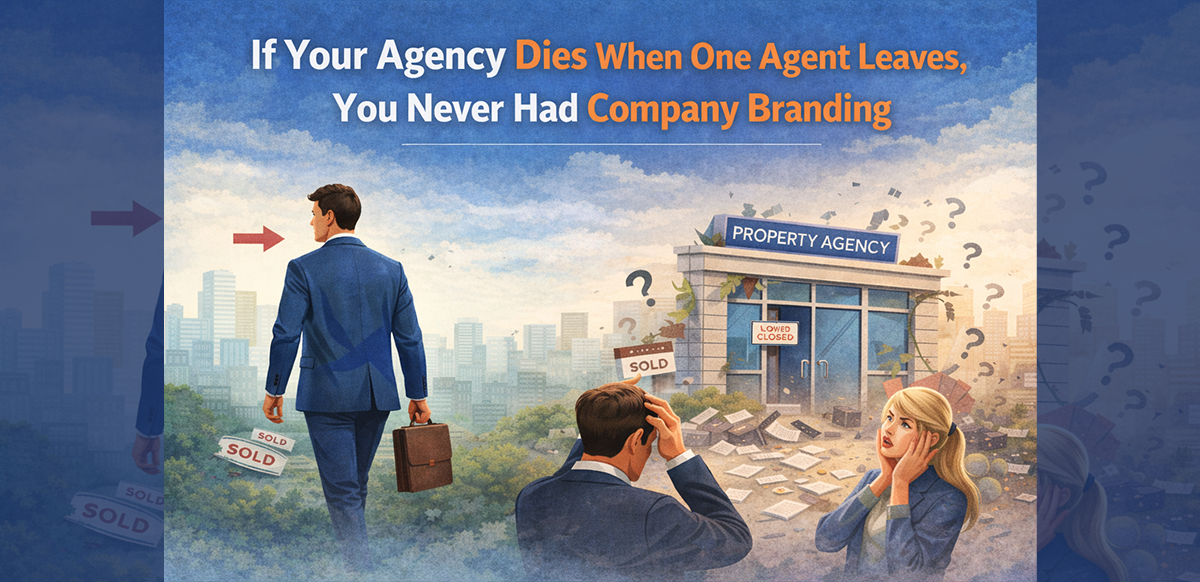
An agency that collapses when one strong agent leaves was dependent on personal branding, not company branding. Real company branding preserves value beyond individual producers.
This is not a criticism. It is a diagnosis.
If your agency weakens dramatically when one top agent leaves—if you lose listings, visibility, or direction overnight—then what you had was not company branding.
You had borrowed momentum.
Many principals say:
These are not isolated incidents of betrayal. They are structural signals. They indicate that trust was stored entirely in the person, not in the organisation.
Most agencies grow by riding the backs of a few strong performers. Success is attributed to "culture," but in reality, it is just dependency. When the agent leaves, the agency resets.
The Hard Truth: Personal branding is designed to be portable. Company branding is designed to be permanent.
If the agent carried the trust, the company never owned it. And only what the organisation owns can be defended, transferred, or scaled. Everything else is rented.
Company branding is not a brand book, a slogan, or a recruitment pitch.
Company branding is infrastructure. It answers the client's unspoken question: "If someone else steps in, will I still be taken care of properly?"
If you have Company Branding, you have:
If the answer is "No," the brand lives with the agent. And when they leave, the brand leaves.
Agencies without company branding face three silent risks that eventually kill growth:
This belief delays the fix. Hiring stronger agents without institutional branding:
It feels like progress—until it isn't. A system that only works with heroes is not a system. It is a risk concentration strategy.
Durable agencies design for this exact scenario: "If my top producer leaves tomorrow, what still works?"
They invest in case documentation, shared standards, and centralized intelligence. They put process before persuasion.
When an agent leaves a durable agency:
The agency does not "win" the departure. It survives.
Ask yourself honestly:
If the answer depends on who is in the room, you are running a collection of individuals, not an institution.
This is not about controlling agents. It is about owning continuity.
Personal branding builds income. Company branding builds survival.
And survival is the prerequisite for everything else—growth, cooperation, leverage, and systems like ACN.
If your agency dies when one agent leaves, the problem is not loyalty. The problem is that the organisation was never designed to live on its own.

Founder of ListingMine and author of Agent for Life. Building ERP for Malaysian real estate agencies since 2008 — and writing to reshape how agencies grow.
More about Marvin Foong →More articles in this topic
This article is one of the sources behind this assessment. Take it to see what you already know and what to read next.
Educational self-assessment. Not a licensing examination or professional certification.