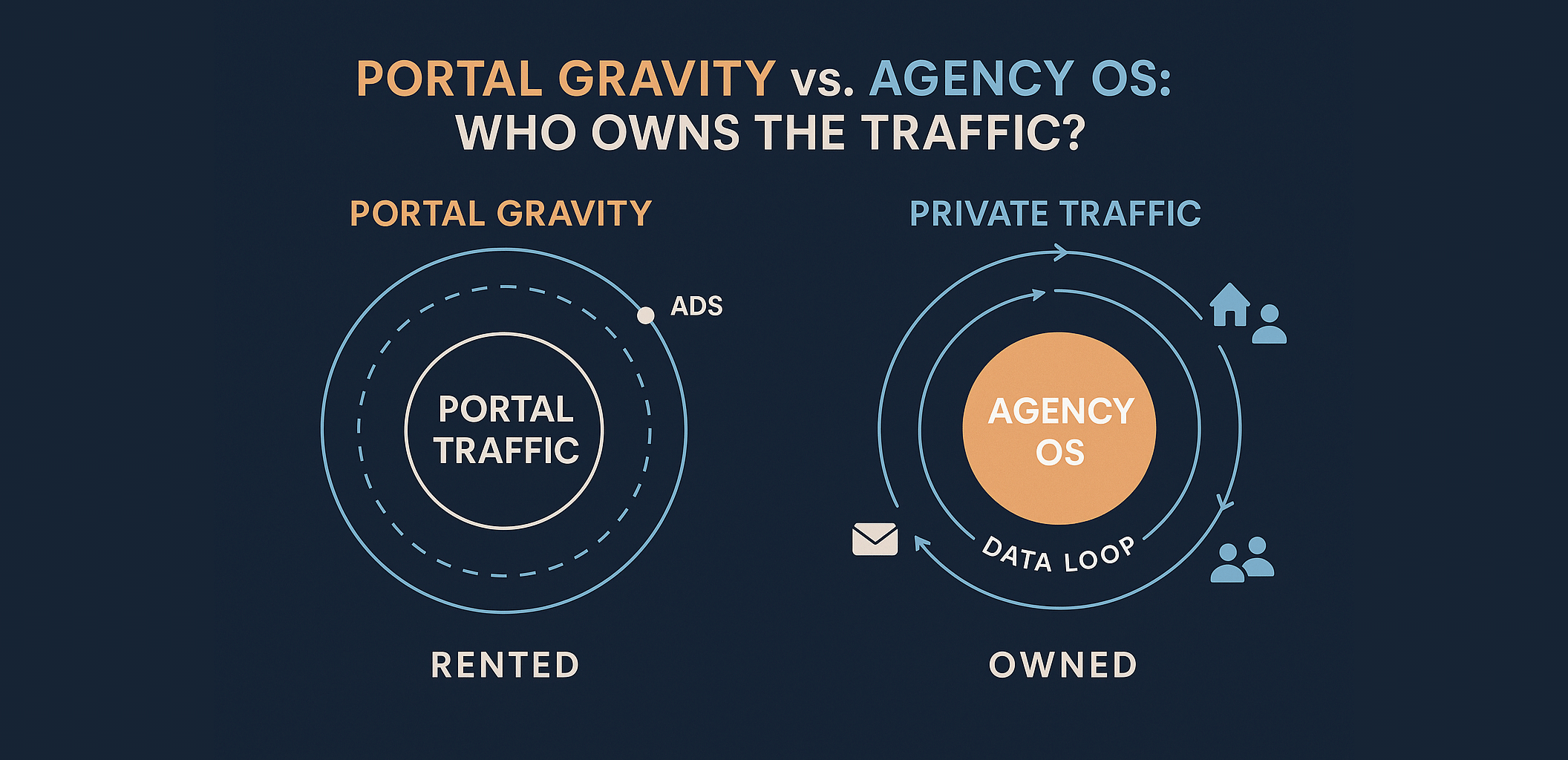
Agencies should build their own operating system and distribution channels instead of depending fully on portals. Owned distribution protects long-term leverage.
Every modern real estate agency faces the same powerful gravitational pull. No matter how strong your listings, your team, or your brand, portals own the public traffic. They aggregate consumer attention and then resell it back to you in the form of expensive leads.
But here is the critical paradox: while portals chase public traffic, your agency already controls something far more valuable: private traffic.
Private traffic consists of the leads, chats, and long-term relationships that you control—traffic that doesn’t vanish when the ad budget stops. The difference between a portal-dependent agency and an Agency OS-driven agency is simply who controls that gravity.
Portal Gravity is the economic black hole of today’s property market. The more listings you upload, the more dependent you become on the platform. Every agent competes for the same eyeballs, and every click is rented, not owned.
This dependency is by design. Portals monetize exposure, not relationships, and their business model requires keeping buyers and sellers within their ecosystem, not yours.
Portal gravity traps your brand in orbit around someone else’s system.
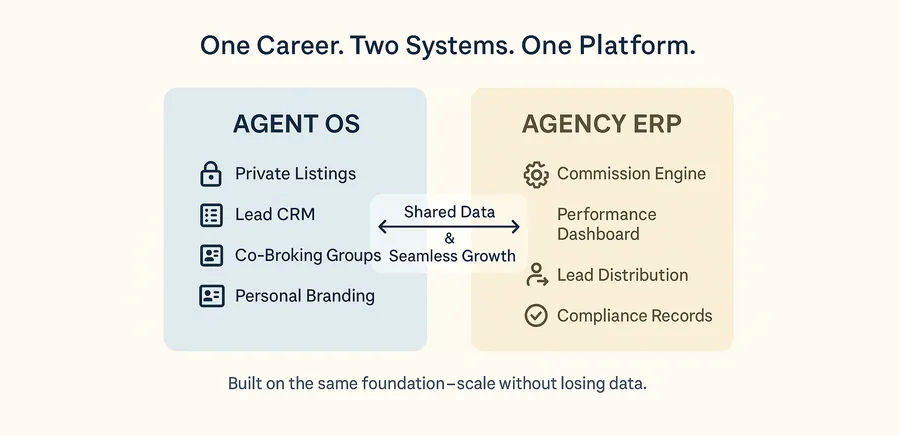
An Agency Operating System (Agency OS) flips this dynamic. It is more than just software; it is a distribution engine that lets your agency capture, manage, and compound its own data.
With an Agency OS:
This is the foundation of private traffic—the compounding asset that portals can never take away.
The fundamental difference lies in ownership and data compounding.
| Traffic Type | Ownership | Lifespan | Cost per Lead | Compounding Effect |
|---|---|---|---|---|
| Public (Portal Ads) | Portal | Ends when ads stop | High, recurring | None |
| Private (CRM, ERP) | Agency | Permanent | One-time setup | Grows over time |
Every interaction—with a buyer, an investor, or a tenant—that happens inside your system adds valuable context: preferences, price range, and buying stage. Over months, this becomes predictive intelligence, allowing for smarter retargeting and higher close rates. Portals can never replicate this because they don't see your full conversation flow or internal data.
The clear digital shift is that brands controlling their distribution layer dominate their markets. For property, this means shifting focus from merely paying for attention to building a platform.
An Agency OS doesn’t eliminate portals; it redefines their role. Portals become necessary top-of-funnel acquisition tools, but your internal system becomes the true center of gravity, where data, follow-ups, commissions, and intelligence converge.
That is how you transform rented attention into owned distribution.
Portals will always promise traffic. But if you build your own Agency OS, you build gravity—the irresistible pull that keeps clients, leads, and agents inside your own ecosystem.
In a market where leads are getting more expensive and trust is fragmenting, private traffic isn't just cheaper—it’s the only kind that compounds.
Public traffic fades. Private traffic pays.

Founder of ListingMine and author of Agent for Life. Building ERP for Malaysian real estate agencies since 2008 — and writing to reshape how agencies grow.
More about Marvin Foong →More articles in this topic