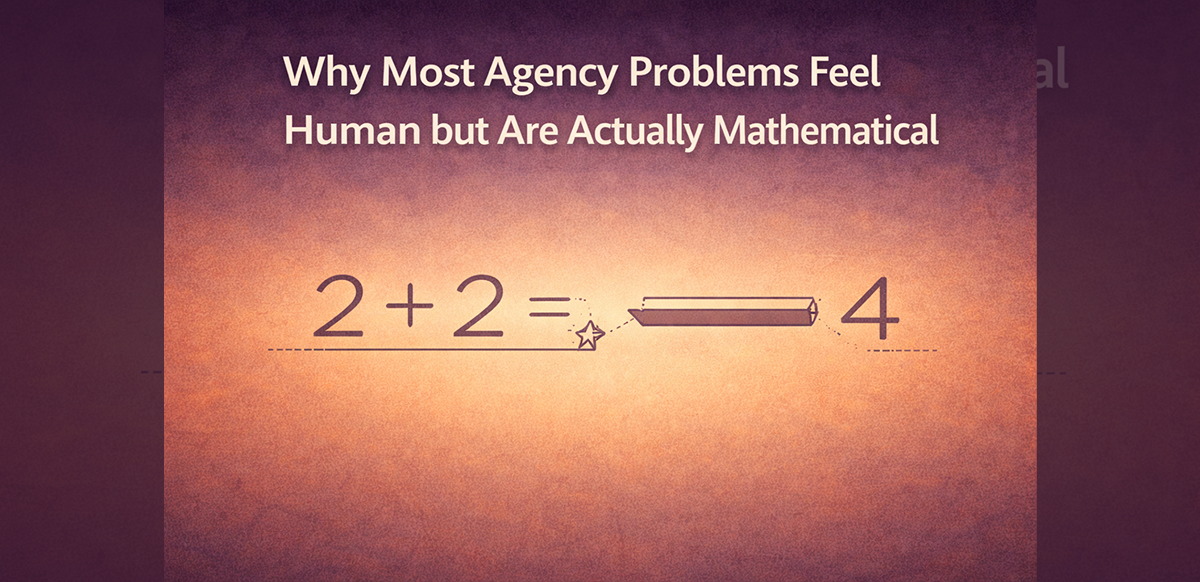
Many agency conflicts come from numbers: margins, payouts, workload, conversion, and incentives. Mathematical structure often explains problems that look emotional.
In a typical real-estate agency, the most exhausting part of the job isn't the market. It's the internal friction.
Principals spend their weeks arbitrating he-said-she-said disputes, managing bruised egos, and pleading for cooperation between people who were productive yesterday and hostile today. Because these conflicts arrive wrapped in anger, frustration, and emotion, the diagnosis is almost always the same: "It's a people problem."
But if you trace these conflicts to their source, a different pattern emerges. Emotions do not appear randomly. They appear precisely where the mathematics ends.
When two team leaders stop speaking after a joint closing, it looks like a personality clash. But when you audit the transaction, you almost always find a logic gap.
The Conflict: "He's being greedy and trying to take a higher cut."
The Reality: The override threshold for cross-regional collaboration was never defined.
The Result: Because the spreadsheet had no answer, the humans had to fight for one.
In many agencies, what gets labeled as "culture issues" is simply the sound of people grinding against the gears of a poorly designed machine.
Nearly all so-called "human drama" in an agency can be traced back to four specific mathematical failures.
1. Threshold Ambiguity
When does a "Senior Negotiator" become a "Team Leader"? If promotion thresholds are based purely on sales volume—without accounting for retention, recruitment cost, or downstream overrides—you create a system that rewards solo hunters while expecting collaboration. The resulting "bad attitude" is not a character flaw. It is a rational response to incoherent incentives.
2. Override Complexity
As agencies grow, override structures compound into a geometric nightmare. When payouts are delayed because an admin is manually calculating three generations of overrides across four deal types, agents don't experience a "calculation delay." They experience a trust failure. And trust failures always surface emotionally.
3. Timing and Liquidity Uncertainty
What looks like greed in a commission dispute is often unmanaged risk. When payout timing is vague, agents become aggressive—not because they want more, but because they don't know when the next dollar arrives. Liquidity certainty reduces the emotional temperature of the entire organization. This is not psychology; it is risk mathematics.
4. Attribution Logic
"Who owns the lead?" is the most common argument in real estate. Most agencies rely on verbal agreements, WhatsApp history, or boss discretion. This isn't management; it's a lottery. Without hard-coded attribution logic, every lead becomes a potential dispute—and every friendship becomes a potential lawsuit.
When the math is missing, principals default to "Fairness" as a management tool. This is where agencies quietly break. Fairness is an emotional variable, not a mathematical constant. By relying on it, the principal:
Every hour spent arbitrating is an hour stolen from growth, recruitment, or expansion. This is the Founder's Hidden Tax.
The shift to a high-performance agency happens at a precise moment: When you realize the spreadsheet should have settled the argument before it started.
If your agents are arguing, your infrastructure has failed. In a well-designed agency:
Administrative reality—who gets paid, how much, and when—should be as undisputed as gravity.
ListingMine was not built to manage people. It was built to settle the math. We turn vague promises into immutable logic. When thresholds, overrides, attribution, and payout timing are encoded into the operating system, emotional conflict collapses. You don't need a culture consultant. You need an economic architect. Because in a modern agency, peace is not achieved through meetings. It is achieved through design.

Founder of ListingMine and author of Agent for Life. Building ERP for Malaysian real estate agencies since 2008 — and writing to reshape how agencies grow.
More about Marvin Foong →More articles in this topic
This article is one of the sources behind this assessment. Take it to see what you already know and what to read next.
Educational self-assessment. Not a licensing examination or professional certification.