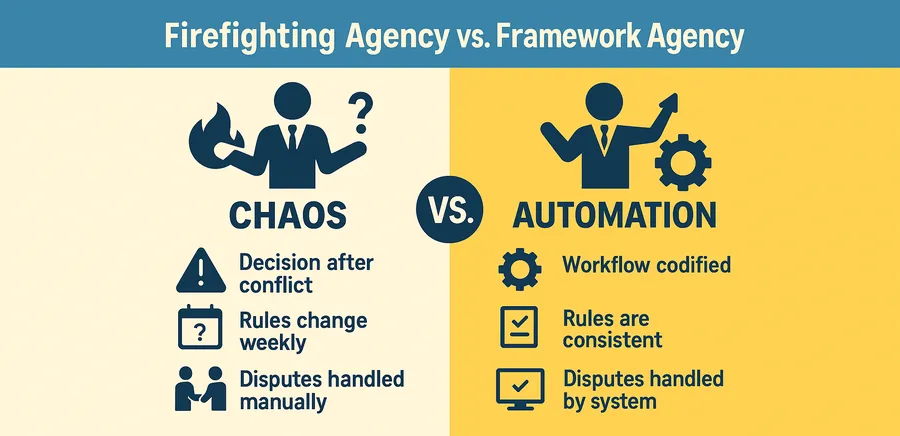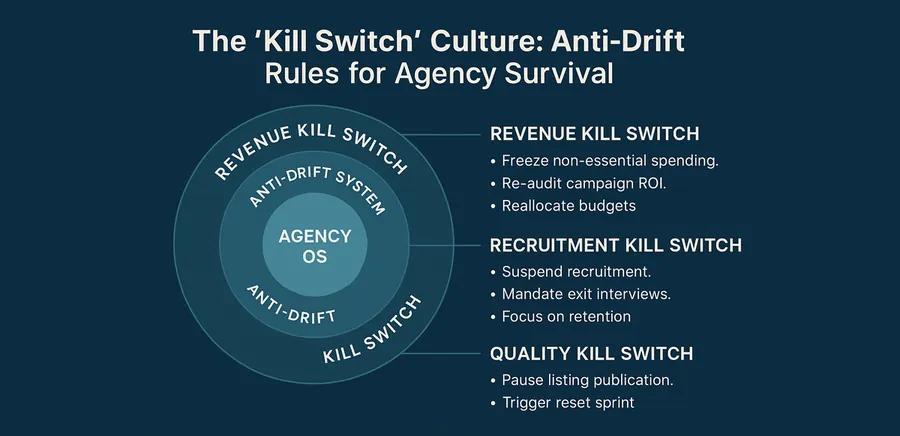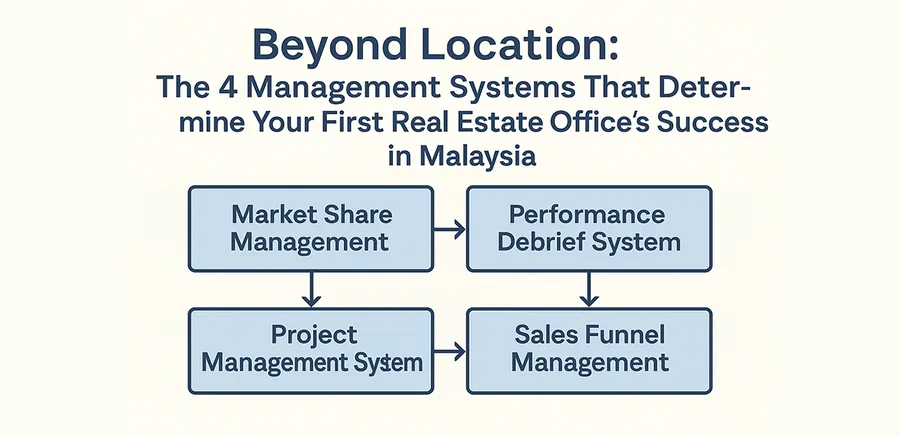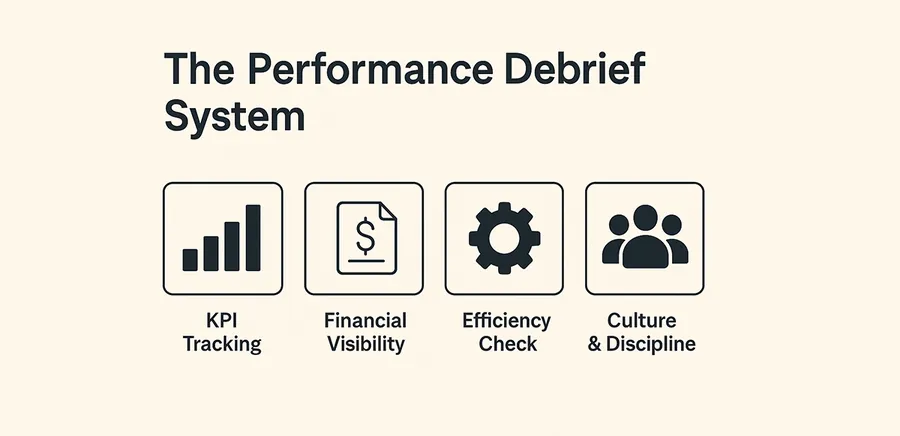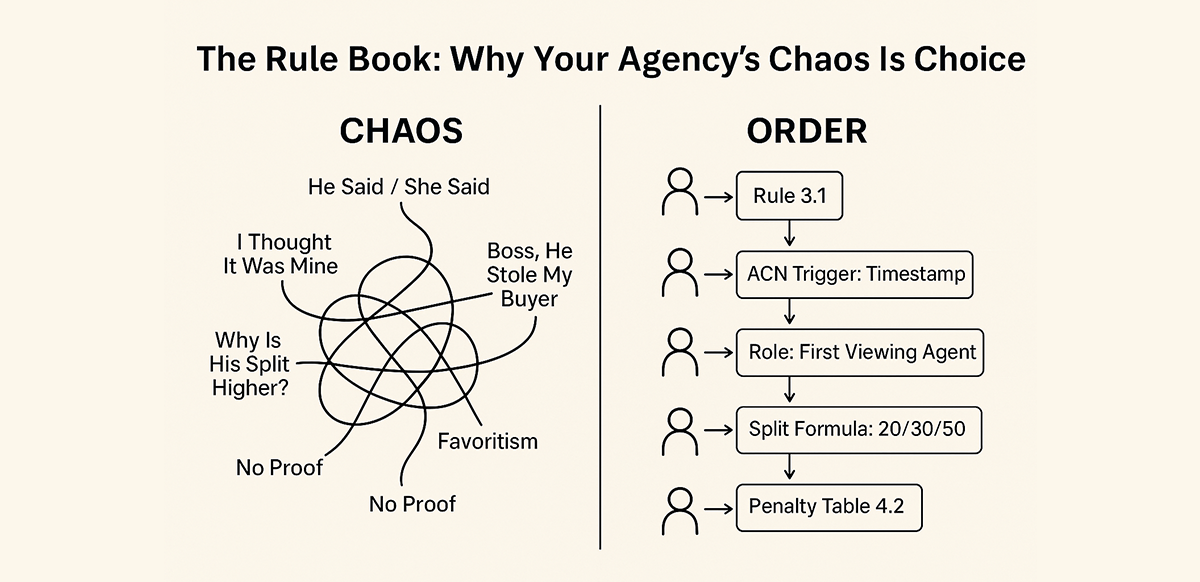
Agency chaos often comes from missing rules, weak enforcement, and unclear workflows. A rule book turns repeated conflict into predictable operating standards.
ListingMine Academy | Governance, Compliance & The ACN Foundation
Most Malaysian real estate agencies do not fail because of “market conditions.” They fail because they operate without written rules.
When nothing is documented, everything becomes negotiable.
When everything is negotiable, chaos becomes the culture.
And when chaos becomes the culture, even good agents leave.
A rule book is not paperwork.
A rule book is the foundation of compliance, trust, and operational stability.
And if an agency wants to move toward ACN-style cooperation, then having a rule book is not optional — it is the minimum requirement.
Below is why.
When rules are verbal, every agent carries a different memory of “what is correct.”
Example: Who Deserves the Split?
Three agents claim the same buyer.
One entered the lead into the system.
One arranged the first viewing.
One closed the deal.
Without rules:
They argue.
The manager becomes the judge.
Someone accuses the company of favoritism.
The customer senses internal dysfunction.
With a written rule book:
Input Agent = Input Credit
First Viewing Agent = Viewing Credit
Closing Agent = Closing Credit
The split formula is documented, predictable, and emotion-free.
Chaos is replaced by structure — instantly.
The real threat isn’t the market.
The real threat is a rookie agent with good intentions but no written rules to stop them.
This is how agencies walk straight into:
Example: Unauthorized Contract Modification
A newbie “helps” a landlord by editing a tenancy clause.
One sentence triggers a legal dispute.
The customer blames the company.
The regulator blames the principal.
A rule book prevents this by stating clearly:
Without written rules, the principal stands defenseless.
Every agency says:
“No private deals.”
“No stealing listings.”
“No lying to customers.”
But unless the rules are written and signed, agents treat them as “guidelines.”
Example: Private Deals (Submit Case Outside)
Some agencies take a firm stance:
The agent is terminated
The team leader in charge is also penalized or removed
This is leadership accountability.
It forces agents to think twice:
“If I cheat, I destroy myself AND my leader.”
The deterrent only works if the rule book clearly defines:
Verbal rules cannot produce compliance. Only written rules can.
High-performing agents rarely leave because of the market. They leave because the company refuses to control unethical colleagues.
Example: Listing Theft
Agent A uploads a verified owner listing.
Agent B copies the photos and posts it as his own.
Without rules: Management hesitates. Arguments escalate. Good agents leave.
With rules:
First verified listing entry owns the case
Duplicates are removed
Listing theft is a punishable offence
Appeal procedures are documented
A rule book protects the agents worth keeping.
Without written rules:
Managers avoid conflict
Agents accuse the company of bias
Punishment depends on mood
With written rules:
Violations → Automatic, predefined consequences
Managers simply enforce policy
Everyone understands how the system works
Governance becomes neutral, not political.
A group of five friends can run on verbal agreements.
A team of twenty cannot.
A company of fifty will collapse.
Culture is not what the founder says.
Culture is what the company writes, trains, and enforces.
A rule book codifies:
It ensures consistency as the agency scales.
Many agencies say they want “cooperation” or “team synergy.” But cooperation without rules always turns into politics.
ACN is not just “sharing listings.”
ACN is role-based proof, event-driven logic, and audited fairness.
To implement ACN, an agency must define:
A. ACN Role Definitions
Clear functions such as:
Undefined roles lead to undefined expectations.
B. ACN Trigger Events
Roles in ACN are not declared — they are earned by proof:
Without proof, ACN becomes a shouting match.
C. ACN Split Logic
An agency must predefine:
When the formula is written, nobody fights.
D. ACN Evidence Standards
Without objective evidence, ACN collapses.
ACN requires:
Written rules
And a system that automatically captures timestamped proof, turning subjective claims into objective, auditable data.
This is where digital ACN infrastructure (like ListingMine) becomes the enforcement engine.
You asked for a strong graphic concept. Here is the breakdown for your designer or image generator:
Panel 1 — CHAOS
Tangled arrows between stick figures labelled:
“He Said / She Said”
“I Thought It Was Mine”
“Boss, He Stole My Buyer”
“Why Is His Split Higher?”
“Favoritism”
“No Proof”
Title: No Rule Book = Chaos
Panel 2 — ORDER
A clean flowchart:
Input → Verification → Viewing → Closing → Documentation
Each step labeled:
“Rule 3.1: Input Credit”
“ACN Trigger: Timestamp”
“Role: First Viewing Agent”
“Split Formula: 20/30/50”
“Penalty Table 4.2”
Title: Rule Book + ACN Rules = Order
Chaos is not an accident. Chaos is a choice.
If an agency refuses to write rules, it chooses:
If it writes the rules — and enforces them — it chooses:
A rule book is not paperwork. A rule book is survival.

Founder of ListingMine and author of Agent for Life. Building ERP for Malaysian real estate agencies since 2008 — and writing to reshape how agencies grow.
More about Marvin Foong →More articles in this topic
This article is one of the sources behind this assessment. Take it to see what you already know and what to read next.
Educational self-assessment. Not a licensing examination or professional certification.