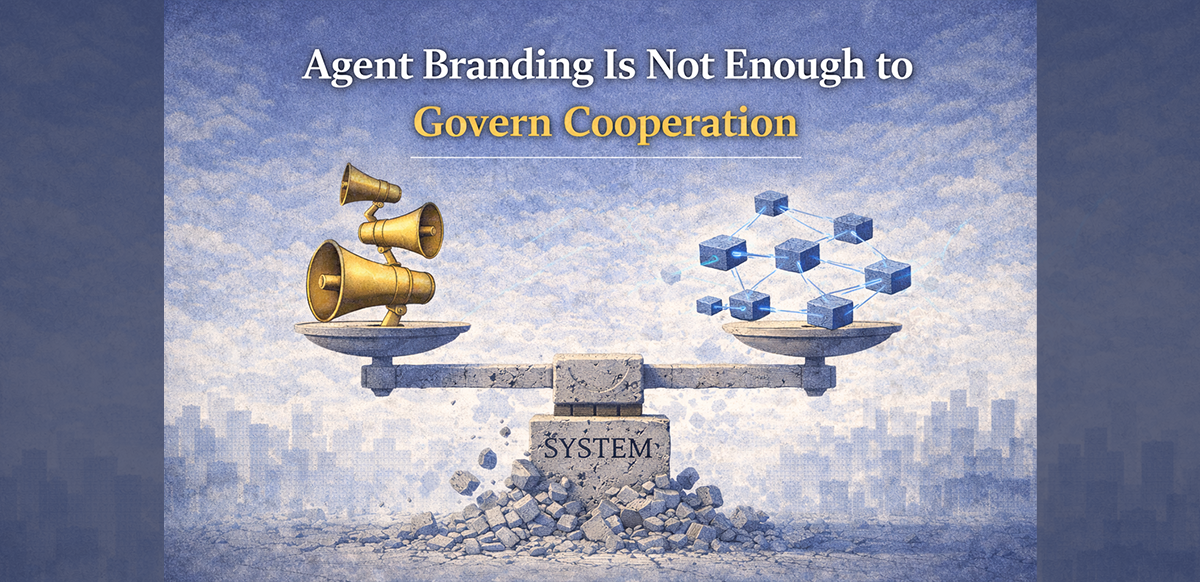
Agent branding can generate leads but cannot govern disputes, roles, and commission sharing. Cooperation requires system-level rules and leadership authority.
At this point, the debate about cooperation is no longer about whether it is "good." It is about why it keeps failing.
Some say it's a mindset problem. Some say it's a money problem. Others say it's a technology problem. All are partially right, but structurally incomplete. The missing conclusion is simple:
Agent Branding alone cannot govern cooperation.
Agents disagree on fundamentals: Leasehold vs. Freehold, Sharing vs. Hoarding, Exclusive vs. Open. These differences aren't caused by ignorance; they are position-dependent beliefs.
An agent's belief is shaped by:
A senior agent with volume naturally believes in control. A junior agent naturally believes in access. Trying to "align beliefs" through branding or culture-building is futile because you are fighting the reality of their differing perspectives.
When belief conflicts with incentive, incentive wins. This is not cynicism; it is human behavior.
Agent Branding is designed to maximize personal leverage and protect individual upside. Therefore, even well-intentioned agents will "defect" from a cooperative system when:
No amount of "alignment" changes the fact that Agent Branding optimizes for the Individual, not the System.
Agent Branding excels at attraction, but it fails at governance. It has no authority. It cannot:
Without authority, cooperation becomes optional. Optional cooperation collapses the moment a high-stakes deal is on the line.
Many agencies confuse loud voices with leadership and high performance with legitimacy.
Influence persuades.
Authority governs.
When cooperation relies on influence, strong personalities dominate and rules become "flexible." This is why most initiatives fail after a few months of early success; the system has no spine to handle the first real conflict between two top producers.
Systems do what personalities cannot: they remove emotion from disputes and make rules non-negotiable.
Durable cooperation in any field—airports, financial markets, or professional sports—is not trust-based; it is rule-based. Trust is the outcome of a system that works consistently, not the prerequisite for it.
Systems do not require everyone to believe the same thing; they simply require compliance.
Agent Branding is not "wrong"—it is simply insufficient. Its role is demand generation and deal execution. However, it must operate inside a governed system, not above it.
When Agent Branding outranks Systems: Structure dissolves into politics.
When Systems outrank Agent Branding: Performance compounds and cooperation becomes the default.
Beliefs will always differ. Incentives will always matter. That is not the problem.
The problem is expecting Agent Branding to do the job of a System. One makes money; the other makes cooperation last. Until agencies accept this hierarchy, no amount of technology or "good intentions" will make a network durable.
Every serious attempt at scale eventually stops debating personalities and starts designing systems.

Founder of ListingMine and author of Agent for Life. Building ERP for Malaysian real estate agencies since 2008 — and writing to reshape how agencies grow.
More about Marvin Foong →More articles in this topic