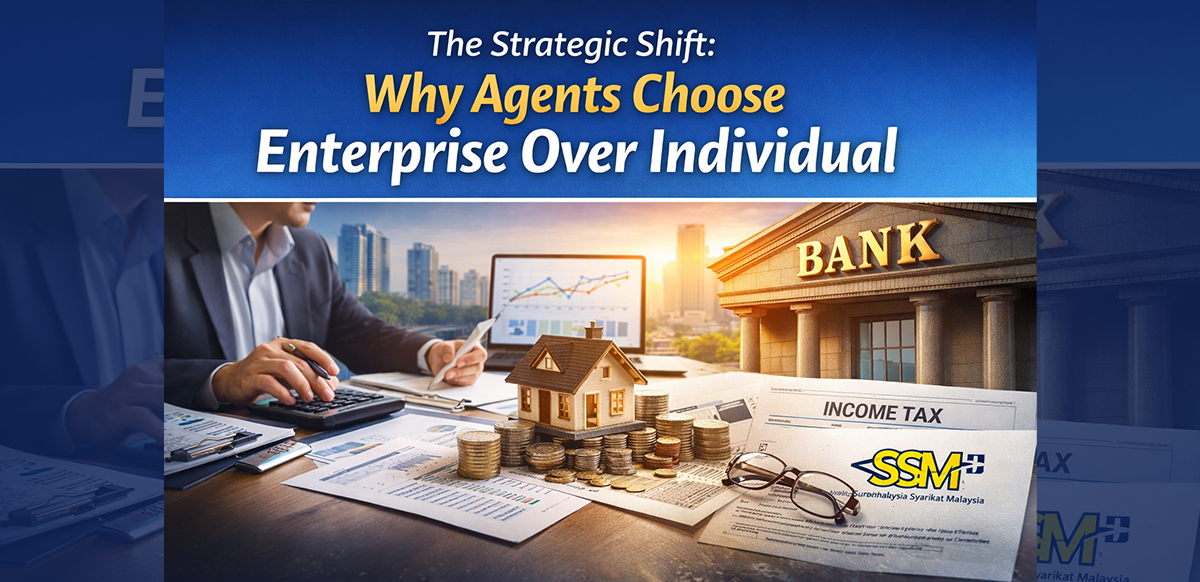
Some agents eventually choose enterprise structures because individual production has limits. Larger systems can provide leverage, brand, support, and scalable income beyond personal selling.
For a high-performing Real Estate Negotiator (REN) or Agent (REA) in Malaysia, requesting commission payments into a Sole Proprietorship (SP) account is neither vanity nor tax evasion.
It is a structural financial decision.
This shift marks the transition from being treated as a commission-only worker to operating as a commercial entity. Below are the real reasons experienced agents prefer this model.
This is the primary driver. The tax rates for individuals and sole proprietorships are identical (0%–30%), but the taxable base is different.
Individual (Form BE): LHDN treats the agent as a natural person earning income. Tax is effectively imposed on gross commission, with very limited room for deducting the real cost of generating that income. Earn RM150,000. Spend RM50,000 to earn it. You are still exposed as if you earned RM150,000.
Sole Proprietorship (Form B): LHDN recognises the activity as a business. Tax is imposed on net profit, not turnover. The math is simple: RM150,000 revenue – RM50,000 legitimate business costs = RM100,000 taxable profit.
The Financial Impact (Year of Assessment 2024/25 Rates):
| Feature | Individual (Personal Name) | Sole Proprietorship (Enterprise) |
|---|---|---|
| Gross Income | RM 150,000 | RM 150,000 |
| Deductible Expenses | RM 0 (approx) | (RM 50,000) |
| Taxable Income | RM 150,000 | RM 100,000 |
| Tax Bracket | 25% | 19% |
| Est. Tax Payable | ~ RM 21,900 | ~ RM 9,400 |
| CASH SAVED | — | ~ RM 12,500 |
Illustrative example only. Actual tax payable depends on personal reliefs, expense substantiation, and prevailing LHDN assessments.
Result: You stop paying tax on money that never belonged to you in the first place. This is not avoidance; it is the correct classification.
Real estate is not a low-expense profession. Under an SP, the agent operates within a framework that legally recognises recurring operational costs, including:
An individual claiming these under personal tax is exposed to scrutiny. A business claiming them is operating exactly as intended.
Property income is lumpy by nature. Months of zero income are often followed by a single large commission.
Personal Income Problem: A one-off RM80,000 payment looks like a "high salary month" to the tax system—ignoring the dry months and sunk costs that came before it.
Business Solution: An SP allows accumulated expenses to be matched against revenue. Crucially, it allows losses in a bad year to be carried forward to offset future profits (currently allowed for up to 10 consecutive years). This protection does not exist for individuals.
Mixing commission income with groceries, family spending, and personal transfers in one savings account is an audit liability.
Business Structure Advantage: Commission flows into a business account; expenses flow out for business purposes. Personal life remains separate.
The Defence: If audited, the agent presents business bank statements—not personal lifestyle records. Clean separation equals clean defence.
Individuals cannot depreciate assets. Businesses can.
Through an SP, agents may claim Capital Allowances on business assets such as laptops, tablets, office furniture, and equipment. This allows essential tools to be written down over time against taxable profit, further reducing tax liability.
Agents change agencies. Their business should not reset each time.
Portability: Operating through an SP preserves bank account history, vendor relationships, and income continuity across agencies.
Banking Perception: Fluctuating personal income looks like an unstable individual. Fluctuating business income looks like operating cashflow. Same volatility, very different risk classification to a bank officer.
While beneficial, this model shifts specific responsibilities to the agent:
1. The Responsibility Shift (No EPF/SOCSO)
The employer-employee dynamic effectively ends.
2. The RM 500,000 "Success Trap" (SST)
This is the most common oversight.
If your taxable service turnover exceeds RM 500,000 in a 12-month period, you may be required to register for service tax, depending on whether your billed services fall within prescribed taxable categories (and the applicable group).
Rate Note: Since 1 March 2024, the standard rate for most taxable services (including Group G Professionals) is 8% (with specific exceptions).
Advice: Once you approach RM 400k/year, consult a tax agent immediately to ensure you don't accidentally trigger SST liabilities.
3. Proper Setup (MSIC Codes)
When registering with SSM, ensure you use a code that aligns with LHDN expectations.
Commonly used MSIC code: 68209 – Real estate activities on a fee or contract basis.
Agents choose the Sole Proprietorship model because it restores tax fairness.
It ensures they are taxed only on what they actually keep—profit—rather than on money that merely passes through their hands to run the business. This is not exploiting a loophole. It is the system finally recognising how the industry actually works.
The information provided in this document is for general educational and informational purposes only and does not constitute professional financial, legal, or tax advice. Tax laws and regulations in Malaysia (including LHDN practices and SST thresholds) are subject to change. Every individual's financial situation is unique. You are strongly advised to consult with a qualified tax consultant, chartered accountant, or professional advisor before making any decisions regarding your business structure or tax filings. The author and distributor of this document assume no liability for any errors, omissions, or actions taken in reliance on this information.

Founder of ListingMine and author of Agent for Life. Building ERP for Malaysian real estate agencies since 2008 — and writing to reshape how agencies grow.
More about Marvin Foong →More articles in this topic
This article is one of the sources behind this assessment. Take it to see what you already know and what to read next.
Educational self-assessment. Not a licensing examination or professional certification.