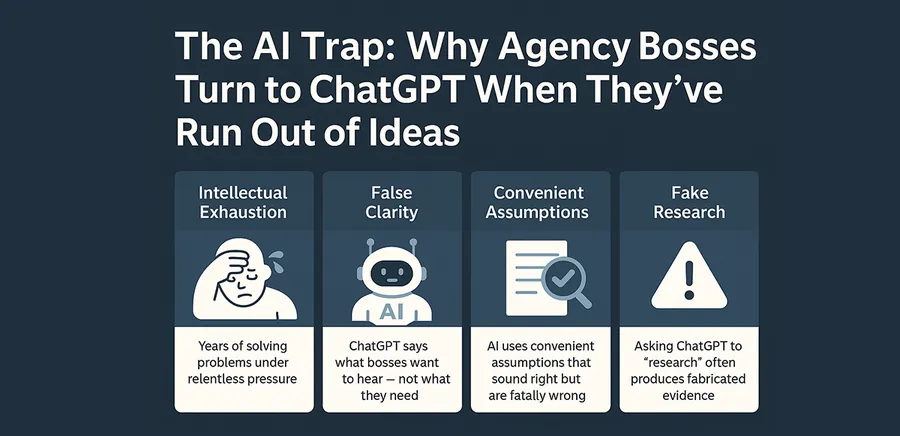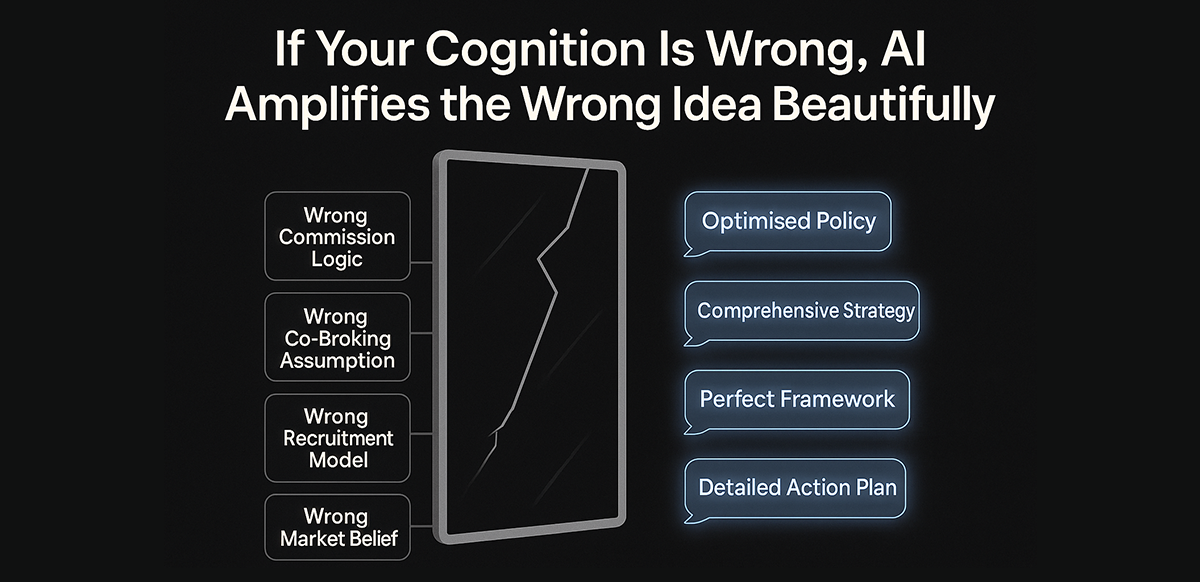
AI can make weak thinking sound convincing if the original business logic is wrong. Good output still depends on correct assumptions, strong judgment, and industry understanding.
ListingMine Academy | Clarity & System Design for Real Estate Leaders
There’s a silent, devastating mistake happening inside Malaysia’s real estate agencies right now.
It’s not a wrong hire, or a bad deal. It’s a thinking error, supercharged by technology.
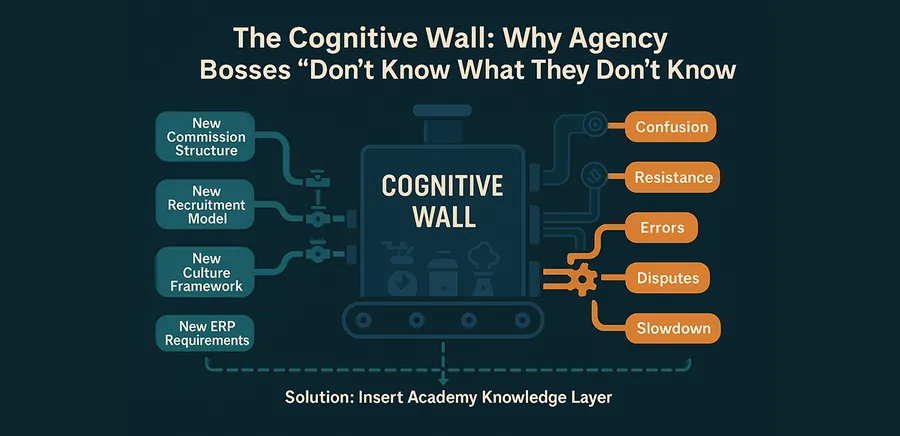
Agency bosses are hitting an invisible cognitive wall. They’re stuck, overwhelmed, and out of ideas. So, they turn to AI for the breakthrough they desperately need.
And they get one. The AI delivers a plan. It’s clear, confident, and beautifully structured. It feels like the answer.
But here is the brutal truth no one is telling them:
If your cognition is wrong, AI doesn’t correct you. It just makes your wrong idea sound brilliant.
And because the plan feels clear, leaders execute it with confidence — accelerating the collapse instead of preventing it.
This is the new path to failure: beautifully articulated, logically framed, and utterly catastrophic business decisions.
Let’s break down why this happens.
Think of AI not as a genius advisor, but as a mirror that reflects your own understanding back at you—polished, expanded, and delivered with unwavering confidence.
If you feed it a flawed commission structure, it won’t say, “This will destroy your cashflow.” It will say, “Here are three ways to optimize and implement this flawed structure.”
If you ask it to design a co-broking policy based on incorrect assumptions, it won’t say, “Malaysian agents will never accept this.” It will draft a “Comprehensive Co-Broking Agreement” for a model that is doomed to fail.
AI reflects the structure of your thinking, not the accuracy of it. It optimizes the expression of an idea, not its underlying truth.
It takes the raw material of your cognition—your assumptions, your biases, your blind spots—and builds a palace out of it. It doesn’t check if the foundation is made of sand.
In the old days, "garbage in, garbage out" meant you got a messy, nonsensical result. It was easy to spot.
Today, it’s different. Now, it’s “Garbage In, Gospel Out.”
You feed the AI:
A vague understanding of BOVAEP rules.
A commission idea you copied from a US realtor blog.
A hope that you can fix agent loyalty with a new bonus.
The AI gives you back:
A polished "Malaysian-Compliant Agency Policy."
A detailed "Tiered Commission & Override Framework."
A "Agent Retention & Performance Incentive Plan."
It all looks real. It sounds professional. The language is perfect. The structure is logical. AI will happily suggest a US-style buyer-agent commission rebate — completely illegal in Malaysia — and present it as a ‘powerful retention incentive.’
But the core is still garbage. The AI has just gilded it. You are now holding a beautifully formatted, perfectly articulated blueprint for failure.
AI is trained on a global dataset. It doesn't understand the unique, unspoken rules of the Malaysian real estate ecosystem.
When you ask it to design a business model, it pulls from:
American MLS logic, which doesn't apply here.
UK tenancy laws, which are irrelevant.
Generic business advice, which misses the point.
The result? It creates beautiful, logical solutions for a market that doesn't exist. AI keeps forcing MLS logic onto Malaysia because that is what the global dataset contains. It has no awareness that Malaysia never adopted MLS — and that ACN, not MLS, is the real trajectory.
It amplifies your own lack of local context by layering on foreign context that is equally wrong.
The Illusion of Progress
AI can make a failing model look sophisticated. It can turn a bad idea into a beautiful PDF. It can convert confusion into confident-sounding structure.
But structure is not strategy. And clarity is not correctness.
The solution is not to abandon AI. The solution is to upgrade your cognition first.
Before you ever prompt an AI, you must become the architect of your own business logic. AI cannot design a system stronger than the mental model you already have. You must build a foundation of understanding that is solid enough for AI to build upon.
Step 1: Diagnose Your Own Blind Spots. What don’t you know? Be brutally honest.
Do you truly understand how 3-tier overrides affect long-term cashflow?
Do you know why your best RENs are actually disloyal?
Can you map the exact points where your co-broking deals break down?
Step 2: Build a Foundation of First-Principles Knowledge. Learn the "physics" of your own agency. This isn't about tips and tricks; it's about understanding the fundamental forces:
Step 3: Use AI as the Builder, Not the Architect. Once you have the correct blueprint in your mind, then deploy AI.
You design the fair, sustainable commission logic. AI writes the policy document.
You map the efficient ACN workflow. AI produces the SOP and role descriptions.
You define the core business strategy. AI helps draft the presentation deck.
AI is the most powerful tool ever created for executing a plan. But it is a dangerous substitute for forming one.
Your primary role as a leader is no longer just to decide. It is to think clearly enough that your decisions are worth amplifying.
The most valuable asset in your agency is no longer your sales team, your listings, or your brand. It is the quality of your thinking.
Because if your cognition is right, AI can help you build an empire.
But if your cognition is wrong, AI will happily help you dig a deeper grave—and make the dirt look like gold.
AI is a multiplier, not a saviour. What it multiplies is up to you.
Upgrade your mind. Then command the machine.

Founder of ListingMine and author of Agent for Life. Building ERP for Malaysian real estate agencies since 2008 — and writing to reshape how agencies grow.
More about Marvin Foong →More articles in this topic