Investors may misunderstand property agents as low-quality or desperate workers rather than transaction infrastructure. The article reframes the industry’s dignity problem and why agents need systems that prove economic value.
A few weeks ago, an investor said something brutally honest to us:
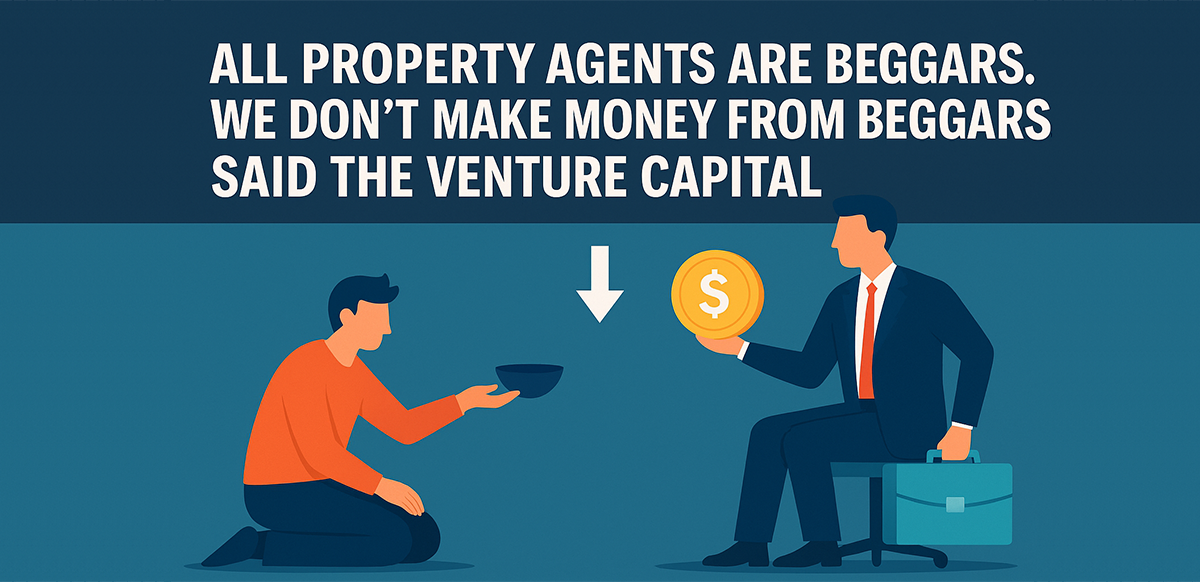
"All property agents are beggars.
We don't make money from beggars."
It sounded offensive.
It felt disrespectful.
But it was not personal.
It was a diagnosis of the industry, not the people in it.
To understand why a venture capitalist would say something so harsh, we must first understand how investors think — and how the traditional Malaysian real estate model looks from their vantage point.
This is not a motivational article.
This is an autopsy of how the market sees the profession — and what must be rebuilt to change it.
In VC language, "beggar" does not refer to poverty.
It means a person or business that:
From an investor's perspective, the traditional Malaysian REN is not a villain.
He is a labour unit inside a broken structure.
Every month, the agent must:
It is not the person who is powerless — it is the model that makes him powerless.
That is what the investor sees.
Venture capital does not invest in people doing work.
It invests in systems that replace or empower those people.
VCs want:
The traditional agent model offers none.
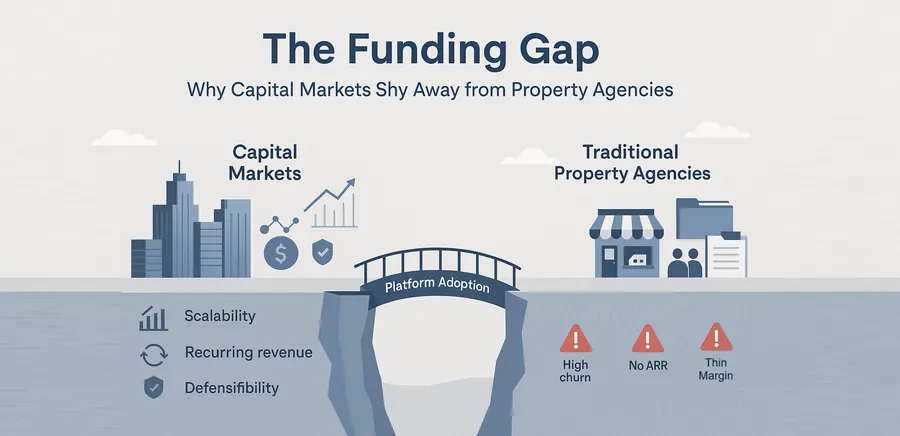
Here is how a VC evaluates the agent industry:
| VC Criterion | Traditional Agent Model | Why They Walk Away |
|---|---|---|
| Scalability | 1 agent = 1 output | Cannot 100x revenue. Labour-bound. |
| Defensibility | Based on personality + hustle | Any competitor can enter tomorrow. |
| Proprietary Asset | Listings? Half fake. Half duplicated. | Nothing to own, nothing to defend. |
| Exit Potential | Zero | You can't IPO someone's phonebook. |
| Recurring Revenue | Zero | Depends on one-off commissions. |
So when a VC says: "We don't make money from beggars."
What they mean is: "We don't make money from businesses that rely on manual labour inside a broken ecosystem. We only invest in platforms that own the ecosystem."
It is not cruel.
It is economics.
Now add another painful truth — the public stigma that property agents inherit the moment they register as REN:
When a parent says:
But when someone says: "My son is a property agent."
The room shifts.
People assume:
This automatic suspicion is what we call the Trust Tax — the psychological penalty the public imposes on agents before they even begin their career.
To a VC, this stigma means:
This is why the investor's sentence, while cruel, is structurally accurate.
The agent is not the problem.
The architecture is the problem.
Agents operate in an industry with:
In such an ecosystem: every agent is forced into beggar economics.
Not because they lack talent.
Not because they lack integrity.
But because the system converts them into beggars.
The VC insult is not directed at the agent.
It is directed at the architecture that fails the agent.
You cannot change the VC's mind by defending agents.
You change it by changing the system.
Here is the transformation:
| The "Beggars" Model | The Investable Model |
|---|---|
| Agents chasing leads | Platform distributing leads algorithmically |
| Fake, duplicate listings | Verified inventory (single source of truth) |
| Random co-broking | ACN-style structured cooperation |
| Manual commission | Automated, role-based governance |
| Trust deficit | Trust infrastructure (proof-of-work, audit logs) |
| Labour-bound income | Platform revenue, data revenue, network revenue |
| No defensibility | High defensibility (roles, data, PDPA/AMLA frameworks) |
The VC will not invest in:
But the VC will invest in:
VCs invest in architecture, not labour.
Build the architecture, and you eliminate the need for begging.
The investor was not saying: "You are worthless."
He was saying: "Your industry is structurally broken. If you want funding, fix the structure — not the people inside it."
This is the mission of ListingMine:
When you build a network, a platform, a cooperation engine, a verified inventory system, a national ACN… you stop being a service.
You become the architect.
And architecture is what investors bankroll.
"Property agents are beggars."
No — they are victims of a design flaw.
"We don't make money from beggars."
Correct — but they will make money from the platform that ends the begging.
The investor's insult is the map.
It points directly to the solution:
That is the future.
And when it arrives, nobody will dare call an agent a beggar again.

Founder of ListingMine and author of Agent for Life. Building ERP for Malaysian real estate agencies since 2008 — and writing to reshape how agencies grow.
More about Marvin Foong →More articles in this topic