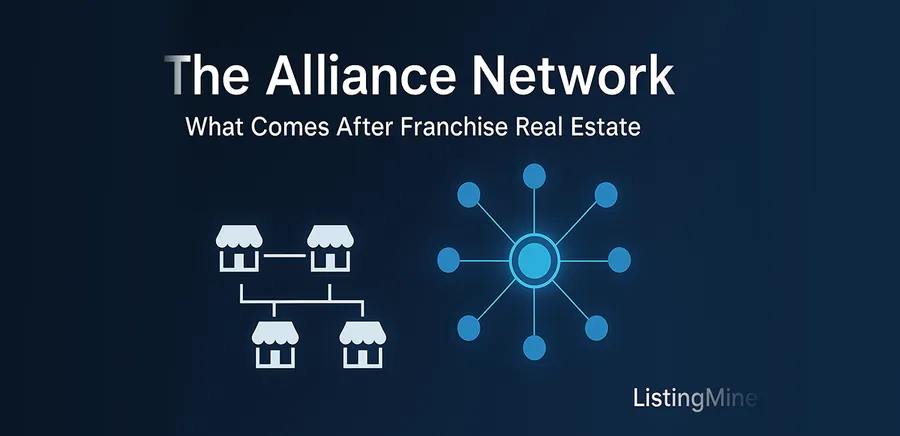
Alliance models may fit Malaysia better than rigid franchises by allowing cooperation without full central control. Agencies can share systems while preserving independence.
The Malaysian real estate industry is in chaos — and that’s not a criticism, it’s a description. Thousands of agencies are fighting for the same agents, the same listings, and the same Facebook leads. Every team claims to have a “system,” but most are still running half their operations through WhatsApp and Excel.
This chaos isn’t failure. It’s the prelude to evolution. Because when chaos matures, it organizes — and that organization won’t come from old-school franchising. It will come from alliances.
The franchise model built the last century of real estate. From RE/MAX to Century 21, franchising thrived because it offered what small firms couldn’t:
In highly regulated markets like the U.S. or U.K., that structure was essential. Agents needed governance. Consumers demanded trust. Regulators enforced uniformity. Franchising was the only way to scale safely.
But Malaysia is not the U.S. It’s a market that rewards speed, flexibility, and relationships — and that’s exactly where the franchise model breaks.
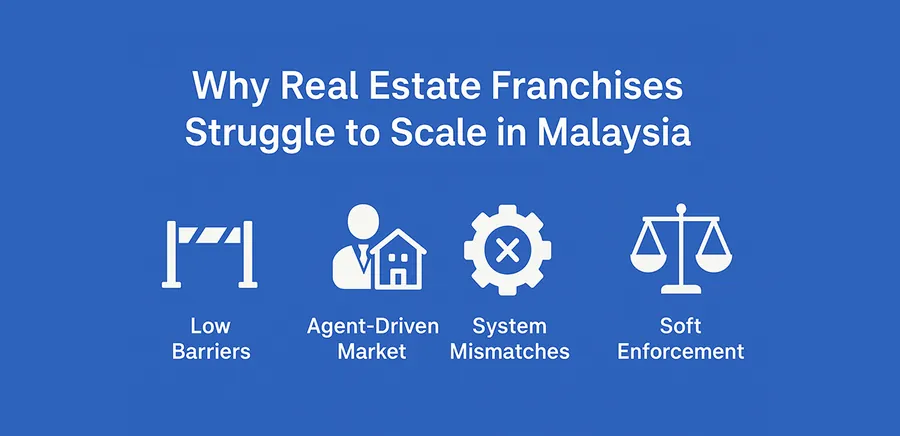
Franchising fails in Malaysia not because the idea is wrong — but because the environment makes it unprofitable and unwanted.
Cultural Misfit: Control in a Freedom Market
Imagine you’re an REA with 80 agents.
You join a global franchise because you’re told the brand will attract clients and top agents.
You pay royalties, follow brand guidelines, and use their global CRM.
But your reality looks like this:
You lose flexibility, you lose margin, and you gain a logo that means little to Malaysian buyers. Because in Malaysia, property deals are personal, not institutional. Clients choose “Jason, who helped my cousin,” not “XYZ Realty.” Agents are the brand — and they don’t want to be managed from above.
“In a fast-moving market, the franchise isn’t a growth engine — it’s a speed limiter.”
Economic Misfit: No Store Productivity, No Scale
Even if the culture problem didn’t exist, the math still kills the model.
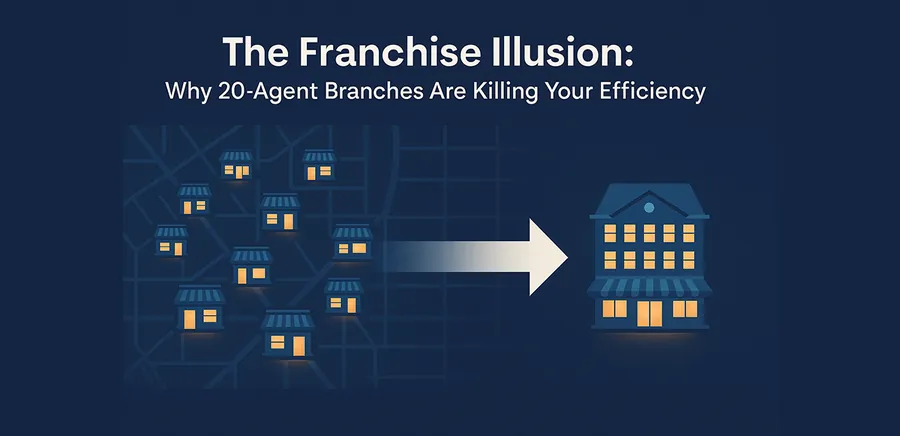
You’ll often see franchise HQs boasting 500 agents nationwide. But each branch — the actual franchisee — only has 10 to 20 agents. That’s poor store productivity — each branch generates too little revenue to sustain its overhead.
With such low headcount per branch:
In the U.S. or Australia, each franchise office supports 200–300 agents, spreading fixed costs efficiently. But in Malaysia, that’s impossible. A 20-person branch can’t afford full-time marketing, admin, and compliance teams — so everyone ends up overworked and underpaid.
The result?
Franchises look large on paper but weak in profit. They multiply offices, not performance.
“Franchise multiplies cost. Alliance multiplies capability.”
Malaysia’s market runs on entrepreneurial freedom today. But that freedom is slowly giving way to proof.
Regulators are tightening the screws:
Soon, agencies won’t be judged by how many agents they have — but by how well they can prove every transaction is compliant, transparent, and auditable.
When that day comes, the market won’t reward size or slogans — it will reward systems. And that’s when franchising will finally evolve into something else.
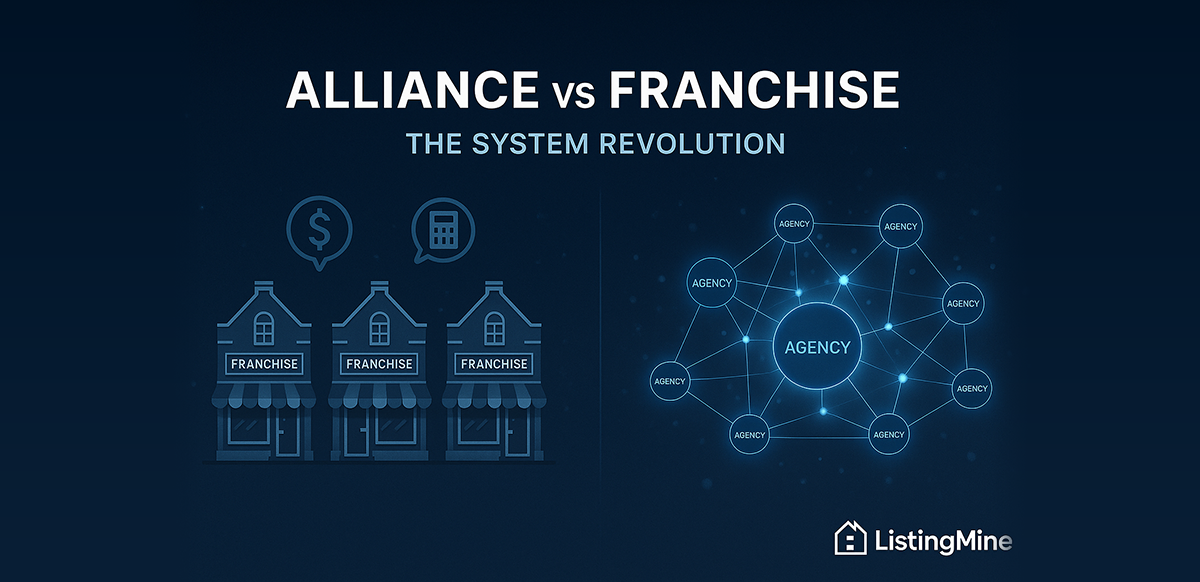
An Alliance isn’t a brand hierarchy — it’s a network built on shared systems, not shared logos. It replaces command with collaboration, and promises with proof.
Where the franchise says “Follow our brand,” the alliance says “Plug into our system.”
| Aspect | Franchise | Alliance |
|---|---|---|
| Ownership | Centralized | Decentralized |
| Identity | One brand for all | Each brand remains unique |
| System Access | Closed to outsiders | Shared across verified agencies |
| Compliance | Top-down enforcement | System-generated proof |
| Growth Model | Duplication of branches | Interconnection of networks |
The Alliance doesn’t suppress independence — it organizes it. It lets agencies cooperate without merging, and scale without losing control.
“Franchise is control. Alliance is coordination with proof.”
This is the foundation of ListingMine’s Alliance ACN (Agent Cooperation Network) — a next-generation system that enables independent agencies to work like a connected ecosystem.
How It Works in Real Life: A Micro-Example
A buyer lead comes in through Agency A’s agent. That agent shares it into an Alliance Group built on ListingMine. Agency B’s agent has the right listing — they arrange the viewing. When the deal closes, the system automatically:
No disputes. No WhatsApp screenshots. No “he said, she said.”
Just automated proof over promise — and both agencies keep their brand, agents, and freedom.
The Alliance Principles
It’s collaboration without surrender — the bridge between today’s free-form chaos and tomorrow’s regulated ecosystem. This isn’t the end of franchising, but the evolution of it.
Franchises won’t vanish overnight — they’ll evolve into system alliances. The next wave of market leaders won’t be those who recruit the most agents, but those who prove the most trust.
The real competition won’t be over brand recognition — it’ll be over data verification. And the winners will be those whose systems make every deal traceable, every agent accountable, and every payout auditable.
That’s not corporate control. That’s digital credibility. And it’s already happening through ListingMine’s Alliance ACN.
“The last generation built empires through control. The next generation will build networks through proof.”
Malaysia is one of the few countries where this transition hasn’t finished — and that’s an advantage. Agency leaders still have time to build alliances instead of dependencies.
To create systems now, before the law requires them.
To lead with proof, not paperwork.
Because once regulation catches up, it’ll be too late to start from scratch.
By then, the alliances will already control the market.
“In the next phase of Malaysia’s real estate industry, those who connect will win.
Not by joining — but by aligning.”

Founder of ListingMine and author of Agent for Life. Building ERP for Malaysian real estate agencies since 2008 — and writing to reshape how agencies grow.
More about Marvin Foong →More articles in this topic
This article is one of the sources behind this assessment. Take it to see what you already know and what to read next.
Educational self-assessment. Not a licensing examination or professional certification.