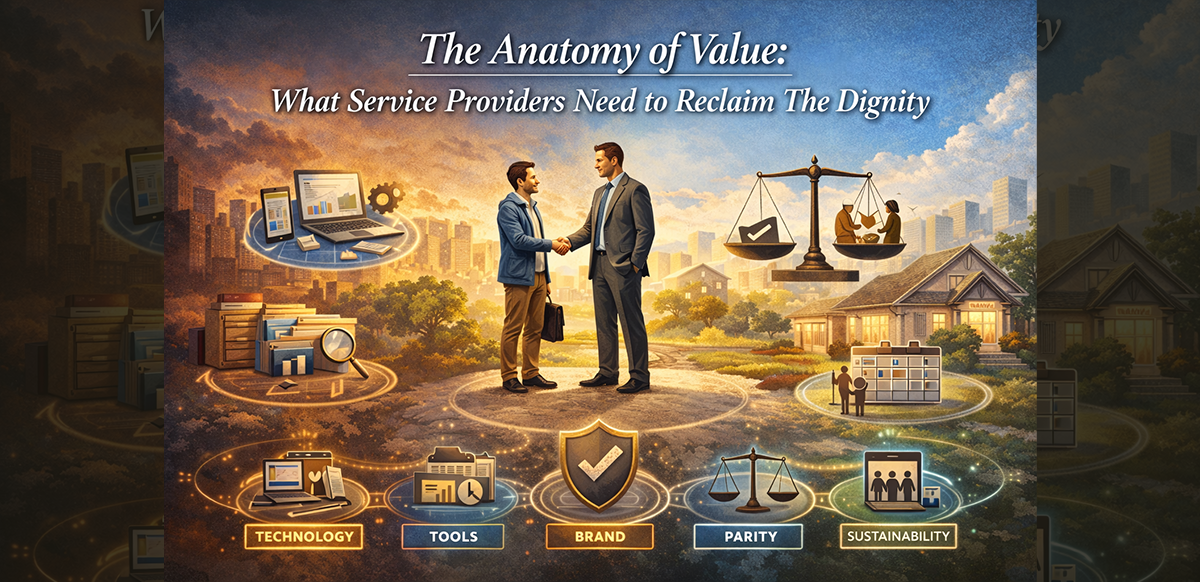
Service providers regain dignity when their value, risk, expertise, and contribution are clearly recognized. Better systems help clients see the work behind the outcome.
For a service provider to earn respect sustainably, they must be equipped to deliver more than just effort. Effort is cheap; Value is structured. If we want agents to move from "commission-chasers" to "dignified advisors," the system must provide six specific conditions. Without these, professionalism is an impossible performance.
Technology should not replace human judgment; it should liberate it.
The Goal: Remove "firefighting."
The Reality: When processes are manual and information is unverified, the provider spends 80% of their time solving disputes and duplicating work.
The Value: Technology provides the "Rails of Trust" (Verified Information, Clear Processes) so the provider can focus on the human side of the deal.
Good intentions do not scale. Tools turn accidental excellence into consistent outcomes.
The Goal: Standardized workflows and shared records.
The Reality: Without tools, the "service" depends entirely on the agent's mood or memory that day.
The Value: Tools ensure that a "High-Dignity" experience happens every time, for every client, regardless of the agent's stress level.
Data allows a provider to advise, not just react.
The Goal: Persistent history and context.
The Reality: Most agents operate in a state of "Professional Amnesia"—they have no data on their past successes or market patterns because the system confiscated it.
The Value: When an agent has data, they can explain decisions with calm authority. Consumers interpret this "Single Source of Truth" as high-level professionalism.
A service provider should not have to prove their legitimacy from zero every time they meet a client.
The Goal: A brand that signals neutrality and standards.
The Reality: In a low-trust market, the agent carries the "stigma" of the industry into every room.
The Value: A credible, system-backed brand (like a "Verified ACN Partner") acts as a shield, setting expectations of fairness before the first word is spoken.
True dignity comes when both sides operate on Equal Informational Footing.
The Goal: Consumers as partners, not targets.
The Reality: Most sales models rely on "Information Asymmetry"—hiding facts to force a closing. This creates a hostile, "predator vs. prey" dynamic.
The Value: Equal standing removes hostility. When everyone sees the same data, the agent moves from "convincing" to "consulting."
This is the most ignored pillar: A provider in survival mode cannot deliver excellence.
The Goal: Balanced life and stable income.
The Reality: An agent who is financially pressured, sleep-deprived, and starting from a "zeroed-out" database every year cannot deliver joy or patience.
The Value: Balance is not a luxury; it is a technical requirement for sustainable professionalism. You cannot give what you do not have.
Consumers do not remember how fast the form was signed or how aggressive the pitch was. They remember the "Emotional Residual" of the transaction.
Did the process feel fair?
Were they treated as an equal?
Was the experience calm or chaotic?
Joy is the byproduct of structural clarity. When the agent is empowered, respected, and balanced, the consumer stops feeling defensive. The transaction stops being a battle and starts being a dignified service.
We do not improve service by telling people to "try harder." We improve it by designing environments where respect is the rational choice. When we equip professionals with the right architecture, we don't just fix a business—we restore the human dignity of the person doing the work. That is what real service looks like.

Founder of ListingMine and author of Agent for Life. Building ERP for Malaysian real estate agencies since 2008 — and writing to reshape how agencies grow.
More about Marvin Foong →More articles in this topic