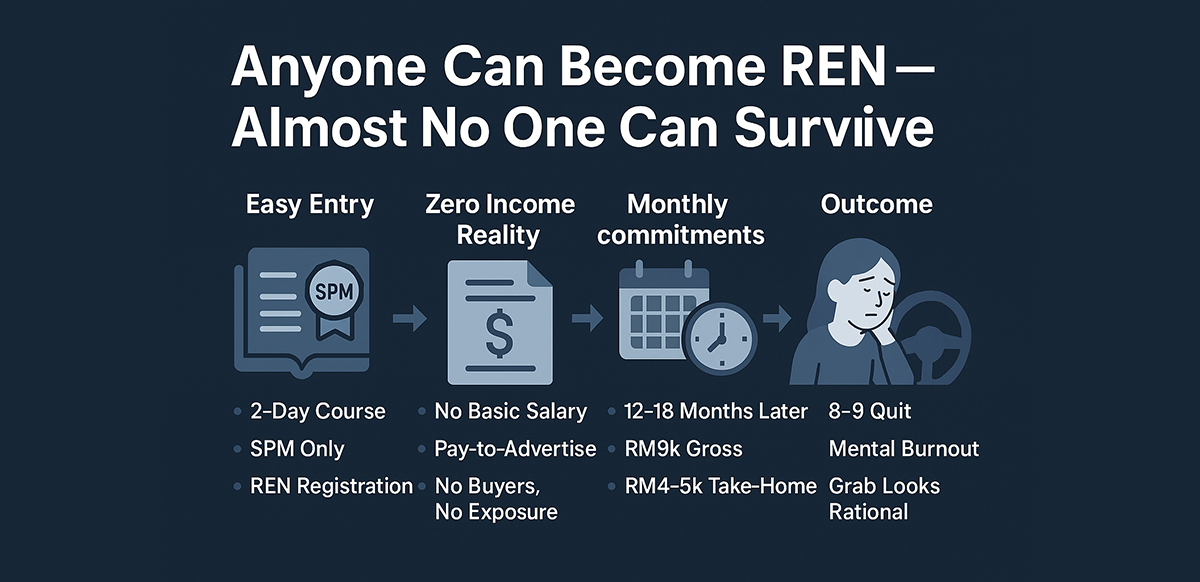
Entry into real estate may be easy, but survival is difficult because income, rejection, skill gaps, and discipline pressure are intense. The real challenge is staying active long enough to mature.
On the surface, becoming a property agent looks simple. Attend a two-day course. Pass the exam. As long as you have SPM, you can register as a REN.
Legally, yes — the door is open. But in reality, definitely not everyone can survive as one.
The industry's low entry barrier creates a dangerous illusion: "If everyone can enter, everyone can succeed."
That assumption is wrong. Out of every 10 people who enter the industry, 8 or 9 will quit before two years. Not because they are lazy. Not because they are incapable. But because the business model is structurally unforgiving. This is a career with no monthly income.
No basic salary. No guaranteed commission. No minimum survival buffer. You only get paid after a deal is completed — and many deals never reach completion.
Most new agents start with the same disadvantage: they have no connections.
No buyer database. No seller pipeline. No referral network.
So what are they told to do?
Now ask a simple question: Which one of these does not require marketing money?
None.
Exposure costs money. Leads cost money. Visibility costs money. If you choose not to pay, then answer this honestly:
Where are your buyers?
Where is your exposure?
Who even knows you exist?
While income is zero, expenses are relentless. You still need to:
Every month, money flows out — with no certainty of money flowing in. This mismatch doesn't just hurt financially. It creates psychological pressure.
Here's the part that breaks most people emotionally. Let's say you do survive. You grind for 12 to 18 months. You finally close your first deal.
On paper:
RM500,000 property
RM15,000 gross commission
But in reality, after:
You take home around RM7,000–RM8,000. That single cheque arrives after 7 months of negative cash flow — and it is expected to repay:
Most people can't handle that math. Not financially. And certainly not psychologically.
That's why many don't quit before their first deal — they quit after, when they realise how long it took and how little was left.
Driving Grab may not sound prestigious. But Grab offers:
For someone under constant financial pressure, stability beats upside. So people choose certainty over hope. Survival over aspiration. And the industry quietly loses another agent — not because they failed, but because the structure failed them.
This is not a career for everyone — at least, not under the current rules. We blame agents for quitting. We call them "soft." But if a system fails 9 out of 10 people, the people are not the problem. The model is the problem.
The industry doesn't need more motivation. It doesn't need louder recruitment talks. It needs a re-architecture. It needs a model where:
The system is broken. It's time we stopped pretending it works — and started building the one that does.
This article should be mandatory reading for every wide-eyed 22-year-old who thinks "I like houses and I'm good with people" is enough to survive this business.

Founder of ListingMine and author of Agent for Life. Building ERP for Malaysian real estate agencies since 2008 — and writing to reshape how agencies grow.
More about Marvin Foong →More articles in this topic
This article is one of the sources behind this assessment. Take it to see what you already know and what to read next.
Educational self-assessment. Not a licensing examination or professional certification.