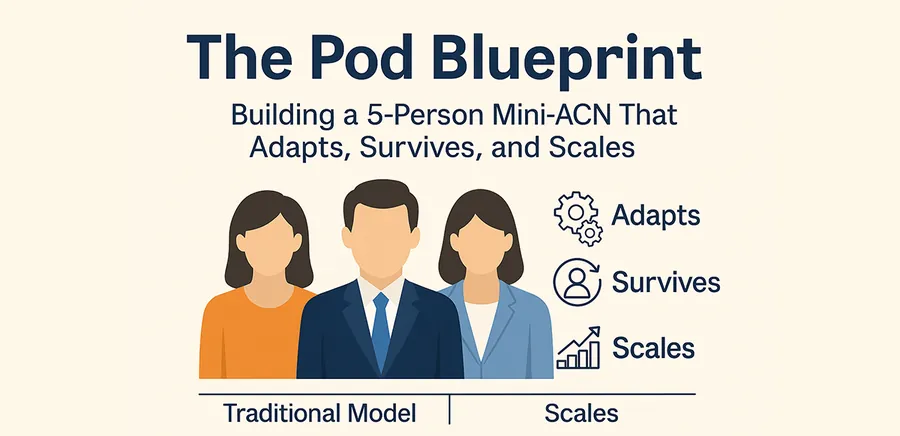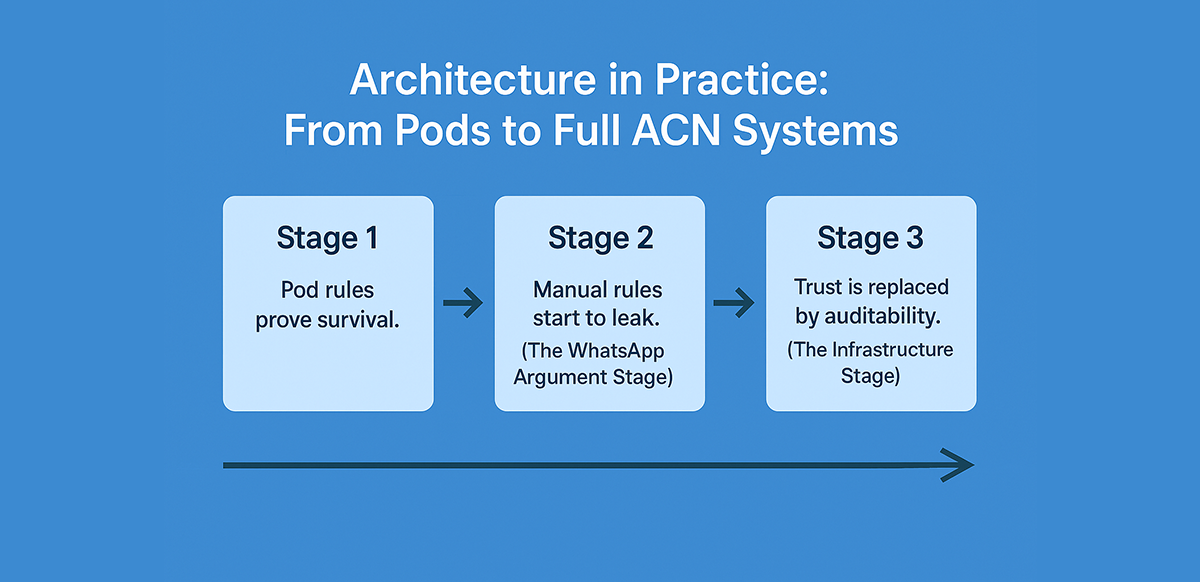
ACN can start with small pods and expand into larger cooperation systems. Scaling requires role clarity, workflow design, and commission logic that can grow with the team.
Pods are not the destination. They are the first stable form that appears when survival is finally engineered. Once a pod works, something predictable happens: it stops being enough.
More listings arrive. More leads flow in. More roles emerge. More coordination is required. At that point, the question is no longer whether cooperation works — but how far it can scale before collapsing. That is where architecture matters.
A pod is a micro-architecture:
It stabilises individuals. But pods have limits:
What worked at 5 people starts to strain at 15. What worked at 15 breaks at 50. This is not failure. This is growth pressure.
Every successful pod eventually follows the same path:
This stage runs on goodwill and proximity. It works because everyone can still “see everything.”
Pods replicate by function or geography
This is the stage where:
Nothing is broken yet — but trust is now doing work that systems should have done. This is the ceiling of manual coordination.
Shared inventory across pods
At this point:
The system has already become an Agent Cooperation Network — whether anyone calls it that or not.
The difference is no longer culture. It is infrastructure.
When pods scale without architecture, four failures appear:
Allocation becomes subjective again. Trust is asked to referee incentives.
Operators feel invisible. Media wants upside. Closers feel overloaded. Without role accounting, resentment compounds.
Listings get hoarded. Visibility becomes uneven. Solo incentives quietly return.
Someone becomes the human spreadsheet. Burnout simply moves up the hierarchy. This is where many “cooperative teams” revert to control — not because control is better, but because architecture was missing.
A full ACN does not change pod logic. It stabilises it at scale. The architecture adds what pods cannot maintain manually:
Listings become shared infrastructure:
Value compounds instead of fragmenting.
Roles are no longer implied — they are defined:
Each role has inputs, outputs, and measurable contributions. Debate disappears.
Instead of memory, the system records:
Commission follows events, not arguments. Trust becomes optional.
Cooperation is no longer permission-based. It is default behaviour.
Agents do not need to agree to cooperate — the system makes cooperation the path of least resistance.
The hardest transition is not technical.
It is psychological.
Leaders must stop asking:
“How do I control my team?”
And start asking:
“What rails do they operate on?”
Control scales poorly.
Architecture scales cleanly.
When rules, visibility, and incentives align, behaviour follows automatically.
An ACN is not hierarchy.
It is:
People move between roles.
Pods form and dissolve.
Specialisation deepens.
The system remains stable because architecture does not care who plays the role — only that the role is fulfilled.
In a mature ACN:
This is when the industry becomes professional.
Not because people behave better —
but because the system finally deserves better behaviour.
Pods prove one thing:
Survival can be engineered.
ACN proves the next:
Survival can scale without collapsing into politics.
The industry does not need more motivation.
It needs architecture.
And architecture, once built, does not argue.
It simply works.

Founder of ListingMine and author of Agent for Life. Building ERP for Malaysian real estate agencies since 2008 — and writing to reshape how agencies grow.
More about Marvin Foong →More articles in this topic
This article is one of the sources behind this assessment. Take it to see what you already know and what to read next.
Educational self-assessment. Not a licensing examination or professional certification.