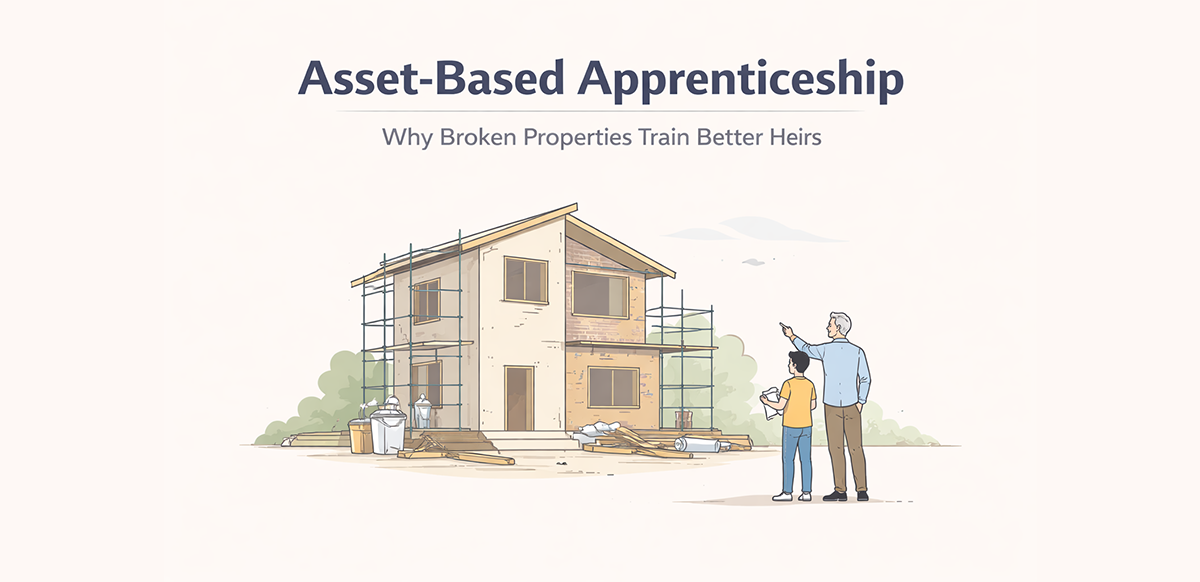
Broken or difficult properties can teach heirs practical lessons about maintenance, tenants, negotiation, cash flow, and ownership responsibility. Real assets become training grounds for judgment.
In high-net-worth families, property purchases are often misunderstood by the public. Observers assume every acquisition must be optimized for yield, appreciation, or portfolio balance. But quietly, a different logic operates—one that has nothing to do with maximizing immediate returns and everything to do with training human judgment.
This is Asset-Based Apprenticeship: the deliberate use of imperfect, even “bad” assets as a controlled environment for teaching heirs how to convert chaos into value.
A clean, fully stabilized asset teaches almost nothing. When a property has a clear title, a strong tenant, and predictable cash flow, all decisions are obvious. Mistakes are rare because the system is already working.
For an heir, this creates a dangerous illusion: that wealth is preserved by choosing correctly once, rather than by continuously correcting under uncertainty.
Broken assets do the opposite. They force the learner to confront:
Broken assets simulate reality; perfect assets simulate a spreadsheet.
HNWI families don’t buy random lemons. They buy educationally rich problems. These are assets broken just enough to demand thinking, but not enough to destroy the family office.
Common examples include:
Property is uniquely suited for apprenticeship because it is multi-disciplinary and tangible. Unlike stocks or crypto, property forces the learner to engage with people, not just numbers.
This is not investment education; it is judgment education.
Crucially, heirs are not thrown in alone. This operates under a Supervised Risk Framework.
The goal is to build pattern recognition: knowing which risks are survivable and which people are extractive.
To a conventional investor, buying a property with "too many problems" looks inefficient.
But the family knows a secret:
The asset is not the product; the heir is.
The family is not allocating capital to real estate; they are allocating capital to human capability. A "bad" property that produces a competent, calm, and ethical decision-maker is far more valuable than a "good" property that produces a complacent beneficiary.
This is where Asset-Based Apprenticeship meets the concept of Stewardship Capital. HNW buyers may deliberately transact through younger, honest agents or tolerate technical inefficiencies because they are evaluating alignment over polish.
They are looking for partners who will grow with the heir—people who show kindness and integrity under the friction of a difficult deal.
The most valuable output of capital is not income; it is competence under uncertainty.
Broken properties are not mistakes in these families; they are classrooms.
Families that understand this are not trying to protect the next generation from problems—they are training them to solve them.
In a world of increasing complexity, the ability to solve a messy problem calmly is the only skill that actually compounds across decades.

Founder of ListingMine and author of Agent for Life. Building ERP for Malaysian real estate agencies since 2008 — and writing to reshape how agencies grow.
More about Marvin Foong →More articles in this topic