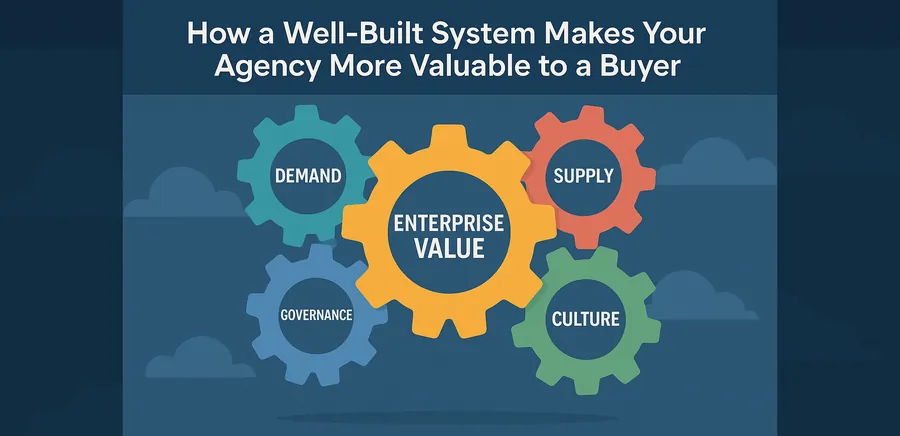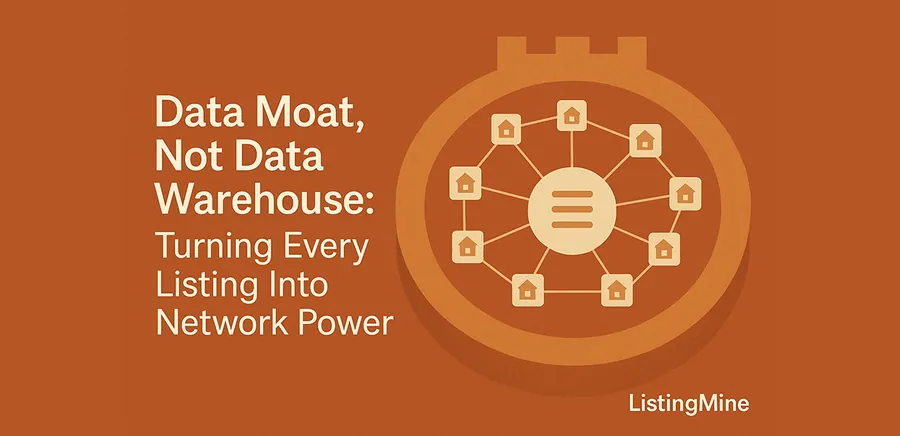
Agencies can build value through data, intellectual property, systems, and distribution without heavy physical assets. Asset-light structure can create scalable enterprise value.
For decades, the dominant business model in real estate has been simple: recruit agents, close transactions, earn commissions. The underlying assumption is that the only path to growth is more people, more listings, and more closings.
That model still works—but it is a linear engine that cannot create true, compounding enterprise value.
A commission-based agency can generate excellent income, but it rarely becomes an appreciating asset. The moment the principal stops working, revenue stops with them. The business behaves like a well-paid job, not a defensible, transferable, or acquirable system.
The next generation of high-value real estate firms will not be defined by headcount or branch networks. They will be defined by what they own, not what they do.
They are moving from a service model to an asset-light model, where the real wealth is generated by proprietary data, intellectual property (IP), and brand power that scale independently of human labor. These assets work continuously, compound in value, and can be monetized without a single agent attached to every dollar.
The agencies that understand this shift will build something far more enduring than annual commission income. They will build equity.
A commission-only business has three built-in ceilings that cap its growth and its ultimate valuation:
A business that depends on activity cannot command the valuation of a business that depends on ownership.
The asset-light agency builds compounding value around three forms of capital that do not require physical expansion or linear headcount growth.
Information is transformed into an income-producing asset.
Most agencies collect data passively. Asset-light agencies structure and monetize it.
Examples of Monetizable Data: Hyper-local pricing intelligence across micro-neighborhoods; real-time buyer behaviour segmentation; and predictive demand curves for developers and investors.
How it creates wealth: Internally, it enables faster, more accurate pricing decisions and higher conversion rates. Externally, it is sold as paid data products, developer reporting subscriptions, or analyst-grade insights for institutional buyers.
Data separates the market participant from the market shaper.
Your agency's operating system becomes a licensable product.
This includes codified assets like: Training frameworks, signature valuation methodologies, negotiation scripts, Standard Operating Procedures (SOPs), and proprietary playbooks.
How it creates wealth: It ensures consistency of output regardless of individual talent and drastically accelerates agent ramp-up time. Most importantly, it creates the ability to license the OS to partner agencies or use it as the foundation for a robust franchise network.
When knowledge is codified, the agency no longer relies on people—people rely on the agency.
A reputation engine that reduces cost and increases margin.
A strong agency brand is not defined by size, but by specialized authority.
Examples: "The most trusted subsale valuation firm in [Region]" or "The No. 1 data-driven agency for investor-grade new builds."
How it creates wealth: It generates premium pricing power, achieves a lower client acquisition cost (due to inbound interest), and unlocks strategic partnerships that deliver deal flow without continuous outbound effort.
A brand with gravity produces revenue without having to chase it.
| Metric | Traditional Agency | Asset-Light Agency |
|---|---|---|
| Primary Revenue | Commissions | Commissions + Data/IP/Brand Monetization |
| Scalability | Linear (Requires more people/offices) | Non-linear (Assets scale without people) |
| Risk Profile | Founder- and people-dependent | System- and asset-dependent |
| Valuation Multiple | 3–4x EBITDA | 6–8x EBITDA or higher |
The key distinction: One model sells effort. The other owns leverage.
The shift does not require abandoning transactions. It requires building assets in parallel.
The asset-light model only works when data, knowledge, and systems are captured, structured, and instantly activated inside a single operating layer.
ListingMine was designed precisely for this transition—not just to record transactions, but to instantly turn them into proprietary intelligence and reusable IP. It enables:
It is the infrastructure layer an agency needs to evolve from commission income to enduring enterprise value.
The real question is no longer: How many deals can we close?
But rather: What do we own that produces value even when we are not closing deals?
Stop selling time. Start building assets. That is how an agency becomes a company worth acquiring, not just a business that earns.

Founder of ListingMine and author of Agent for Life. Building ERP for Malaysian real estate agencies since 2008 — and writing to reshape how agencies grow.
More about Marvin Foong →More articles in this topic