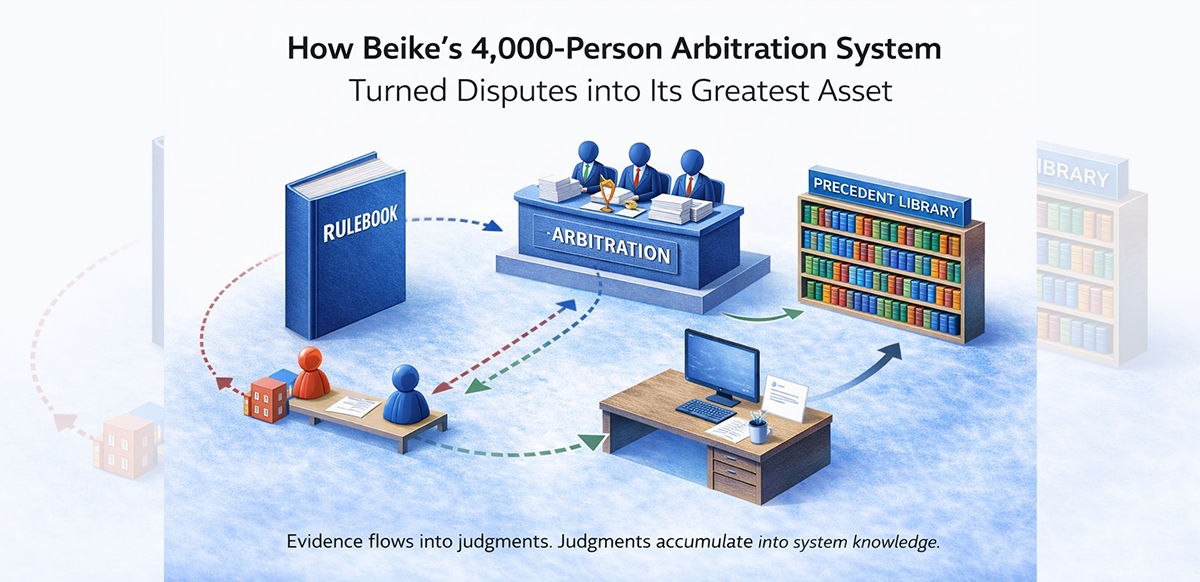
Beike shows how dispute resolution can become a core platform asset. Strong arbitration builds trust, protects cooperation, and makes large networks more scalable.
When people study Beike's Agent Cooperation Network (ACN), they usually focus on the rules: no hidden listings, protected buyer introductions, defined agent roles, and automatic commission splits. These rules look clean—almost perfect.
But they are only half the system. The other half exists because no rulebook is ever complete—and in the messy reality of property transactions, the moment rules end, disputes begin. Most agencies treat disputes as a cost to be eliminated. Beike treated them as an input to be engineered.
ACN is often misunderstood as a collection of rules. It is not. ACN is a coordination engine. Its purpose is to convert informal cooperation—WhatsApp messages, verbal understandings, and personal trust—into formal, enforceable logic. This logic determines:
This is why ACN scales better than trust-based systems. However, every rule-based system has a fundamental limitation: it cannot anticipate every real-world scenario. At small scale, disputes are rare and manageable; at large scale, disputes grow faster than trust.
Blind spots appear when rules conflict or a scenario occurs that was never designed for. For example, two agents might both claim a "first viewing" because one introduced the buyer verbally while the other logged it in the system ten minutes later.
At this point, rules alone cannot decide. This is where most agencies fail. They either escalate the issue to the boss or suppress the conflict until cooperation collapses. Beike chose a third path: Structural Arbitration.
According to Reinventing Platforms (Gao Jun & Luo Yining, 2025), Beike's ACN operates as a rule-based coordination engine. However, the authors emphasize that no rule system can fully cover real-world operations. To address rule blind spots, Beike introduced a formal arbitration mechanism in 2018.
By the end of 2023, this system operated across 72 cities with over 4,000 trained agent-arbitrators. It is important to note: this is not legal arbitration, but operational judgment embedded inside the network.
Beike deliberately staffed these panels with agents, not compliance officers or HQ executives. This is because legitimacy in a network depends on peer judgment, not authority.
In Beike's logic, arbitration protects the integrity of the entire network. One unresolved dispute poisons multiple future cooperations. By preventing this "contagion," arbitration preserves market liquidity. Without a dispute-to-rule feedback loop, cooperation doesn't fail loudly—it quietly decays.
Beike's arbitration system performs two functions simultaneously:
Disputes are how a rule-based system learns. Without arbitration, blind spots accumulate. With arbitration, blind spots are systematically removed. Through this loop, rules evolve into durable industry infrastructure.
In many Malaysian agencies, disputes are resolved by principals or team leaders. Even when these leaders are fair, three structural failures occur:
When judgment lives in a person, the system stays static. When judgment lives in a process, the system compounds.
Malaysia does not need thousands of arbitrators, but it does need the same logic. A serious agency can start with a neutral jurisdiction panel and written outcomes to create "case law."
One honest warning: In the early phase, arbitration increases visible conflict because hidden conflict is finally surfaced. Agents will test boundaries. But this short-term discomfort is the prerequisite for long-term stability.
ACN succeeds not because its rules are perfect, but because they are improvable. Rules create cooperation; cooperation exposes blind spots; blind spots create disputes; and disputes refine the rules.
Most agencies stop at rules. Some rely on culture. Beike built the full loop. In the long run, the agencies that win will not be those with the loudest leaders or the "nicest" culture. They will be the ones with systems capable of learning from their own friction, because that is how rule-based networks become truly powerful. Any rule-based network that refuses to learn from its own disputes will eventually be replaced by one that does.

Founder of ListingMine and author of Agent for Life. Building ERP for Malaysian real estate agencies since 2008 — and writing to reshape how agencies grow.
More about Marvin Foong →More articles in this topic
This article is one of the sources behind this assessment. Take it to see what you already know and what to read next.
Educational self-assessment. Not a licensing examination or professional certification.