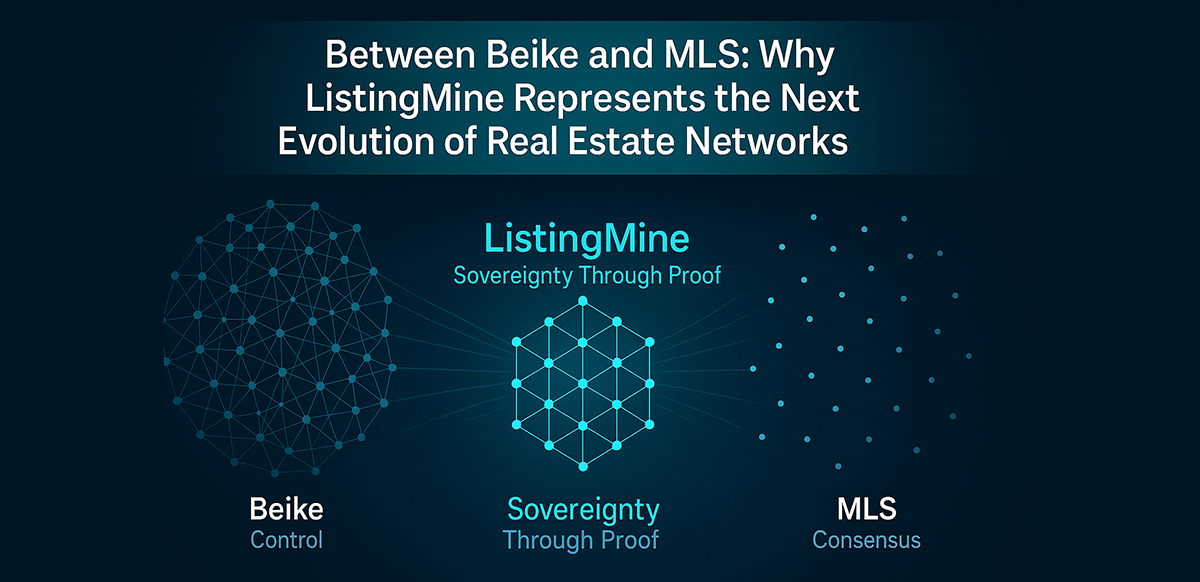
ListingMine is positioned between Beike-style ACN and MLS-style cooperation. It aims to fit Malaysia’s need for structured collaboration without copying either model blindly.
Most agency founders think the future of real estate platforms will look like either Beike (corporate control) or MLS (member cooperation).
But the truth sits somewhere in between — a space that combines Beike's efficiency with MLS's fairness, without inheriting their flaws.
That space is ListingMine.
And understanding where ListingMine sits between these two giants explains why it represents the next evolution of real estate networks — one built for independent sovereignty, not central control.
Beike (贝壳找房) transformed China's property industry by creating the Agent Cooperation Network (ACN) — a standardized, role-based system where every transaction is verified and audited.
It was a masterclass in execution.
Beike solved chaos by imposing structure — standardizing listings, defining agent roles, and automating commission splits.
But Beike's structure came at a cost:
Beike's ACN built fairness through control.
It was efficient, but not free.
The Multiple Listing Service (MLS), born in the United States over a century ago, had a very different philosophy.
It was built on trust through openness — agents and brokers pooling data to help one another close deals.
Its strengths were transparency and shared access.
Its weaknesses were bureaucracy and stagnation.
Because MLS is run by committees and associations, innovation is slow.
It ensures fairness, but not adaptability.
Everyone has a seat at the table — yet no one can move the table forward.
MLS built fairness through consensus.
It was fair, but not fast.
ListingMine takes the efficiency of Beike and the integrity of MLS, but evolves both into something new: a Distributed Agent Cooperation Network (Distributed ACN) where each agency governs its own system using shared rules of proof and audit.
In other words,
Beike unified control.
MLS unified data.
ListingMine unifies sovereignty.
Here's how the models compare:
| Aspect | Beike (Corporate ACN) | MLS (Open Cooperative) | ListingMine (Distributed ACN) |
|---|---|---|---|
| Governance | Centralized under one company | Decentralized under boards | Distributed — each agency governs its own ACN within a shared protocol |
| Ownership | Platform-owned | Member-owned | Agency-owned (SaaS sovereignty) |
| Trust Model | Control-based | Consensus-based | Proof-based (event + audit trail) |
| Purpose | Monetize participation | Ensure fairness | Scale sovereignty |
| Economics | Commission revenue, platform fees | Membership dues | Subscription + transaction rails |
| Data Rights | Owned by platform | Shared across members | Owned by each agency (PDPA-compliant) |
| Culture | Corporate standardization | Cooperative ethics | Entrepreneurial independence |
| Outcome | Scalable but dependent | Fair but stagnant | Scalable and sovereign |
Beike's ACN was revolutionary — but it was born inside a brokerage.
Its purpose was to strengthen Lianjia's control, not distribute it.
Even as Beike opened its platform to others, the power remained centralized: the company controlled the listings, payout logic, and data governance.
ListingMine's design flips that completely.
A. Beike Owns the Platform — ListingMine Powers the Platforms
Beike is a network host.
ListingMine is a network enabler.
Every agency using ListingMine runs its own ERP + ACN system — their data, their agents, their governance.
ListingMine doesn't own the network; it provides the rails for agencies to build their own.
Beike runs one giant ACN.
ListingMine powers thousands of independent ones.
B. Beike Defines Fairness — ListingMine Lets You Define It
Beike's rules are fixed. Its philosophy of fairness is corporate law.
If you want to change commission logic or role structures, you adapt to their system.
ListingMine flips that power dynamic.
Agencies define their own proof rules, commission logic, and event-based entitlements — while the system ensures every transaction remains auditable, compliant, and fair.
Fairness isn't imposed — it's codified by each agency.
C. Beike Owns the Data — ListingMine Protects It
In Beike's network, data belongs to the platform.
Agents and agencies are participants, not owners.
ListingMine is PDPA-first by design.
Each agency owns its data, its contacts, and its listings.
The system simply provides the encryption, version control, and audit trails to make that sovereignty real.
D. Beike Scales Compliance — ListingMine Scales Freedom
Beike scaled by enforcing rules.
ListingMine scales by enabling governance.
It's the difference between a regulated empire and a network of empowered nations.
Beike's strength was control.
ListingMine's strength is independence through structure — allowing agility without chaos, and collaboration without surrender.
| Phase | Era | Model | Governance Type | Philosophy |
|---|---|---|---|---|
| 1. MLS Era | 1900s–1990s | Cooperative | Non-profit | Fairness through community |
| 2. Beike Era | 2010s–2020s | Corporate | Centralized | Fairness through control |
| 3. ListingMine Era | 2025s– | Distributed | Sovereign | Fairness through proof |
Beike built trust through control.
MLS built trust through consensus.
ListingMine builds trust through proof.
That's the next paradigm.
Instead of corporate dependency or institutional bureaucracy, ListingMine enables a third path:
independent, verifiable, and self-governing agency systems.
The future of real estate isn't owned by any single platform.
It belongs to agencies that govern themselves — transparently, efficiently, and independently.
Beike proved cooperation could scale.
MLS proved fairness could endure.
ListingMine proves sovereignty can scale.
And that's why it stands right between the two — not as a copy of either, but as the evolution of both.

Founder of ListingMine and author of Agent for Life. Building ERP for Malaysian real estate agencies since 2008 — and writing to reshape how agencies grow.
More about Marvin Foong →More articles in this topic
This article is one of the sources behind this assessment. Take it to see what you already know and what to read next.
Educational self-assessment. Not a licensing examination or professional certification.