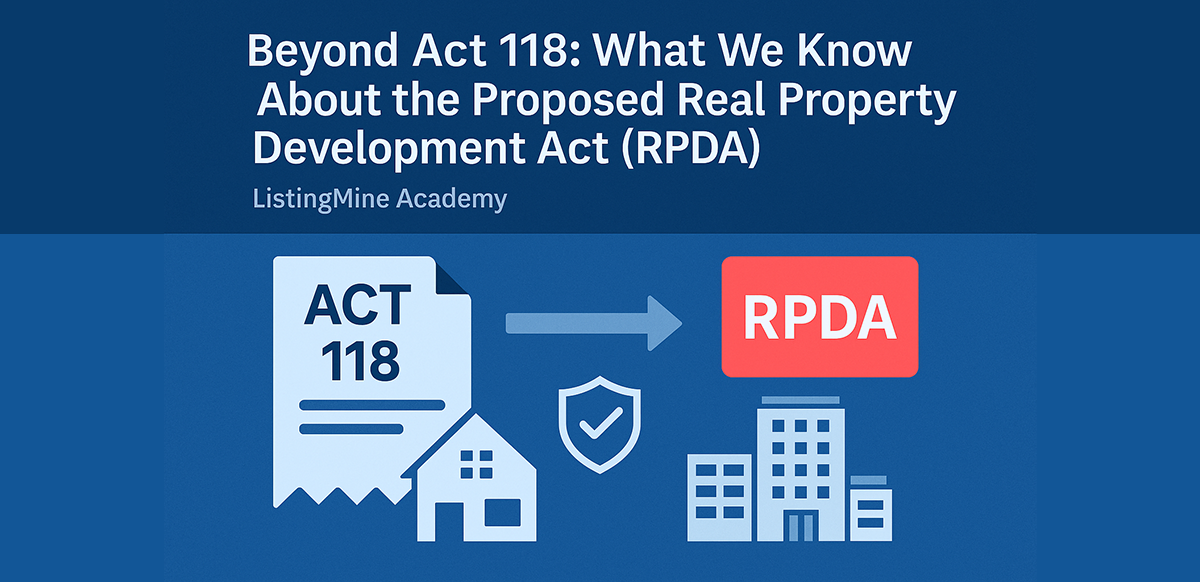
The proposed RPDA could reshape developer regulation, buyer protection, and project accountability. Agents should understand policy changes that affect new launches.
ListingMine Academy | Legal Policy & Future Trends
For 60 years, the Malaysian property industry has operated under one "Bible": Act 118 (The Housing Development (Control and Licensing) Act 118).
It is the law that gives us Schedule H, the Defect Liability Period (DLP), and the Housing Tribunal. But Act 118 was designed for a different era. Its jurisdiction is strictly limited to "Housing Accommodation."
As the market evolves into complex mixed-use developments, Act 118 is showing its age.
Enter the proposed Real Property Development Bill (RPDA). Currently being drafted by the Ministry of Housing and Local Government (KPKT), this new legislation aims to modernize the entire landscape. While the final text is not yet gazetted, the policy direction suggests a massive shift from "Housing Licensing" to "Total Industry Regulation."
Here is the strategic breakdown of what is being proposed and why it matters.
The most significant limitation of the current Act 118 is its scope. It protects buyers of "Housing Accommodation" (Residential titles and, often, SoHos).
However, it generally excludes pure commercial properties like:
The Current Reality (Non-HDA): Buyers of these units currently do not have access to the Homebuyer Tribunal. If a project is delayed or abandoned, they cannot claim statutory Liquidated Ascertained Damages (LAD) under standard HDA schedules. They are bound by the contract (SPA) written by the developer, and disputes must be settled in civil court, which is costly.
The RPDA Proposal: The Ministry has signaled that the RPDA aims to expand the scope of regulation beyond just housing. The goal is to provide a regulatory framework for all property development. If passed as intended, this would mean commercial buyers could finally enjoy statutory protections similar to residential buyers, ending the "two-tier" safety system.
Act 118 is fundamentally a Control and Licensing Act. Its primary lever is issuing licenses (APDL) to developers.
The RPDA is envisioned as a holistic management framework. Based on ministry discussions, the new Act aims to introduce stricter governance on:
There is significant industry buzz regarding "En Bloc" sales and redevelopment, specifically lowering the consent threshold from 100% to a lower majority (e.g., 75% or 80%).
Important Distinction: While often discussed alongside the RPDA, these reforms are largely being driven under the separate Urban Renewal Bill (also in drafting).
However, the RPDA is expected to lay the operational groundwork for how these redevelopments are managed. The industry is watching closely to see if the RPDA will include specific clauses regarding the termination of strata schemes—a necessary legal step to allow old, decaying buildings to be redeveloped without requiring unanimous consent from every single owner.
If the RPDA is passed with its intended scope, the sales narrative will shift.
Act 118 has done its job for decades. But as Malaysia builds more complex, integrated, and commercial-heavy townships, we need a law that covers the whole picture, not just the "housing" slice.
The RPDA represents the ambition to fix this. While we await the final parliamentary bill to confirm the specific mechanisms, the direction is clear: More regulation, wider coverage, and better protection for all property buyers, not just homeowners.

Founder of ListingMine and author of Agent for Life. Building ERP for Malaysian real estate agencies since 2008 — and writing to reshape how agencies grow.
More about Marvin Foong →More articles in this topic
This article is one of the sources behind this assessment. Take it to see what you already know and what to read next.
Educational self-assessment. Not a licensing examination or professional certification.