Property liquidity improves when information flows accurately between owners, buyers, and agents. Delegation alone is not enough without trustworthy data.
Securing delegation from a seller is not a success. It is merely permission to begin.
Once a seller delegates the right to sell, the agent has obtained the product. But in real estate, possession of the product does not generate revenue. The hardest stage comes next: converting a static asset into a liquid transaction.
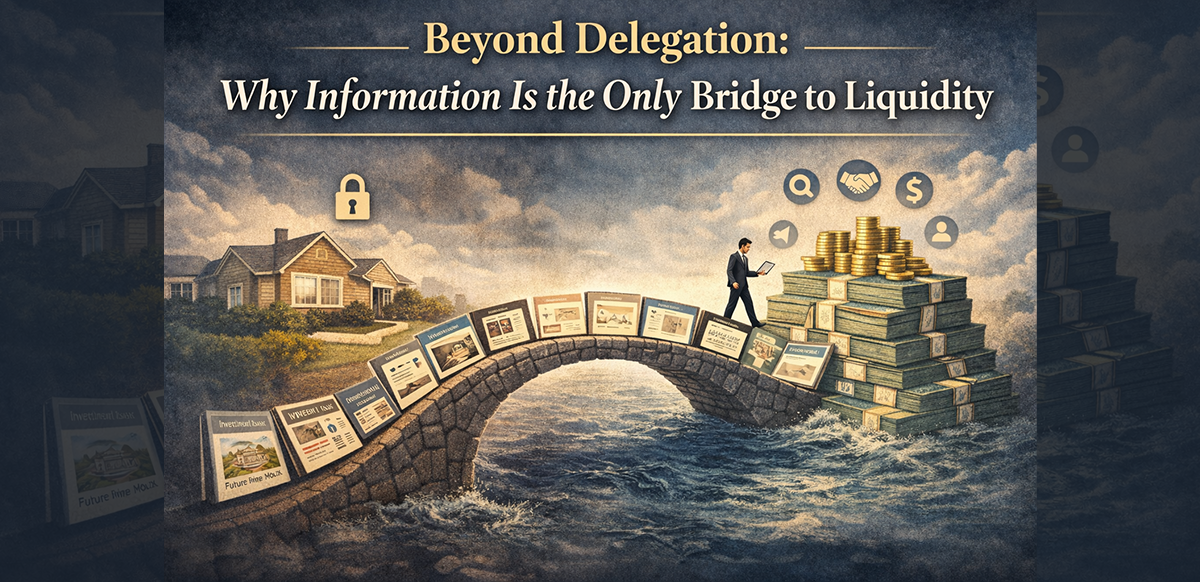
That conversion does not happen through the physical house. It happens through information.
A physical house is immobile. It cannot be broadcast, duplicated, or moved through networks. Only its representation can.
What actually flows through portals, WhatsApp groups, internal ACNs, and private buyer networks is not the property itself—it is the product description:
Without this informational twin, the asset is economically invisible. In a modern market, what is undocumented does not exist.
If delegation gives you inventory, information converts inventory into liquidity. This is where the agent's real work begins.
You are not selling bricks and mortar. You are shaping how the market understands those bricks. The physical object does not change, but the outcome does, depending on the lens:
The difference lies entirely in how information is structured, emphasized, and sequenced. Information is the software; the property is merely the hardware it runs on.
Portals do not sell properties. Social media does not sell properties. Networks do not sell properties. They are pipes.
They transmit information, but what determines success is not reach—it is fidelity.
This is why two agents can market the same unit with radically different results. One distributes noise; the other manufactures signals.
Professional agents are not messengers. They are conversion engineers. Information manufacturing involves:
The market does not pay equally for identical bricks. It pays for clarity of value. That is why two identical units on the same floor can transact at different prices. One crossed the liquidity bridge cleanly; the other stalled.
A transaction is not a single act. It is a sequence of conversions:
Agents who stop at delegation become listing collectors. Agents who master information manufacturing build leverage.
The profession is not selling houses. It is turning delegated assets into tradable, high-fidelity information that the market can understand, trust, and act upon. That is where liquidity comes from.

Founder of ListingMine and author of Agent for Life. Building ERP for Malaysian real estate agencies since 2008 — and writing to reshape how agencies grow.
More about Marvin Foong →More articles in this topic