Marketing that hides important terms in small text may create legal and trust risk. Agents should avoid tricks that could become complaints or penalties.
Imagine walking past a new Kopitiam or a glossy restaurant in KL. The signboard is massive and screams in bold font:
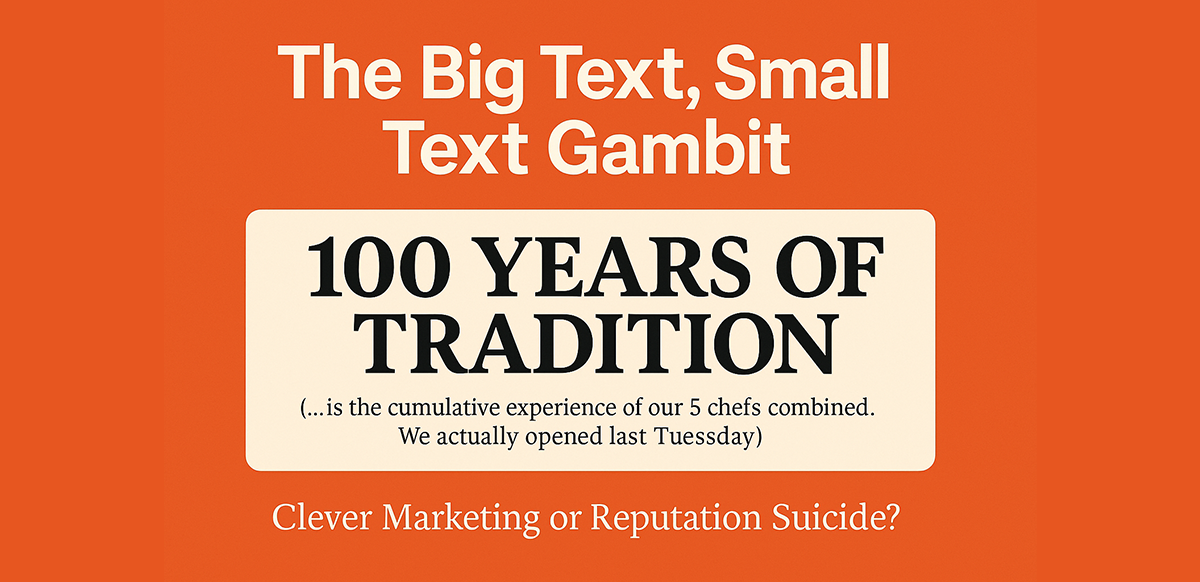
"100 YEARS OF TRADITION"
Impressed, you step closer. You squint at the microscopic text at the bottom right corner: "(... is the cumulative experience of our 5 chefs combined. We actually opened last Tuesday)."
Technically, the math works. But the moment you read that fine print, your reaction shifts from awe to "Walao, bluff one."
This is the "Big Text, Small Text" Gambit. It is the art of using visual hierarchy to make a huge promise while using fine print to hedge your bets. From property developers to insurance agents, this tactic is everywhere in Malaysia.
But is it a clever way to stand out in a noisy market, or are you just destroying your reputation?
This technique exploits a glitch in human psychology:
Visual Hierarchy Wins: Our brains process large, bold text as "The Truth."
The Logic Lag: Small text registers as "legal T&C." By the time the logical brain reads the disclaimer (if it reads it at all), the emotional first impression is already stuck.
Marketers love this because it offers plausible deniability. When a client complains, the defense is ready-made: "But boss, we disclosed it! It's right there at the bottom."
In the Malaysian property and agency world, this tactic creates a dangerous illusion of competence. We see it all the time:
The Big Text Promise: "WE GENERATED RM50 MILLION IN SALES!" The Small Text Reality: (Collectively across the whole agency since 2010).
The Big Text Promise: "NO. 1 AGENCY IN CHERAS!" The Small Text Reality: (In total volume of rental leads generated on Tuesdays, according to our own internal survey).
The Big Text Promise: "EARN RM50,000 PER MONTH!" The Small Text Reality: (Only one top performer did this once during a launch; most agents earn RM3k).
The Big Text Promise: "0% DOWNPAYMENT!" The Small Text Reality: (If you are a first-home buyer, qualify for 100% loan, and the developer gives a rebate).
The big text gets the clicks. The small text acts as a shield. But while this might protect you from a lawsuit (maybe), it does not protect you from the market's judgment.
Is this technique always bad? No. It depends entirely on intent. You can use the "Big Text / Small Text" format in two ways:
This is when the small text contradicts the big text to hide a negative truth.
Goal: To trick the prospect into calling you.
Result: You trade Reputation for Attention. You might get the lead, but you enter the relationship with a "Trust Deficit." In Malaysia, word spreads fast. If you are known as the "trickster" agent, no amount of Facebook Ads can save you.
This is when the small text clarifies the big text to provide honesty or wit.
Example:
Big Text: "VOTED BEST AGENT IN PJ!"
Small Text: (By my mother. But she is very picky about service).
Result: This builds rapport. It signals confidence. It tells the audience, "I know how marketing works, I have a sense of humor, but I'm honest with you."
Using the Deceptive Pivot is a sugar high.
Short-Term: You get the click. You feel like a marketing genius.
Long-Term: You suffer the crash. Clients attracted by hype are often the most difficult to manage. When the reality doesn't match the "Big Text" promise, they will bad-mouth you to their friends, family, and on Lowyat forums.
The modern alternative isn't to be boring; it's to be layered.
Instead of shouting "500% ROI GUARANTEED," try:
Layer 1 (The Hook): "We help clients achieve massive growth."
Layer 2 (The Proof): "Our case studies show results ranging from 15% to 500%."
Layer 3 (The Truth): "Every project is different. Let's sit down for 'yum cha' and audit your numbers to see what is realistic."
This approach attracts clients who value strategy over magic tricks.
The restaurant with the "almost 100-year-old recipe" might get a few curious customers. But the restaurant that says "Family recipes, perfected over decades" and actually delivers good food builds regulars.
In the Malaysian agency world, flashy claims might fill your WhatsApp with inquiries today, but transparent excellence fills your bank account for years.
The Rule of Thumb:
If the small text makes the client feel smart (for getting the joke), use it.
If the small text makes the client feel conned (for missing the detail), delete it immediately.
Trust scales. Tricks do not.
[LEGAL DISCLAIMER & WARNING]
We do NOT encourage deceptive marketing. Misrepresentation, false advertising, and misleading claims are illegal in Malaysia under the Consumer Protection Act 1999, MEAS, and can result in fines, lawsuits, and BOVAEP disciplinary actions.
This article is educational. Do not use these tactics to mislead the public.

Founder of ListingMine and author of Agent for Life. Building ERP for Malaysian real estate agencies since 2008 — and writing to reshape how agencies grow.
More about Marvin Foong →More articles in this topic
This article is one of the sources behind this assessment. Take it to see what you already know and what to read next.
Educational self-assessment. Not a licensing examination or professional certification.