Agency bosses often feel operational pain but misdiagnose it as people problems. The real issue may be hidden labour caused by weak systems and founder dependency.
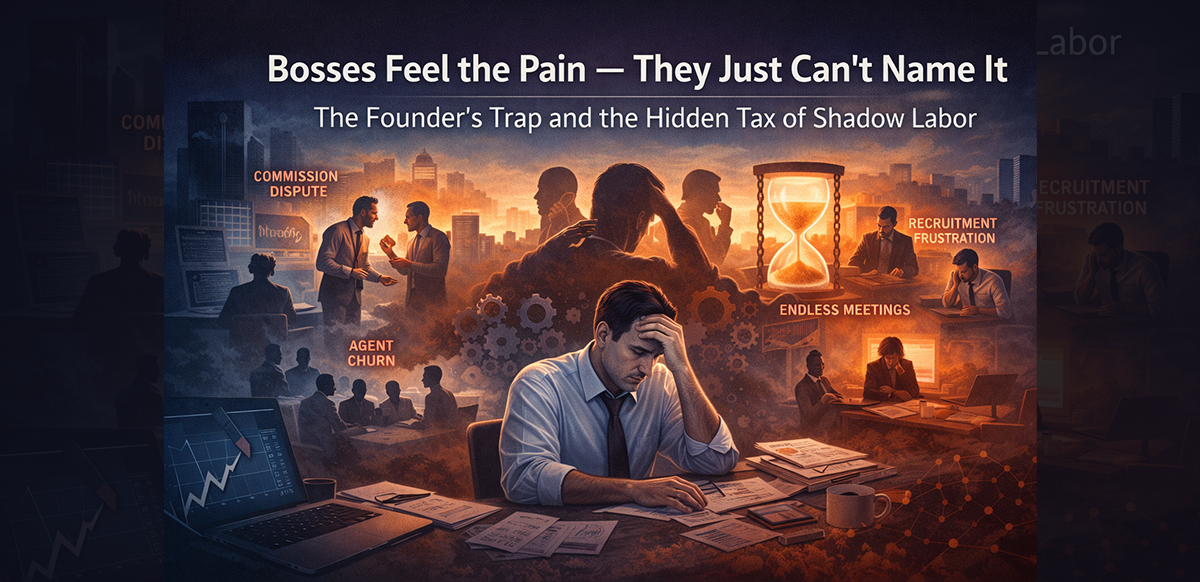
Most agency principals already know something is wrong. They don’t experience it as a spreadsheet error or a strategy gap. They experience it as a relentless, daily friction:
These are not random problems. They are repeating symptoms. What is missing is not intelligence, experience, or effort. What is missing is a coherent causal map—the language to explain why these failures appear together, and why fixing one never seems to fix the rest.
In the absence of a clear diagnosis, founders do what responsible leaders always do: They step in.
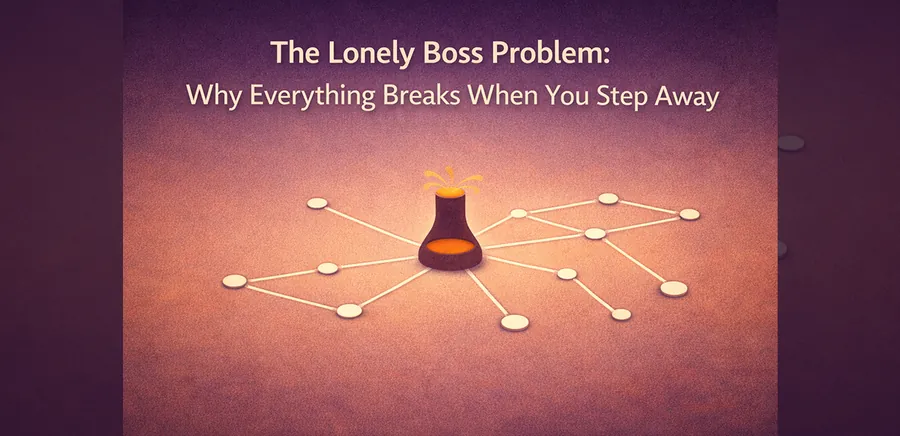
They arbitrate disputes. They approve exceptions. They smooth egos. They rewrite splits. They hold “alignment meetings.” For a while, this works. But over time, the organization develops a dangerous dependency: the business only functions when the founder is present.
This is the Founder’s Trap. The agency does not scale around a system; it scales around a person. Growth eventually hits a hard ceiling because a founder’s time is finite.
Most principals don’t realize how much work they are actually doing because it never shows up as a line item on a financial statement. This is Shadow Labor.
Shadow Labor is the invisible work a system should be doing, but isn't. It is the mental and emotional tax of:
Because this labor is invisible, it feels unavoidable. But it carries a devastating opportunity cost. Every hour a principal spends arbitrating a commission dispute is an hour not spent on:
You are not just losing sleep; you are losing the future of the firm.
When problems cannot be named, they must be discussed. So, calendars fill up with town halls, closed-door conversations, and "let’s talk this through" sessions.
These meetings feel productive because they reduce immediate tension. But they don't compound. They consume the most expensive resource in the company: the founder’s attention. A business that requires constant meetings to stay together is not "aligned." It is under-designed.
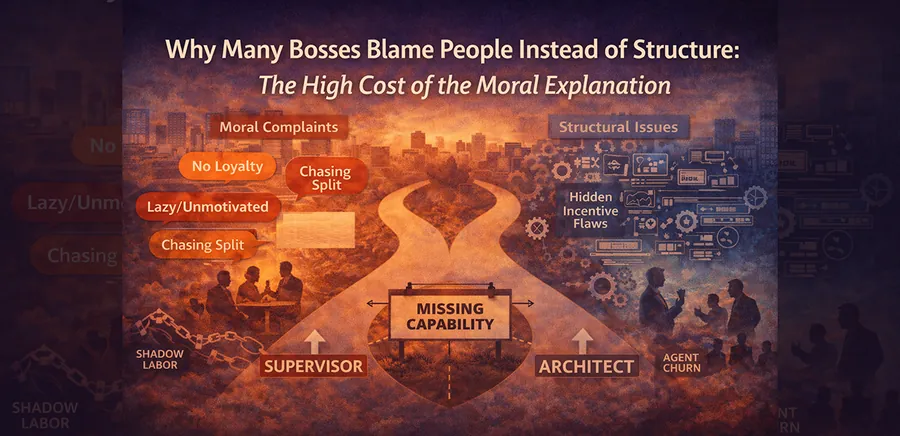
Without diagnostic language, every failure feels like a personality flaw. The table below illustrates how Language transforms a "People Problem" into a "Design Problem":
| The Symptom (What you feel) | The False Diagnosis (People) | The True Diagnosis (Systems) |
|---|---|---|
| High Churn | "Agents aren't loyal anymore." | Retention Economics Failure |
| Commission Fights | "They are being greedy." | Override Design Failure |
| Internal Disputes | "They have bad attitudes." | Attribution & Logic Failure |
| Stagnant Growth | "The team is lazy." | Productivity Leakage |
| Team Fragmentation | "The leader is a rebel." | Architecture & ACN Failure |
This distinction is the key to the next stage of your business.
You cannot fix a "bad attitude," but you can fix a misaligned override.
You cannot force "loyalty," but you can design retention economics.
Saying “bosses don’t know anything” is false—and insulting. The truth is more precise: They feel the problem before they can name it. But until a problem can be named, it cannot be engineered away.
This is why the Language Factory matters.
ListingMine Academy exists to give names to the weights principals have been carrying alone for years. Once the language is fixed, the software is no longer a "management tool." It becomes the syntax of your business—the execution environment where your new logic finally comes to life.

Founder of ListingMine and author of Agent for Life. Building ERP for Malaysian real estate agencies since 2008 — and writing to reshape how agencies grow.
More about Marvin Foong →More articles in this topic
This article is one of the sources behind this assessment. Take it to see what you already know and what to read next.
Educational self-assessment. Not a licensing examination or professional certification.