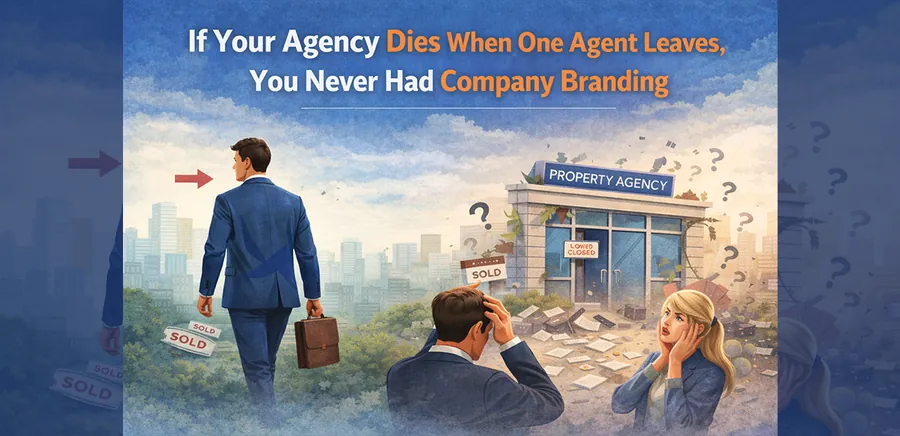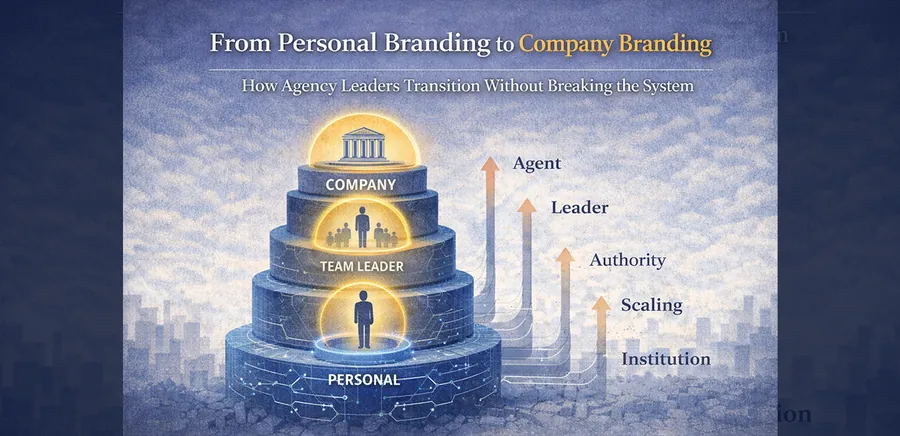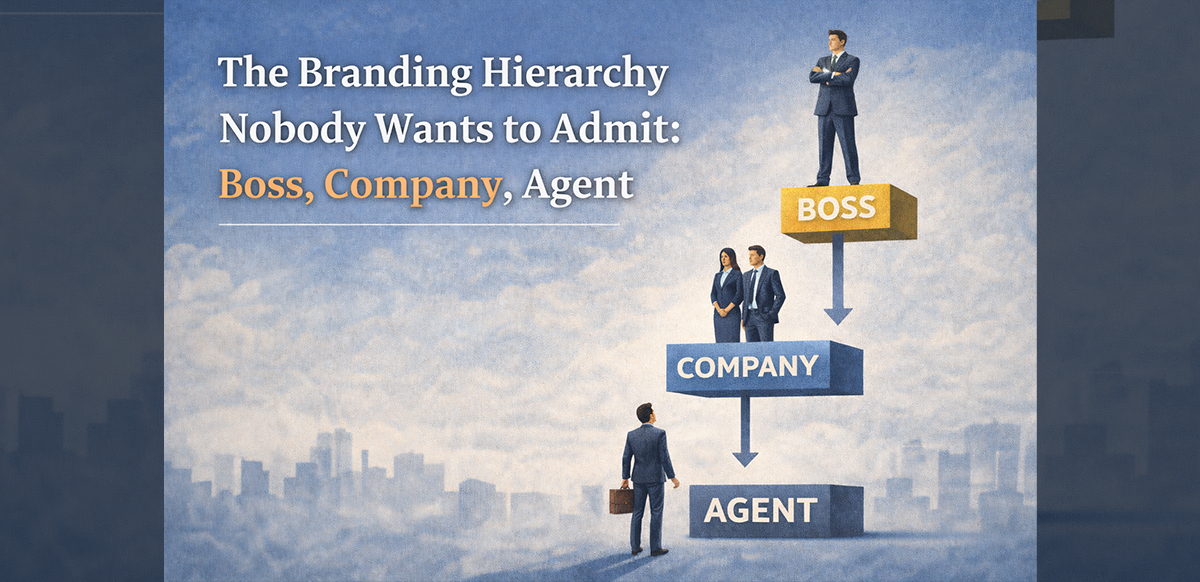
Agency branding has a hierarchy involving the boss, company, and individual agents. Understanding this hierarchy helps prevent confusion over authority, trust, and market identity.
When branding is ranked by visibility, agencies become fragile. When branding is ranked by governance, agencies become durable.
Most discussions about branding in property agencies start at the wrong place. They start with who is most visible:
That framing feels intuitive—and it is exactly why most agencies remain structurally weak.
Branding is not about attention. Branding is about control, continuity, and enforcement.
Once you accept the fragility problem—that agencies collapse when a single agent leaves—the real hierarchy becomes unavoidable. There is a branding order that actually governs organisations, whether people like it or not:
Boss Branding → Company Branding → Agent Branding
This is not a value judgment. It is a structural truth.
Boss branding is the most misunderstood—and most powerful—layer.
It has nothing to do with social media presence. A boss can be completely invisible online and still dominate the brand of the organisation.
Boss branding is the belief system that gets enforced when it becomes uncomfortable. It is revealed in the difficult moments:
The "Shadow" Brand Every agency has boss branding, even if the boss denies it. The real brand is not found in speeches. It is found in:
If a founder preaches "Transparency" but retreats the moment a top agent pushes back, then the brand is not Transparency. The brand is Avoidance.
You can delegate execution. You cannot decentralise belief.
Company branding is what most agencies think they have—but rarely do.
It is not a logo, a colour scheme, or a recruitment pitch. Company branding is the Operating Contract.
It answers the hard questions:
The Institutional Layer Company branding is the only thing that allows an agency to survive personnel changes. If processes, logic, standards, and decision-making live only in people's heads, then the company does not exist independently.
Without Company Branding:
At that point, you don't have an institution. You have a shared workspace with a letterhead.
Agent branding matters. It creates trust. It closes deals. It produces cash flow.
There is no denial of its importance. But agent branding has a hard structural limit: It optimises for individual upside, not system resilience.
This is not greed. It is rational behaviour. Agents respond to incentives, optionality, and personal risk.
The Structural Limit This is exactly why Agent Branding cannot sit above Company Branding. When Agent Branding outranks the Company:
The organisation bends around whoever produces the most. That is not leadership. That is hostage management.
This hierarchy offends modern narratives. It contradicts the ideas that "everyone is equal" or "brand follows revenue."
But organisations do not run on narratives. They run on Order.
Strong agencies are not democratic in belief. They are democratic in execution—within enforced boundaries.
When founders avoid this hierarchy:
The result is growth without stability.
ACN (Agent Co-Agency Network) is not a technology problem. It is not an agent problem. It is a branding hierarchy problem.
ACN requires:
If any one of these is missing, ACN collapses into theory. That is why adoption always fails at the top—not at the bottom.
You can have all three forms of branding. But they cannot be equal.
Reverse this order, and the agency becomes loud, busy, and profitable—right up until it breaks.
That is the branding hierarchy nobody wants to admit. And it is the difference between an agency that grows and an institution that lasts.

Founder of ListingMine and author of Agent for Life. Building ERP for Malaysian real estate agencies since 2008 — and writing to reshape how agencies grow.
More about Marvin Foong →More articles in this topic