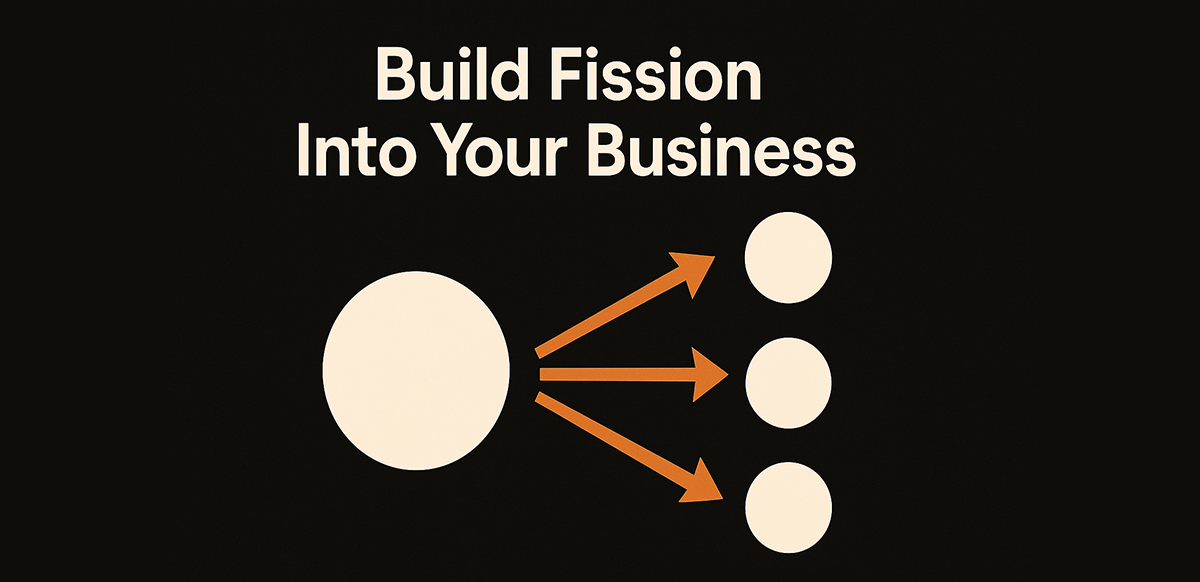
Businesses need referral, sharing, and internal growth loops instead of relying forever on paid marketing. Fission creates self-spreading momentum.
When most people start a company, they think about product, branding, and sales. Very few think about Fission.
That omission is expensive. In simple terms, fission means this: Your business grows by splitting itself through the people who already exist inside your system.
Some call it "referral," but that is too small a word. Referral is a campaign you run once a month. Fission is a design philosophy.
In an era where marketing costs keep rising and attention keeps fragmenting, any business that relies purely on paid acquisition is structurally fragile.
Marketing today is no longer cheap.
If your growth depends entirely on external spend, your margins will compress over time.
Fission flips the equation. Instead of paying strangers to notice you, you design the business so insiders pull others in naturally.
For agency bosses and team leaders, two problems never go away:
Both are expensive. Both are recurring. Both drain management attention. Fission thinking attacks both at the root.
Most agencies treat recruitment as a constant chase: running ads, hosting roadshows, making short-term promises. A fission-based approach changes the incentive logic.
The Design: Instead of paying a recruiter, you incentivise the Senior Agent.
If a Senior Agent incubates 2–3 performing agents, they unlock a higher commission tier or a permanent team override.
The agency reduces its margin on the individual deal, but gains volume from multiple new contributors.
The Result: Your existing agents become your recruiters. They don't just "refer" a friend; they have a vested interest in that friend's success. One income stream splits into several. That is fission.
Lead generation is often treated as a media problem ("How much should I spend on FB ads?"). It is actually a relationship design problem.
The Design: Stop asking for favors. Build the referral into the lifecycle.
The Result: Each successful transaction generates the seed for the next one. These are leads that cost RM0 in advertising spend.
The mistake most businesses make is treating referral as an afterthought. Fission must be designed upstream:
Fission does more than reduce cost. It aligns incentives. It builds internal loyalty. It turns clients into promoters. It turns growth into a byproduct of existence, not an expense line item.
Before scaling your marketing budget, ask one question: If all advertising stopped tomorrow, would the business still grow?
If the answer is no, the issue is not marketing. It is design.
All strategies and examples discussed in this article are conceptual and must be implemented in full compliance with applicable Malaysian laws and regulations, including the Board of Valuers, Appraisers, Estate Agents and Property Managers (BOVAEP) guidelines and the Valuers, Appraisers, Estate Agents and Property Managers Act 1981 (Act 242). Agencies and individuals are responsible for ensuring that all recruitment practices, referral incentives, commission structures, and marketing activities adhere strictly to professional standards, ethical requirements, and regulatory obligations.

Founder of ListingMine and author of Agent for Life. Building ERP for Malaysian real estate agencies since 2008 — and writing to reshape how agencies grow.
More about Marvin Foong →More articles in this topic
This article is one of the sources behind this assessment. Take it to see what you already know and what to read next.
Educational self-assessment. Not a licensing examination or professional certification.