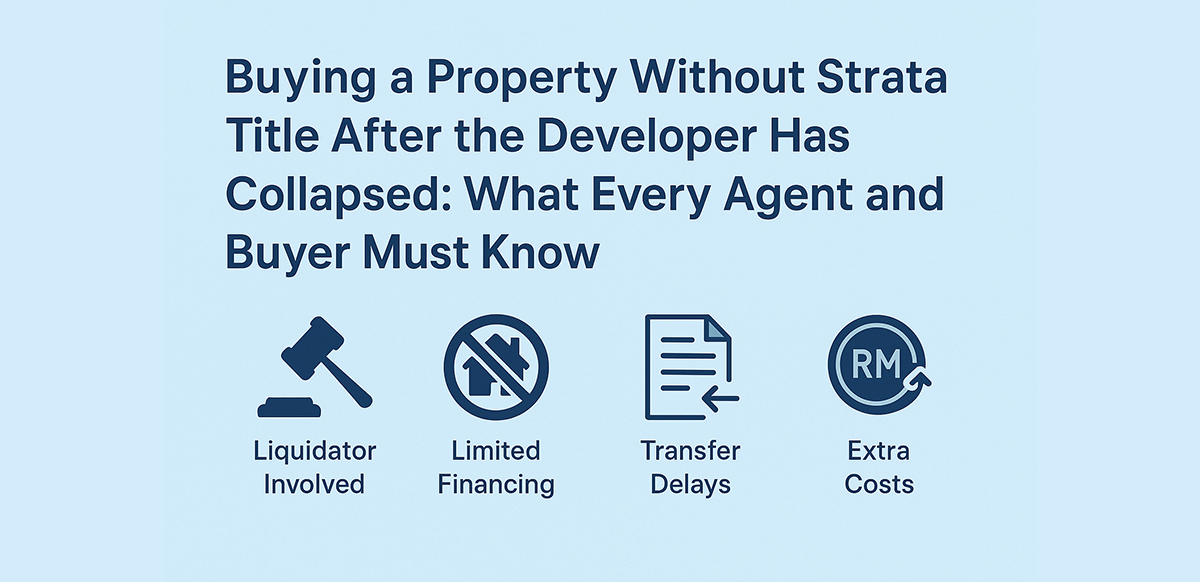
Properties without strata title after developer collapse carry legal, financing, and resale risks. Agents and buyers need careful due diligence before proceeding.
When a property is completed but the strata title has not yet been issued — and the developer subsequently goes bankrupt — the transaction is no longer a normal subsale. It becomes a legal, financial, and procedural case where every step is slower, riskier, and more expensive for all parties involved.
Most buyers, and many agents, only discover these complications after the deal is already in motion, resulting in rejected loan applications, legal disputes, and collapsed transactions. This article explains the situation clearly so that agents, lawyers, buyers, and investors can make informed decisions before committing.
Once the developer is wound up, a liquidator is appointed. This liquidator becomes the legal authority replacing the developer for all matters involving consent, documentation, title progress, and outstanding liabilities. Unlike a developer, the liquidator’s goal is not to assist owners, but to close the company and recover whatever value is left. Every document, consent, and verification now goes through the liquidator — often with imposed fees and delays.
This immediately affects:
Most banks either decline or heavily limit financing for properties in this category because there is no strata title to charge and no solvent developer to hold liability.
Typical consequences:
A property that normally has 90% loan eligibility may be reduced to 60–70%, forcing the buyer to prepare significantly more cash. This is the primary reason such deals collapse.
With no strata title issued, transfer must be done via Deed of Assignment.
However, the DOA requires the developer’s consent — and in this case, the “developer” is now the liquidator.
Common complications:
Where a normal subsale completes in 3–4 months, this type of transaction may take 9–18 months depending on document status.
| Cost Type | Why It Occurs |
|---|---|
| Liquidator consent fee | Developer no longer exists, liquidator charges for replacement role |
| Legal fees (higher than normal subsale) | Requires assignment route and specialised conveyancing |
| Strata title continuation cost | Application may be incomplete and requires funding |
| JMB contribution | JMB may need to fund certain compliance stages to proceed with title |
| Outstanding dues from previous owner | Liquidator may refuse consent until cleared |
These costs are often not disclosed early, leading to buyer dissatisfaction and deal withdrawal.
A professional agent should confirm:
Failure to confirm these before listing the property exposes the agent to legal and reputational risk.
This type of property is not a basic listing. It requires:
Agents who treat this as a normal subsale often face:
Agents who master this niche, however, become specialists able to close deals most agents avoid.
| Type | Behaviour |
|---|---|
| Basic Agent | “Below market value, can faster sell.” |
| Professional Agent | “This property is legally and financially complex. Here is the full process, risk, and pathway to completion.” |
The second type closes fewer deals, but closes higher-value, low-competition deals and becomes trusted by:
This is a long-term positioning advantage.
This is not a listing problem. It is a systems problem involving land law, liquidation, loan risk, and title administration.
Agents who learn how to navigate it become:
The future of agency work belongs to those who can handle complexity, not those who repeat marketing slogans.

Founder of ListingMine and author of Agent for Life. Building ERP for Malaysian real estate agencies since 2008 — and writing to reshape how agencies grow.
More about Marvin Foong →More articles in this topic
This article is one of the sources behind these assessments. Take one to see what you already know and what to read next.
Educational self-assessment. Not a licensing examination or professional certification.