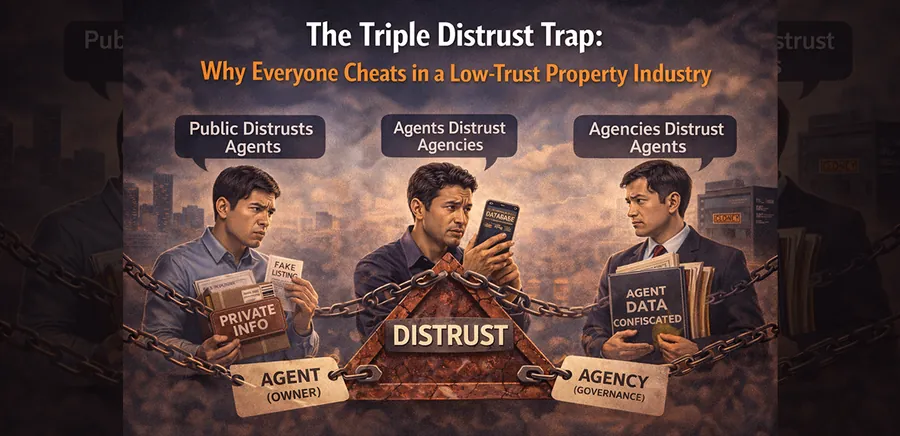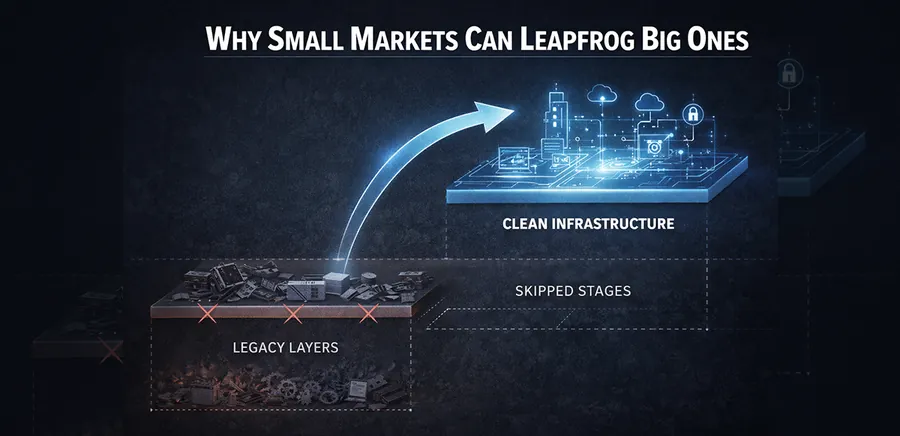
Malaysian real estate must move from individual survival tactics to system design. The industry needs structures that make professionalism, cooperation, and trust repeatable.
Every industry carries an invisible doctrine — a set of beliefs that quietly shape behaviour, incentives, and career outcomes.
In Malaysian real estate, the old doctrine was forged in an era of low transparency, weak systems, and human-enforced trust. It trained agents to survive chaos.
The modern market demands the opposite: agents who eliminate chaos.
Below is the definitive doctrine shift — not aspirational, but structural.
| Domain | Old Doctrine | Modern Doctrine |
|---|---|---|
| Core Belief | Endurance creates success | Systems create repeatability |
| Agent Role | Salesperson / persuader | Transaction architect / verifier |
| Source of Power | Seniority & hierarchy | Workflow ownership & data |
| Learning Method | Follow senior, copy behaviour | Document process, iterate fast |
| Success Signal | Closed deals only | Closed deals + clean audit trail |
| Risk Management | Trust people | Verify events |
| Trust Model | Relationship-based | Proof-based |
| Control Strategy | Control people | Control process |
| Career Moat | Loyalty to team | Ownership of private data |
| Exit Risk | High (everything tied to agency) | Low (portable systems) |
Interpretation:
Old doctrine assumed chaos was permanent. Modern doctrine assumes chaos is a design flaw.
| Domain | Old Doctrine | Modern Doctrine |
|---|---|---|
| Listings | Listings are gold | Verified listings are gold |
| Exclusivity | Hoard exclusives | Share to increase liquidity |
| Market Power | Control stock | Control verification & access |
| Listing Strategy | Quantity first | Quality & readiness first |
| Sharing | Protect your own | Cooperate by default |
| Differentiation | "I have listing" | "I have proof" |
Interpretation:
In a portal-flattened world, access is no longer scarce.
Credibility is.
| Domain | Old Doctrine | Modern Doctrine |
|---|---|---|
| Co-broke Trust | Only with people you know | With anyone, via rules |
| Commission Logic | Who worked harder | Who triggered which event |
| Dispute Resolution | Argue, escalate to leader | System auto-allocates |
| Risk View | Co-broke is dangerous | Solo deals are dangerous |
| Behaviour | Defensive | Open but governed |
| Reputation | Social memory | System record |
Interpretation:
Old co-broking relied on memory and morality.
Modern co-broking relies on event-based proof.
| Domain | Old Doctrine | Modern Doctrine |
|---|---|---|
| Follow-Up Style | Chase until reply | Follow structured milestones |
| Silence Means | Buyer not serious | Buyer not ready |
| Closing Logic | Pressure closes | Clarity closes |
| Buyer Behaviour | Emotional & irrational | Self-directed & informed |
| Agent Value | Reminding & pushing | Filtering & aligning |
| Communication | High frequency | High relevance |
Interpretation:
Chasing was a response to information scarcity.
Today, relevance beats persistence.
| Domain | Old Doctrine | Modern Doctrine |
|---|---|---|
| Entry Requirement | Just tahan | Cash + system readiness |
| First Year | Must suffer | Should stabilise |
| Income | One big deal solves | Small, repeatable wins compound |
| Savings | Emergency buffer only | Runway for experimentation |
| Risk Strategy | Spend to look busy | Spend to reduce variance |
| Failure Narrative | Personal weakness | Structural mismatch |
Interpretation:
Volatility is not a rite of passage.
It is an unmanaged risk.
| Domain | Old Doctrine | Modern Doctrine |
|---|---|---|
| Credibility | Look rich | Look reliable |
| Car | Signal success | Manage cashflow |
| Appearance | Flashy = trust | Clean = trust |
| Branding | Fake it till make it | Be consistent till believed |
| Buyer Perception | Wealth = competence | Transparency = competence |
Interpretation:
Image once substituted for proof.
It no longer does.
| Domain | Old Doctrine | Modern Doctrine |
|---|---|---|
| Team Choice | Big name | Clear systems |
| Leader Value | Motivates | Standardises |
| Leads | Leader provides | System generates |
| Loyalty | Time-based | Value-based |
| Growth | Wait for promotion | Build autonomy |
| Switching Teams | Disloyal | Rational optimisation |
Interpretation:
A good leader no longer "inspires".
They remove randomness.
| Domain | Old Doctrine | Modern Doctrine |
|---|---|---|
| Success Filter | Attrition | Compounding advantage |
| "Not for everyone" | Many must fail | Many were misdesigned |
| Skill Transfer | Minimal | High |
| Career Ceiling | Team-bound | Portable |
| Long-Term Value | Commission only | Data + relationships + systems |
Interpretation:
Survival is not a competitive advantage.
Portability is.
Old doctrine trained agents to survive chaos.
Modern doctrine trains agents to eliminate it.
That is not a mindset change.
It is an infrastructure change.
And once agents see that distinction, they never unsee it.

Founder of ListingMine and author of Agent for Life. Building ERP for Malaysian real estate agencies since 2008 — and writing to reshape how agencies grow.
More about Marvin Foong →More articles in this topic