Agents need to distinguish between legitimate financial strategy and manipulative sales narratives. Cash-out concepts can become dangerous when used to push unsuitable property decisions.
In parts of the Malaysian property market, junior negotiators are sometimes introduced to what is framed as a “cash-out strategy.”
When they hesitate about marking up the SPA price to obtain higher loan disbursement, the reassurance they receive is rarely technical. It is emotional.
They are told:
They are also reminded that housing loan interest rates are lower and that by facilitating this structure, they are improving the client’s financial position.
The phrase is powerful because it appeals to morality rather than mechanics. No junior wants to feel unethical. When the structure is framed as compassion, resistance weakens.
The conversation shifts:
The moral evaluation becomes outcome-based rather than truth-based.
However, intention does not replace mechanism.
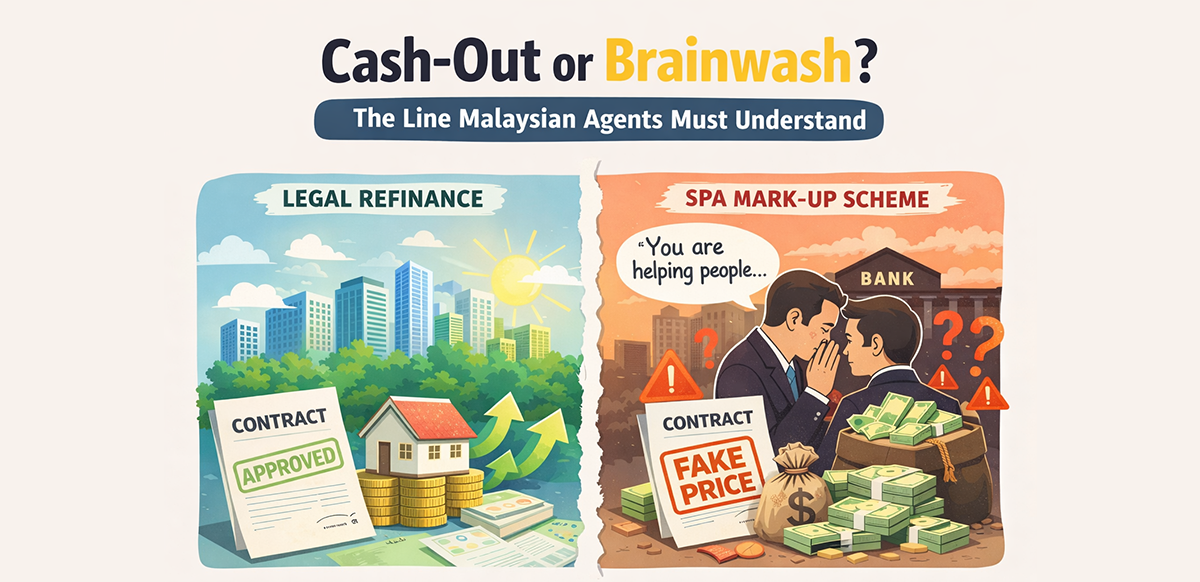
There is absolutely nothing wrong with cashing out through legitimate refinancing.
If a property has genuinely appreciated in value, the owner may refinance based on current market valuation conducted independently by the bank.
Example:
The owner refinances and extracts part of the equity created by real appreciation.
If the funds are used to consolidate higher-interest debt or support business liquidity, the structure remains clean because it is supported by independent verification and truthful declaration.
In this structure:
The client benefits, but the benefit is built on accurate representation.
This is legal cash-out.
It does not require moral justification because it stands on factual valuation.
The problem arises when the SPA price is intentionally inflated beyond true market value in order to influence the loan amount.
In such cases, the declared transaction price does not reflect reality.
The justification may still revolve around helping the client reduce interest burden, but the structure depends on misrepresentation.
Lower interest rates do not legalize false numbers.
The comparison between housing loans and personal loans does not change whether the declared price is accurate.
When the transaction value is engineered rather than supported by independent valuation, the foundation of the deal shifts:
The difference between refinancing after appreciation and marking up an SPA is not minor.
One is valuation-based. The other is declaration-based.
These are fundamentally different mechanisms.
In Malaysia, the junior negotiator’s name is typically not printed as a contracting party on the SPA or loan agreement.
The legal relationship exists between:
Because of this, many juniors believe they carry minimal exposure.
If the bank discovers the inflated value, the most common outcome may simply be loan rejection rather than prosecution.
This perception contributes to normalization.
When enforcement appears inconsistent and consequences seem limited, ethical evaluation shifts:
The act becomes measured by probability of detection rather than structural honesty.
But professional standards are not defined by enforcement frequency.
They are defined by whether the declared information is truthful.
Even if no immediate action is taken, normalization reshapes industry culture.
The most subtle aspect of this issue lies in psychological framing.
When juniors question the structure, they may be told:
The explanation often becomes comparative:
Instead of asking whether the transaction value reflects market reality, the conversation shifts to whether the client’s financial position improves.
The moral compass shifts from compliance to compassion.
This is how brainwashing operates.
It reframes misrepresentation as assistance.
Once that shift occurs, ethical lines begin to blur.
Malaysia’s property industry already operates within an environment of cautious trust.
Banks monitor risk carefully and regulators tighten processes when irregularities accumulate.
When artificial mark-ups become normalized under the banner of helping clients, the long-term cost is borne by the entire profession.
In contrast, genuine refinancing after appreciation strengthens financial sophistication.
It:
It does not rely on emotional reassurance.
If a structure repeatedly requires the explanation “you are helping people,” it may signal that the mechanism itself cannot stand comfortably on its own.
Cash-out is not inherently unethical.
Legal refinancing based on genuine market appreciation is a legitimate financial strategy.
Debt consolidation conducted through transparent valuation is responsible advice.
Artificially inflating the SPA price to extract additional loan is not the same thing.
It is misrepresentation regardless of intention.
Helping people and telling the truth must exist together.
If helping someone requires distorting declared value, the help is built on an unstable foundation.
The line is not blurry.
Understanding this distinction protects professional integrity and long-term credibility.
The difference is clear. The responsibility to maintain that clarity belongs to every agent who wants the industry to mature.

Founder of ListingMine and author of Agent for Life. Building ERP for Malaysian real estate agencies since 2008 — and writing to reshape how agencies grow.
More about Marvin Foong →More articles in this topic
This article is one of the sources behind this assessment. Take it to see what you already know and what to read next.
Educational self-assessment. Not a licensing examination or professional certification.