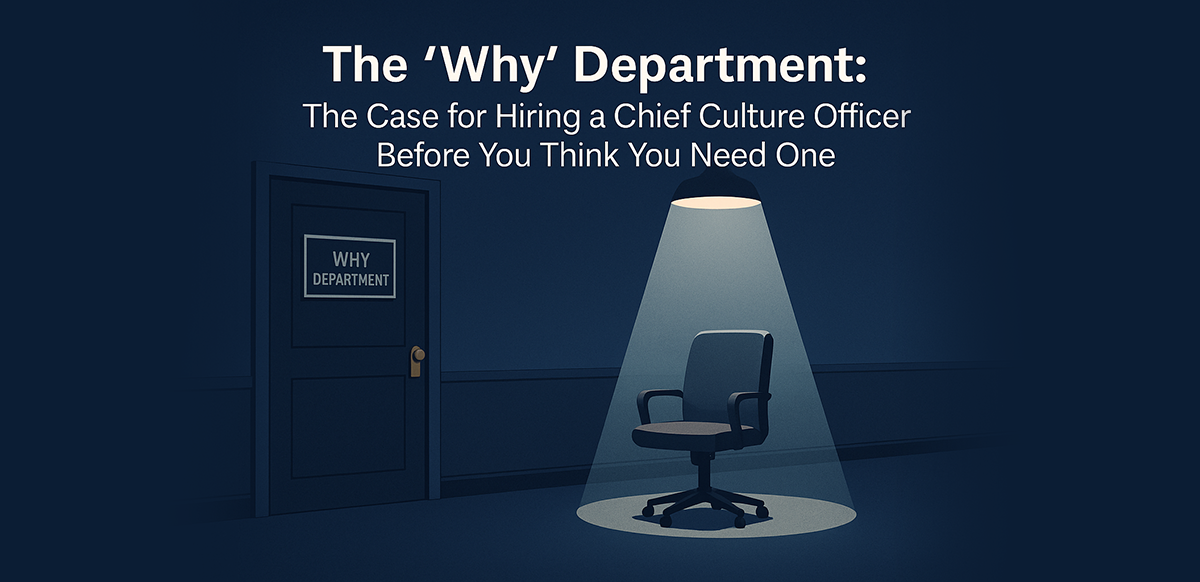
The "Why" Department: The Case for Hiring a Chief Culture Officer Before You Think You Need One
In short
Culture needs active ownership before problems become visible. A culture-focused role can protect values, onboarding, communication, and retention.
In a property agency, every role has a clear, tangible function. The Sales Director drives revenue. The Head of Operations ensures compliance and smooth transactions. The Marketing Manager fills the funnel. These are the "What" and "How" departments—they execute the business of the day.
But who is responsible for the "Why"?
Why should a top agent choose to build their career here instead of next door? Why do we do things this way? Why does our team consistently go the extra mile for a client?
As your agency scales beyond a single, founder-led team, the "Why"—your culture—becomes fragile. It can't just be embodied by one person anymore. It needs a steward. This is the case for hiring a Chief Culture Officer (CCO), not as a luxury for when you're large, but as a strategic necessity for when you're on the cusp of growth.
The "Culture Tax" of Scaling
Every growing agency pays a "culture tax"—the slow, often invisible erosion of its core values and collaborative spirit as it adds people, layers, and new divisions.
You see the symptoms:
- The "Siloed" Syndrome: The sales team blames property management for lost clients. New branch offices feel disconnected from the "mothership." Collaboration breaks down.
- Onboarding Dilution: New hires learn the "what" (the process) but miss the deep-seated "why" (the values), becoming technically proficient but culturally adrift.
- Inconsistent Client Experience: The service a client receives from Agent A is wildly different from Agent B because there is no unifying cultural compass guiding their autonomous actions.
- The Founder's Fading Voice: You can't be everywhere. Your personal influence, which once was the culture, inevitably diminishes.
A CCO is not an HR manager who processes payroll. They are the architect and guardian of your agency's soul, tasked with operationalizing your culture and making the intangible, tangible.
What Does a Chief Culture Officer Actually Do?
A CCO's role is to turn abstract values into daily behaviors and systems, ensuring the culture scales along with the revenue.
- 1. They are the Chief Context Provider: They ensure every team member understands not just what they are doing, but why it matters to the agency's mission. They translate the founder's vision into a living, breathing narrative that binds a growing, diverse team together.
- 2. They Architect the Ecosystem of Growth: While the Sales Director manages performance, the CCO focuses on belonging, growth, and retention. They design the mentorship programs, recognition systems, and career pathways that make people feel seen, valued, and invested in the agency's future (The Career Lattice).
- 3. They are the "Voice of the Team": A CCO conducts regular "culture pulse checks" and gathers anonymous feedback, identifying friction points, organizational anxiety, and silos before they become full-blown crises. They provide an empathetic, neutral channel for the team's concerns and innovative ideas.
- 4. They Codify the "How": They translate your core values into observable, daily actions. If "transparency" is a value, the CCO ensures it's consistently reflected in how you run sales meetings, handle pricing feedback with landlords, and communicate mistakes to a client.
The Preemptive Hire: When to Act
The most powerful time to hire a CCO is before you think you need one. The goal is not to repair a broken culture, but to protect and scale a thriving one.
- At 15-20 Employees: This is the tipping point where the founder can no longer personally connect with every individual daily. A CCO, even on a part-time or senior-manager-with-this-remit basis, can solidify the cultural foundation for the next growth phase.
- Before Opening a Second Branch: A CCO is your single most important tool for ensuring your culture successfully replicates in a new location, preventing a detrimental "head office vs. branch office" divide from day one.
- During a Merger or Acquisition: A CCO is essential to navigate the complex process of blending two distinct agency cultures into one cohesive, high-performing whole, minimizing talent loss.
The Return on Investment (ROI) of the "Why" Department
Hiring a CCO is not a soft, "feel-good" expense. It is a hard-nosed strategic investment with a clear ROI:
- Reduced Talent Churn: A strong, intentional culture is your most powerful retention tool, directly reducing the immense cost of replacing experienced agents.
- Enhanced Employer Brand: Your agency becomes a magnet for top talent who seek more than just a commission structure—they seek a mission and a supportive community.
- Faster, Better Decision-Making: When everyone is aligned on the "why," they can make autonomous decisions on the spot that are still in the best interest of the agency, eliminating the leader as a bottleneck.
The Final Viewing
Your company culture is not a poster in the breakroom. It is your most valuable, yet most vulnerable, asset. It dictates how your team behaves when you're not in the room.
By hiring a Chief Culture Officer, you are making a profound statement: that the "Why" behind your work is as critical as the "What." You are investing in the very ecosystem that allows your people—and your profit—to thrive.
Don't wait for your culture to break before you decide to fix it. Hire the architect while the foundations are still strong.