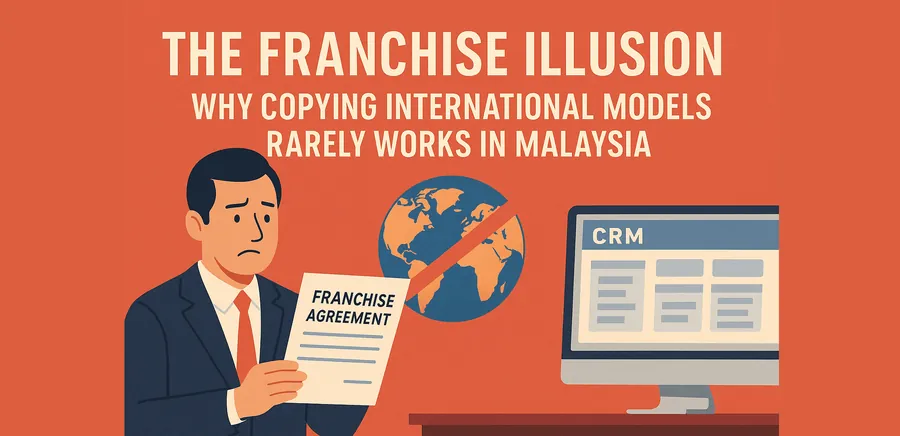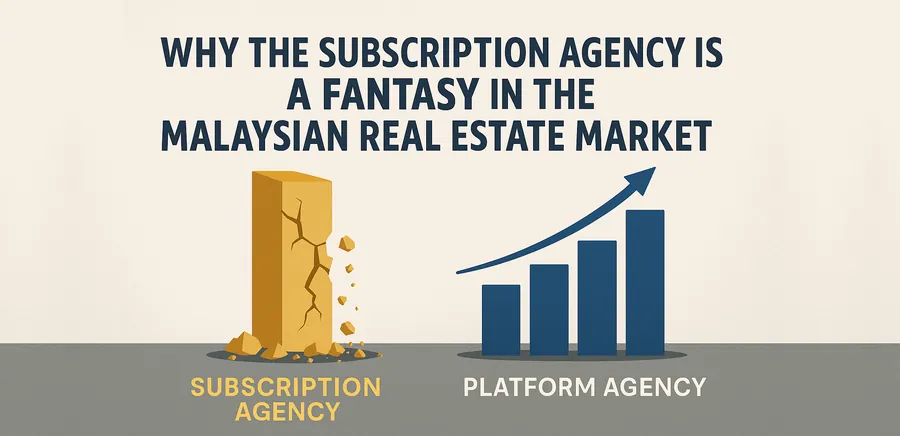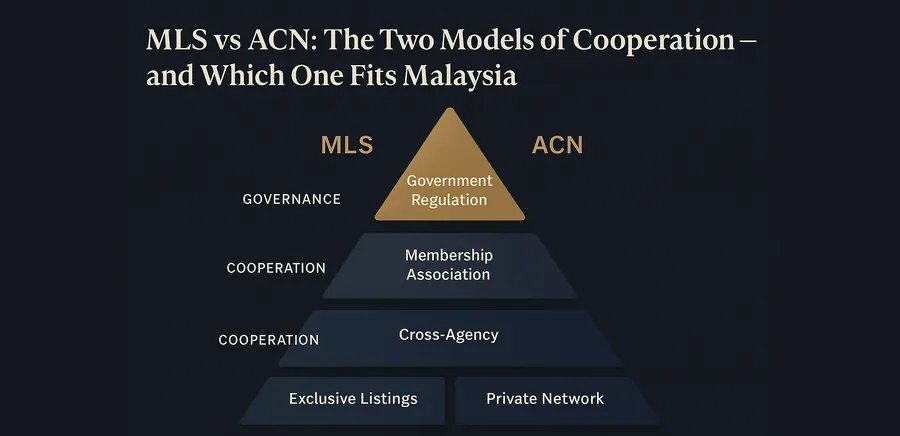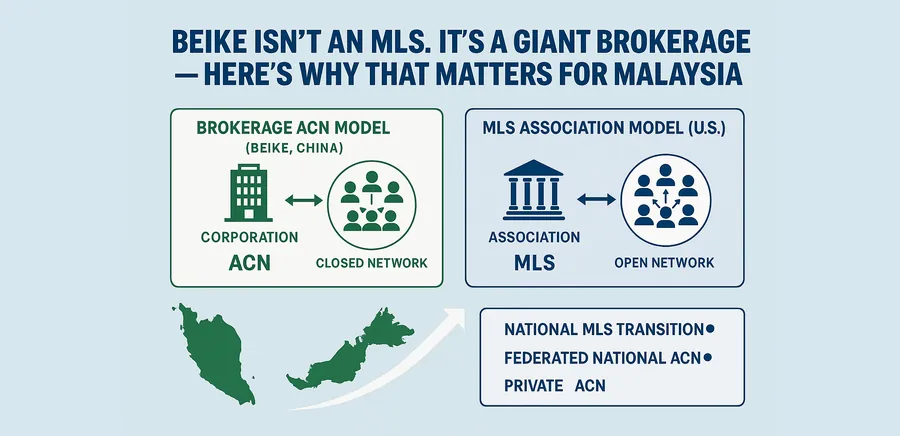
Beike shows how structured cooperation can scale through agent roles, verified inventory, and platform governance. Malaysia may benefit more from ACN than a traditional MLS model.
For decades, property technology revolved around one idea — exposure. If more listings were visible, more deals would happen. That logic gave birth to the MLS (Multiple Listing Service), the backbone of American real estate.
But in 2018, China’s Beike (贝壳找房) proved that exposure alone wasn’t enough. To truly transform the industry, you needed verified cooperation, not just shared data.
That evolution gave rise to the ACN (Agent Cooperation Network) — a workflow-driven, trust-based framework that redefined how agents collaborate, share commissions, and build credibility.
Today, as Malaysia’s property industry faces fragmentation, low trust, and rising compliance demands, Beike’s journey offers a crystal-clear roadmap — why ACN, not MLS, is Malaysia’s future.
The MLS model was born from a noble goal: to let agents share listings and cooperate to achieve faster transactions.
In the U.S., MLS platforms became the central registry of all listings — complete with photos, prices, and histories. In China, platforms like Beike and Anjuke attempted to replicate this.
And it worked — up to a point. Beike’s network now spans over 52,000 branches and 450,000 agents, with more than 85% of listings shared under MLS-like rules.
But Beike soon realized a hard truth:
Listing exposure doesn’t automatically create trust.
Agents still fought over leads, commissions, and client control. Without a verifiable workflow, the system couldn’t solve the human part of the problem — who actually did the work?
That gap led to Beike’s next innovation: the ACN.
The Agent Cooperation Network (ACN) transformed the industry by redefining cooperation — not as data sharing, but as role-based participation.
Instead of everyone marketing the same property, Beike’s ACN assigned specific, verifiable roles within each transaction:
| Side | Key Roles | Description |
|---|---|---|
| Listing Side | Lister, Verifier, Keyholder, Doc Collector | Handle property intake, verification, and authorization |
| Buyer Side | Referrer, First-Viewing Agent, Closer | Handle customer introduction, engagement, and closing |
| Cross-Over | Finance / Transaction Advisor | Manage loan and paperwork processes |
Each role earned a transparent percentage of commission, automatically distributed once event proofs were verified — such as “first viewing completed,” “documents accepted,” or “deal closed.”
This structure achieved three revolutionary things:
Malaysia’s real estate ecosystem looks nothing like the U.S. — or even China. It’s highly fragmented, with:
Agents guard their listings like personal IP. They switch agencies frequently and operate mainly through WhatsApp networks, not centralized databases.
That’s why MLS-style systems — which depend on exclusive mandates, collective discipline, and uniform listing standards — struggle to gain traction here.
The structural and cultural DNA of Malaysia’s market is simply not MLS-compatible.
Unlike the United States, Malaysia currently has no laws to enforce or govern MLS participation. There is no statutory definition of:
At first glance, this may seem like a weakness — but it’s actually a strategic advantage.
Because there’s no rigid MLS framework, agencies have the freedom to build cooperation systems from within. They can adopt ACN-based governance internally without waiting for new legislation.
That means:
When there are no laws, it’s easier to build from inside the agency than from the top down.
This is exactly how Beike started in China — they didn’t wait for law or policy.
They built an internal ACN to solve real problems, and the rest of the market followed.
In contrast, the ACN model fits Malaysia like a glove.
Because each participant represents only one side (seller or buyer), ACN prevents the dual-agency conflict that plagues traditional systems. And by using event-based proof (like verified viewings or accepted offers), it maintains transparency without any central authority.
With Malaysia’s Act 242, PDPA, and AMLA compliance environment, ACN’s traceable and privacy-respecting design is far more aligned with the regulatory direction than an open MLS.
ListingMine brings Beike’s logic to Malaysian soil — but through a capital-efficient, bottom-up approach.
Instead of building an expensive national MLS, ListingMine embeds ACN inside each agency’s ERP, connecting teams through:
This model lets agencies remain independent while still cooperating transparently — a distributed ACN network, not a centralized MLS portal.
| Lesson | Beike’s Experience | Malaysia’s Application |
|---|---|---|
| 1. Standardization enables scale | ACN defined clear transaction roles and proofs. | ListingMine ERP enforces the same logic through templates. |
| 2. Trust beats exposure | Beike’s success came from verified cooperation, not listing volume. | Malaysia’s challenge isn’t data — it’s reliability and fairness. |
| 3. Automation prevents conflict | Beike’s event-based commission engine eliminated disputes. | ListingMine achieves the same through ERP automation. |
| 4. Compliance builds long-term moat | ACN created audit-ready trails for regulators and banks. | ListingMine’s PDPA/AMLA alignment future-proofs adoption. |
If MLS makes listings visible, ACN makes cooperation verifiable. That’s the difference between a portal and a platform — between exposure and governance.
For Malaysia, the winning path isn’t to rebuild Beike’s MLS. It’s to localize its ACN principles — to create a trust infrastructure that rewards contribution, automates fairness, and aligns with national compliance laws.
That’s exactly what ListingMine’s ACN ERP is doing: turning Malaysia’s fragmented agent ecosystem into a connected, auditable, and profitable network — bottom-up, not top-down.
MLS improves exposure.
ACN builds trust, fairness, and governance — and that’s the real foundation for Malaysia’s next property revolution.

Founder of ListingMine and author of Agent for Life. Building ERP for Malaysian real estate agencies since 2008 — and writing to reshape how agencies grow.
More about Marvin Foong →More articles in this topic
This article is one of the sources behind this assessment. Take it to see what you already know and what to read next.
Educational self-assessment. Not a licensing examination or professional certification.