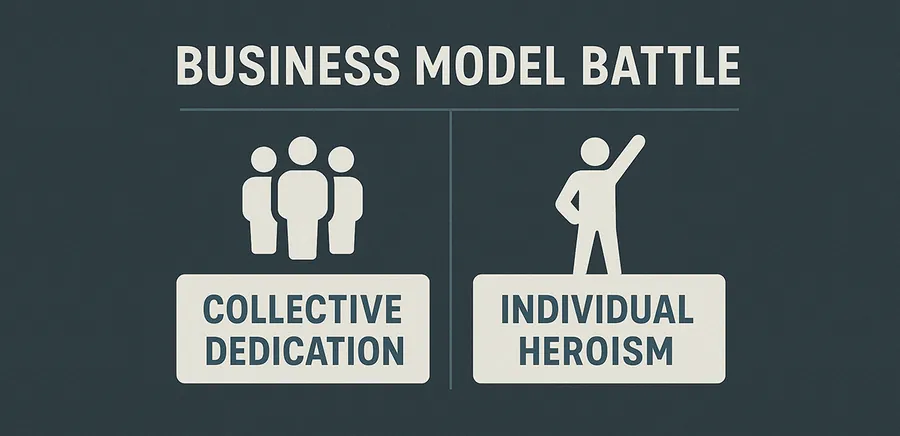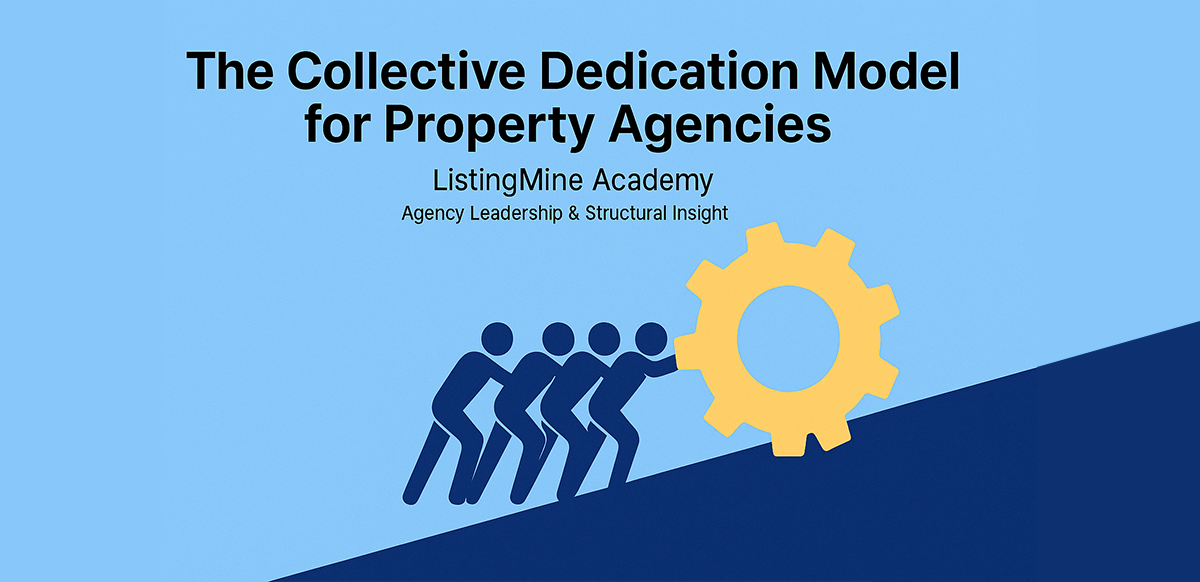
Collective dedication turns agency growth into a shared operating model rather than individual heroism. Teams perform better when responsibility, roles, and outcomes are aligned.
ListingMine Academy | Agency Leadership & Structural Insight
Before high-payout platforms, before downline-poaching, before the era where every agent insisted on “being their own boss,” Malaysia’s strongest property agencies grew from one powerful idea:
Today, we finally have the exact term that describes this strategy with precision: The Collective Dedication Model.
In Malaysia, agency leaders often try to describe this using vague phrases:
These capture the intention — but not the discipline, sacrifice, alignment, and identity required to build a scalable organisation.
Collective Dedication is the accurate term Malaysian agencies have been trying to express for years — but never named correctly.
This article explains:
10–20 years ago, agency principals understood a simple truth: Fresh recruits are clean. Experienced agents often carry corrupted habits.
“Corrupted” here does not mean illegal — it means:
So the strategy was simple: Don’t fix damaged culture. Grow clean culture from scratch.
Agencies focused heavily on fresh graduates and newcomers. Some even offered salary-based probation to help them survive their first months. This was the foundation of Collective Dedication.
The philosophy is simple: When everyone starts from zero and grows under one system, the organisation becomes unstoppable.
Agents trained under this model shared one workflow, one pitch, one discipline, and one identity. But the deeper power was Shared Sacrifice:
The Growth Pattern:
This is how Malaysia’s strongest legacy agencies were built.
In the last decade, high-payout agencies entered the Malaysian market offering 90–100% payouts.
Their pitch was irresistible:
“You’re experienced now. One deal there = two or three deals here.”
Agents trained for 2–3 years under disciplined environments started saying:
And they left.
This is the part nearly nobody talks about. When agents leave a Collective Dedication environment:
Then reality hits: Their performance came from the culture — not their individual ability.
Once the environment that made them productive vanished, income, confidence, and consistency collapsed. Many struggled for months without closing. Many quietly exited the industry. Many still don’t understand what happened.
For principals, the cycle was heartbreaking: Train → Grow → They Leave → Restart → Repeat
Years of effort were wasted. Eventually, many bosses surrendered:
“I’ll stop training fresh people. I’ll recruit only experienced agents.”
But this created a new type of chaos.
When agencies began importing agents from everywhere, they also imported:
The result? Endless arguments, internal politics, no alignment, and no unified identity. Collective Dedication collapsed instantly.
In the early days, Collective Dedication created unity. But when leading real estate organisations (such as Beike, Maitian, 5i5j) introduced Role-Based Systems, something remarkable happened: they became far more powerful than in their early years.
The magic formula was: Collective Dedication Culture + Role-Based Operating System
This created a scalable, disciplined, frictionless machine.
Why it works:
Fresh recruits fit in instantly. Experienced agents cannot break the culture. Structure becomes stronger than personality.
The Pattern: Culture alone is not enough. Structure alone is not enough. Culture + Structure = Platform Dominance.
The Collective Dedication Model didn’t fail because it was wrong. It failed because Malaysia had no infrastructure to protect it.
ListingMine ACN finally solves this.
For the first time, Malaysian agencies have an operating system that enforces culture, standardises behaviour, and protects training investment.
Every task becomes a defined role:
The system decides the split — not the people. No more fights. No more “I did more than you.”
Fresh agents can work as Viewers, Verifiers, or Follow-up specialists. No more 6-month starvation. Fresh recruitment becomes viable again.
The system is so clear that even senior agents must follow. Roles neutralise bad habits and personality-driven behaviour. Structure forces alignment.
ListingMine ACN retains verified listings, logs, workflows, and contributions. When someone leaves, the system keeps the value.
Agents stay because the system multiplies their capacity and protects fairness. Loyalty becomes logical, not emotional.
For decades, this model built Malaysia’s strongest teams. It collapsed only because the ecosystem rewarded agents for leaving.
ListingMine ACN is the missing infrastructure that allows Collective Dedication to return.
With ListingMine ACN, agency bosses can:
This is the new era of Malaysian real estate operations.
ListingMine Academy

Founder of ListingMine and author of Agent for Life. Building ERP for Malaysian real estate agencies since 2008 — and writing to reshape how agencies grow.
More about Marvin Foong →More articles in this topic