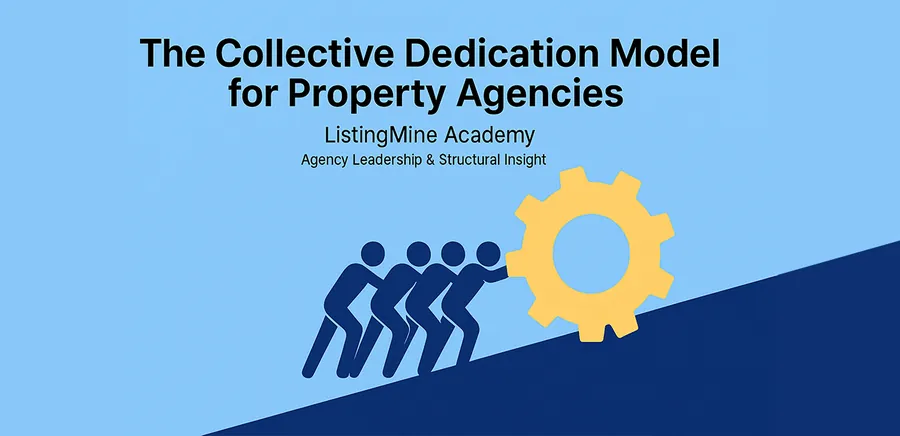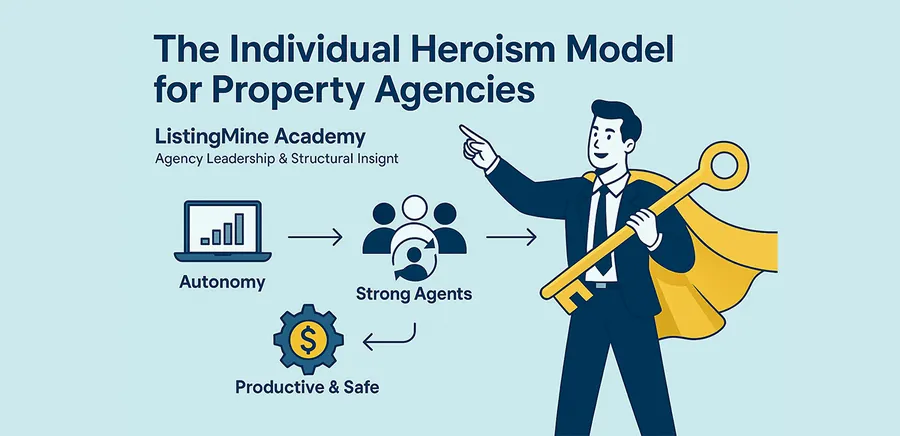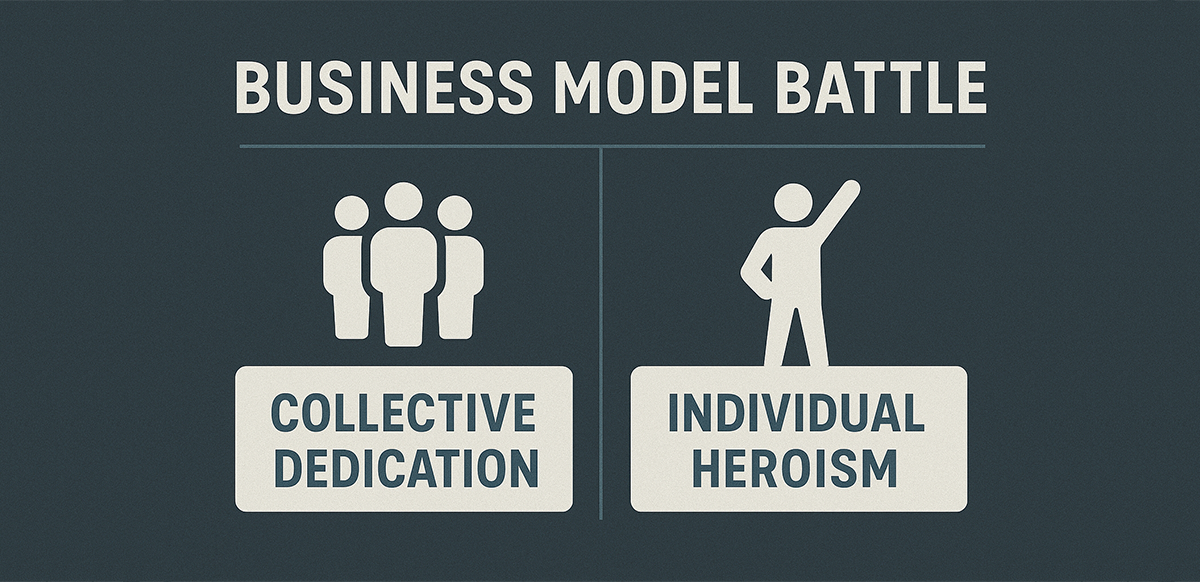
Agencies must choose between scalable collective systems and fragile hero-based performance. Collective dedication is harder to build but more sustainable than relying on individual stars.
ListingMine Academy | Agency Leadership & Structural Insight
For decades, Malaysian real estate leaders have been stuck between two agency models — each powerful, each proven, but each carrying a fatal structural weakness:
Both models work.
Both have built successful agencies.
Both can scale.
But every Principal has felt the hidden cracks behind each model — even if they did not have the language to describe them.
This article breaks both models down side-by-side, using clear agency language, and shows how ACN (Agent Cooperation Network) acts as the missing structural layer — not a miracle, but a tool — that helps stabilise both models when used properly.
| Feature | Collective Dedication Model | Individual Heroism Model |
|---|---|---|
| How Bosses Describe It | “Build culture”, “Train from zero”, “System first” | “High payout”, “Experienced agent model”, “Be your own boss” |
| Recruitment Target | Fresh graduates, New joiners | Senior agents, Lone wolves, Team leaders |
| Leadership Style | Hands-on, Coaching, Discipline | Hands-off, Freedom, Minimal control |
| Growth Speed | Slow Start — heavy training | Fast Start — plug-and-play |
| Internal Harmony | High (one direction) | Fragmented (many internal tribes) |
The Collective Dedication Path
Slow at first — culture takes time to build.
But once the culture locks in, duplication becomes extremely powerful because everyone follows one unified system.
The Individual Heroism Path
Explodes immediately — high payout attracts seniors and downlines fast.
But eventually, internal chaos appears because different leaders run different “mini-companies” under the same roof.
Every Principal knows these patterns.
Now the problems finally have names.
The “Free University” Problem
| Issue | Explanation |
|---|---|
| Year 2–3 leakage | Trained agents feel they have “graduated” and jump to high-payout firms |
| Value loss | Principal’s training investment disappears |
| Culture damage | When seniors leave, juniors lose direction |
Result:
The agency is always rebuilding its middle layer.
The “Dead Weight” Problem
| Issue | Explanation |
|---|---|
| Large inactive base | 300 agents on paper, but only 30 closing deals |
| Wasted potential | Juniors cannot close end-to-end; contribute zero |
| Growth bottleneck | Team leaders burn out supporting non-producers |
Result:
Huge headcount, low profitability.
Both models produce cashflow.
But capital markets look for assets, not just income.
Historically, Malaysian real estate agencies were valued at 1–2x PE — similar to manpower businesses.
Why?
| Weakness | Explanation |
|---|---|
| Value lives inside agents | They leave → business value disappears |
| Personality dependency | Agency relies on “Stars,” not systems |
| No proof-of-work | WhatsApp-based operations, no audit trail |
| No moat | Culture and payout can be copied easily |
| No data ownership | Listings and workflows sit with leaders, not agency |
Conclusion:
Both models are operationally strong but structurally weak.
ACN is not a new business model.
It is the structural backbone that both models were missing.
It moves value from: Individuals → Into the Company System
| Old Problem | ACN Solution |
|---|---|
| Retention leakage | System stickiness — leaving means losing access to verified inventory & logs |
| Slow junior earnings | Micro-roles (Viewer, Verifier, Referrer) enable immediate income |
| Culture collapse | System-enforced workflow keeps standards intact |
| Training loss | Listings, logs, contribution history remain with agency |
| Old Problem | ACN Solution |
|---|---|
| Ducks problem | Activation — low-skill agents become productive via micro-roles |
| Fragility | Data stays even when leaders leave |
| Inconsistent quality | ACN checkpoints enforce minimum workflow |
| No enterprise value | Workflow data becomes a real asset |
ACN does not magically fix an agency.
It does not replace leadership, policy design, or organisation logic.
What ACN does provide is the missing infrastructure to express, enforce, and measure whatever model the agency wants to build.
Think of ListingMine ACN as: A supercharged Excel + workflow engine
But:
If your agency logic is flawed, messy, or politically inconsistent — ACN will reflect the mess. Just like Excel reflects a bad financial model with perfect accuracy.
Realistic View: ACN Reduces Chaos — It Does Not Erase It
ACN helps agencies run hybrid strategies such as:
…but the results depend entirely on how clearly the agency defines:
If these are unclear, the system becomes unclear.
If the policies are messy, the system reflects the mess.
ACN doesn’t create good policy — it only enforces it.
Stop Debating the “Better Model” — Start Strengthening the One You Run
Both Collective Dedication and Individual Heroism can work.
Both can fail.
Both can scale or collapse, depending on policy quality and leadership execution.
ACN is not a guarantee of success.
It is simply the missing infrastructure Malaysian agencies never had:
ACN improves clarity.
ACN reduces chaos.
ACN exposes weak logic and rewards strong logic.
But the agency still needs:
In other words:
ACN makes a good agency stronger.
ACN makes a bad agency visible.
It does not magically save anyone.
The real competitive advantage is the combination of:
Agencies should not “embrace ACN thinking it solves everything.”
They should embrace ACN because it gives them the tools to finally build the model they claim to believe in — whether that model is Dedication, Heroism, or a hybrid of both.
ListingMine Academy

Founder of ListingMine and author of Agent for Life. Building ERP for Malaysian real estate agencies since 2008 — and writing to reshape how agencies grow.
More about Marvin Foong →More articles in this topic
This article is one of the sources behind this assessment. Take it to see what you already know and what to read next.
Educational self-assessment. Not a licensing examination or professional certification.