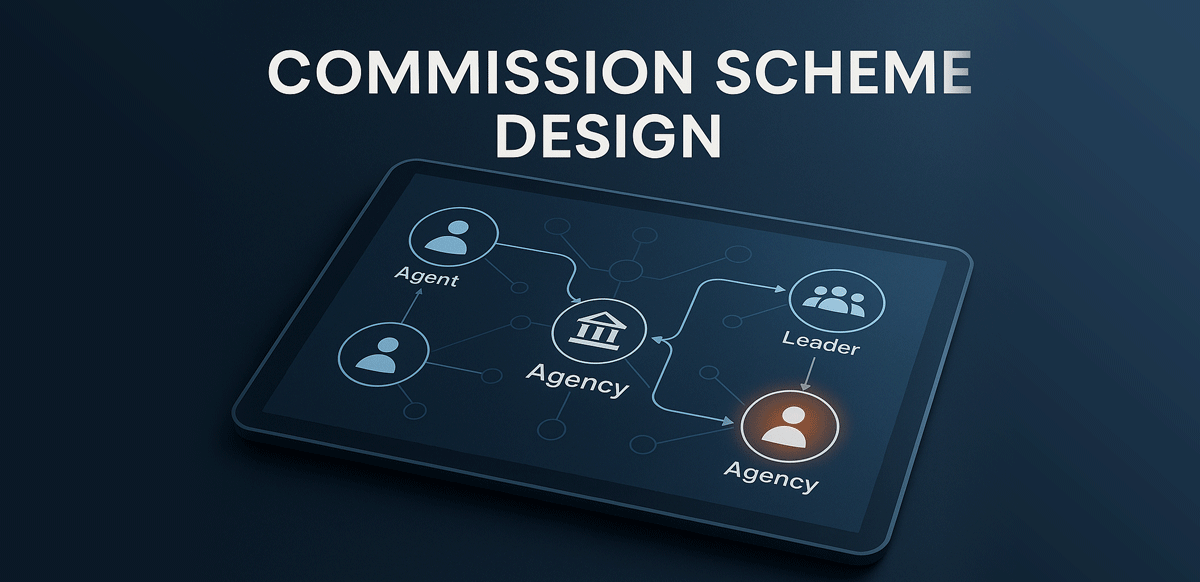
Commission scheme design is a core management discipline, not just a payout decision. Good schemes align recruitment, retention, profitability, and contribution fairness.
Why most agency bosses lose their best agents not because of payout ratios — but because of poor system design.
Commission scheme design is the single most critical, yet completely overlooked, discipline in agency management. It should be a core subject taught in business schools, but it's missing from every university curriculum in the world.
In Malaysia’s real estate industry, this gap is stark. Almost no one—from experienced team leaders to agency owners—has been formally taught how to design one.
Most leaders default to the only metric they know: the split ratio (e.g., 80/20, 70/30). But a commission scheme is far more than just numbers. It is the real-world expression of your entire business. It reflects your:
A ratio is just an outcome; the scheme is the system.
This lack of design is the primary, silent reason your top performers leave and your leadership team constantly manages disputes. You might think it’s a numbers game, but your commission structure is your primary competitive weapon.
When designed poorly, it fuels attrition and creates endless tension.
When designed with intent, it builds loyalty, profitability, and scale.
Without a strategic framework, most leaders design schemes emotionally, not competitively. The thinking is often reactive:
This creates a closed system that rewards the company’s cost structure, not the market’s talent structure.
When your agents become successful, they inevitably outgrow a system built to cover your costs. An opaque or cost-based commission scheme is the single biggest driver of agent turnover in Malaysia.
Your scheme is your culture. Before setting a single number, decide what kind of organization you want to build.
Here are 9 primary frameworks in Malaysia’s real estate landscape:
| Model | Key Traits | Best For... | Biggest Risk |
|---|---|---|---|
| 1. Corporate Model | Salary + capped bonus. Predictable but limited upside. | Stability and institutional work. | Capping high performers. |
| 2. Traditional Agency | Pure split with overrides. Simple hierarchy. | Familiar structure; easy onboarding. | High conflict from manual overrides. |
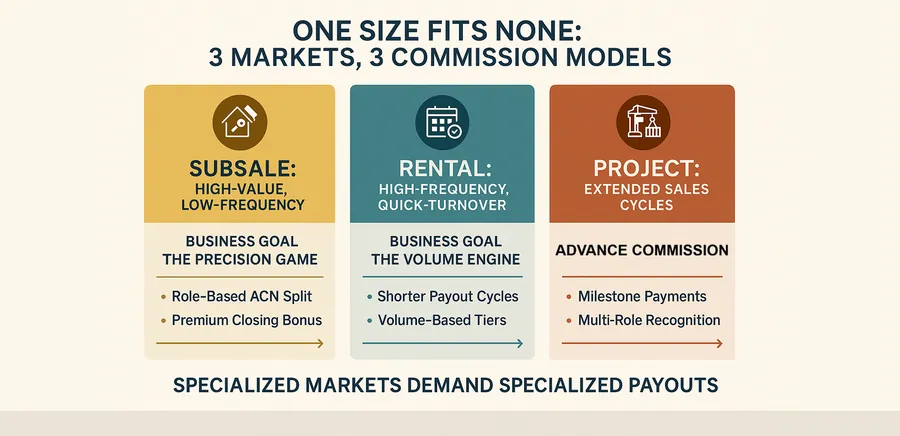
| 3. Rent /Sale Split | Different rates for rentals vs. sales. | Rental-heavy firms needing cash flow. | Demotivates sales focus. |
| 4. Role- Based (ACN) | Splits by role: lister, advertiser, closer, etc. | Transparent, teamwork-oriented. | Requires an ERP or ACN system. |
| 5. Buyer- Channel Model | The company owns leads; agents close. | High lead volume teams. | Feels restrictive; low autonomy. |
| 6. Fusion Model | Leaders run semi-independent teams. | Rapid recruitment scaling. | Complex to manage and audit. |
| 7. Exclusive Inventory | Focus on verified, exclusive listings. | Building brand trust and discipline. | Slower scaling; inventory bottleneck. |
| 8. Multi- System | Mix of frameworks under one ERP. | Agencies with diverse teams. | High system maintenance. |
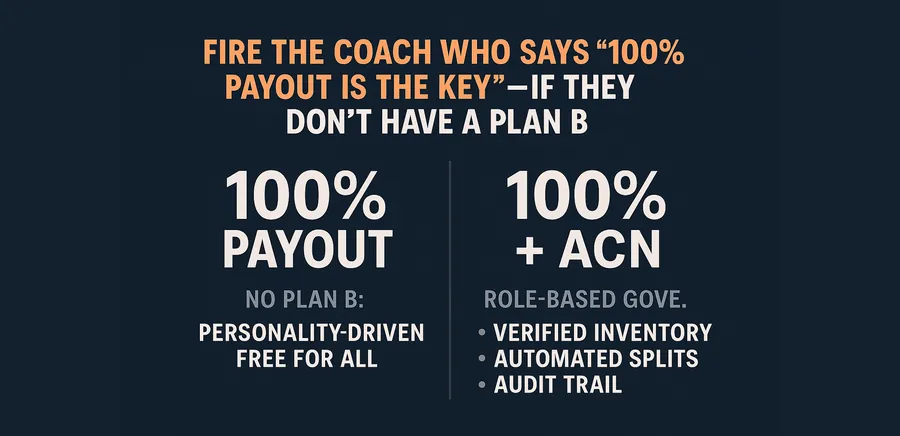
| 9. Shared Office | Platform fee + 100% payout. | Senior, independent agents. | Weak retention and training culture. |
Expert Advice:
The nine frameworks above are not an exhaustive list — they’re just the most common foundations. In real practice, most agencies end up creating hybrids that mix multiple models: a bit of override structure here, some role-based logic there, and a few special exceptions for top producers. Over time, these hybrid schemes grow increasingly complex and harder to manage.
Bottom line: your choice defines everything. Are you building a collaborative machine (Role-Based) or a network of high-performing independents (Shared Office)?
Commission design is an act of competitive intelligence, not an internal accounting exercise.
Look beyond the headline split (e.g., "90% payout!") and study the Effective Agent Take-Home (EATH). Ask:
If a competitor offers a more generous split and is still growing, don't dismiss them—study their system advantage. Are they using automation? Do they have a shared, verified listing network that reduces agent workload? You’re not copying their numbers; you're decoding their business model.
A commission scheme is an economic system that must align three parties: the agent, the team leader, and the agency. It is not a reaction to your expenses.
Start with the agent, not your rent: "What must a top-performing agent earn to feel valued and stay loyal?"
Then, model backward. Your model must balance four key economic forces:
Model your splits, overrides, and bonuses until you achieve a balance that funds agency growth, rewards leadership, and makes your top agents feel like they have the best deal in the market.
A strategic model is useless if it’s implemented manually. Manual tracking on spreadsheets is the number one source of commission disputes, and it kills trust.
This is where a modern Real Estate ERP (Enterprise Resource Planning) system becomes non-negotiable. It must automate fairness by providing:
But automation is not enough. You also need agility.
A commission scheme has no permanent structure. It must change over time to adapt to new competitive threats and market opportunities.
This is the trap most agencies fall into. They invest in a rigid ERP, only to find themselves locked in. Imagine needing a 3-month coding cycle and a RM10,000 fee just to test a new bonus to counter a competitor. Your most strategic weapon is held hostage by your own software. This model is broken.
You need a system that is as flexible as Excel but as robust as an enterprise platform. You must be able to apply whatever you want, whenever you want, and adapt to market needs instantly.
ListingMine ERP is designed to completely fix this. It provides the automation for fairness and the deep flexibility for agility. You become more agile, save significant costs on customization, and can finally afford to trial-and-error your way to the perfect, most competitive scheme.
Think of your ERP not as mere software, but as the infrastructure that makes your commission system work.
Not sure where you stand? Before you design a new scheme, run your current one through this 5-point stress test. If you answer "no" to two or more, your scheme is actively leaking talent and trust.
A commission scheme isn’t just a spreadsheet; it’s your agency’s entire operating philosophy expressed in numbers.
It’s the core mechanism that defines your culture, dictates your competitiveness, powers your recruitment, and determines your scalability. When designed with intent, it attracts the right talent, scales fairness, and compounds loyalty. When left to guesswork, it silently bleeds your best people.
This is the missing discipline of agency management. You don’t need another ratio—you need a system.
Start with a clear cultural model, build a competitive economic engine, and automate its fairness with technology that gives you both power and flexibility. Because in the end, brilliant commission design isn't about payouts—it's about building a permanent, profitable business.

Founder of ListingMine and author of Agent for Life. Building ERP for Malaysian real estate agencies since 2008 — and writing to reshape how agencies grow.
More about Marvin Foong →More articles in this topic
This article is one of the sources behind this assessment. Take it to see what you already know and what to read next.
Educational self-assessment. Not a licensing examination or professional certification.