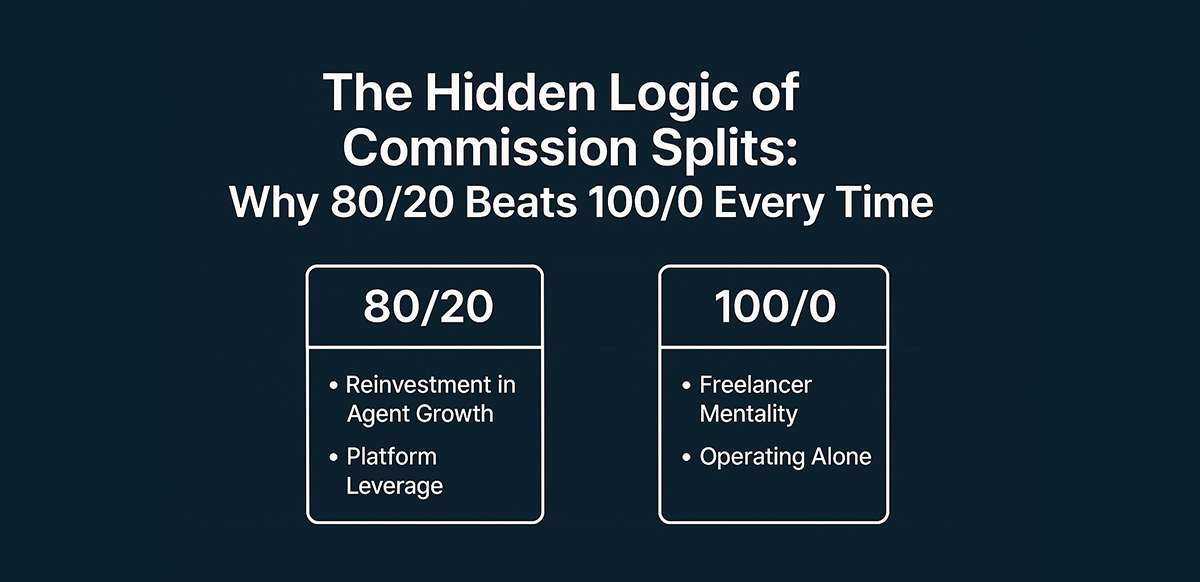
A balanced split can outperform 100% payout when the agency provides real value, support, systems, and growth infrastructure. Agents need value, not only percentage.
The oldest debate in real estate is also the simplest math problem: 80% vs 100%.
Agents ask:
“Why should I give 20% to the company?”
“If another agency offers 100%, shouldn’t I take it?”
That sounds like a smart financial decision — until you realize the real question isn’t the split. It’s the system behind the split.
The real question is:
“Who is reinvesting in my growth, and who isn’t?”
Most agents see the 20% as “money taken from them.”
That is freelancer thinking — not business thinking.
In reality, that 20% is pooled capital. It is the fuel that funds everything one agent cannot build alone:
One agent keeping 100% has zero leverage. A platform pooling hundreds of 20% creates compound leverage.
The 100% model sounds perfect — until you understand its hidden contract.
You keep everything because the company builds nothing for you.
A 100% agency typically provides:
But here is what is missing:
It is not an agency model. It is a chair-rental model disguised as an agency.
You keep 100% — and also bear 100% of the cost, risk, time, and workload.
Top agents don’t ask, “What’s my split?”
They ask, “What’s my net?”
Because 80% of a bigger pie consistently beats 100% of a smaller one.
| Scenario A | Scenario B |
|---|---|
| 100% Model (Solo Agent) | 80/20 Platform Model |
| 100% of RM 10,000 | 80% of RM 30,000 |
| = RM 10,000 | = RM 24,000 |
The platform did not “take 20%.” It generated an additional RM 14,000 in value for you.
That is why the highest-earning agents in Malaysia, the US, and China are not inside 100% agencies. They are inside platforms that multiply output, not percentage.
The commission split you choose determines your career ceiling.
100% Model = Freelancer Trap
80/20 Platform = Scalable Career Path
Because the 20% funds a system, the system gives you a ladder:
You are not just earning commissions. You are earning position, overrides, and downstream revenue.
Freelancers protect percentages. Builders secure platforms.
Instead of asking:
“How much of my commission do I keep?”
Ask:
“What does the company build with the 20%, and how does it multiply my income?”
If the answer is:
“Nothing. We just provide a license and a desk.”
Then it is not a business. It is a seat rental.
If the answer is:
“Technology, leads, brand equity, team systems, override pathways, long-term income model…”
Then it is not a split. It is a platform.
Platforms like ListingMine exist because agents are tired of choosing between:
The new model is platform-based:
The 20% no longer disappears. It compounds into infrastructure that lifts every agent inside the network.
There is one group who can survive in a 100% model:
The already-successful, already-branded, already self-sufficient “super agent.”
Someone who:
For that tiny group, 100% can make sense — because they are the platform.
But here is the reality:
99% of agents are not there.
100% models do not create super agents — they only accept them.
No one becomes a top producer in a 100% environment. They only arrive there after the platform has already built them.
The 100% model is not the fast track. It is the graduation stage — not the growth stage.
100% is not freedom; it's self-employment with no leverage. 80/20 is not a deduction; it's pooled capital that funds the machine which scales you beyond your personal capacity.
The smartest agents don't compete for higher splits. They compete for access to better platforms. Because the real career ladder isn't Higher Split → Higher Income. It's Agent → Leader → Owner → Platform Equity.
Don't choose the split that pays you the most today. Choose the platform that makes you worth the most tomorrow. The future belongs to builders, not just earners.
Important: In Malaysia, 80/20 or 100% split models cannot be applied directly because BOVAEP caps REN commission at 40%. The point of this article is to explain the economics behind split logic, not to suggest illegal payout structures. Agencies must comply with Act 242 and design models within the legal 60/40 framework.

Founder of ListingMine and author of Agent for Life. Building ERP for Malaysian real estate agencies since 2008 — and writing to reshape how agencies grow.
More about Marvin Foong →More articles in this topic
This article is one of the sources behind this assessment. Take it to see what you already know and what to read next.
Educational self-assessment. Not a licensing examination or professional certification.