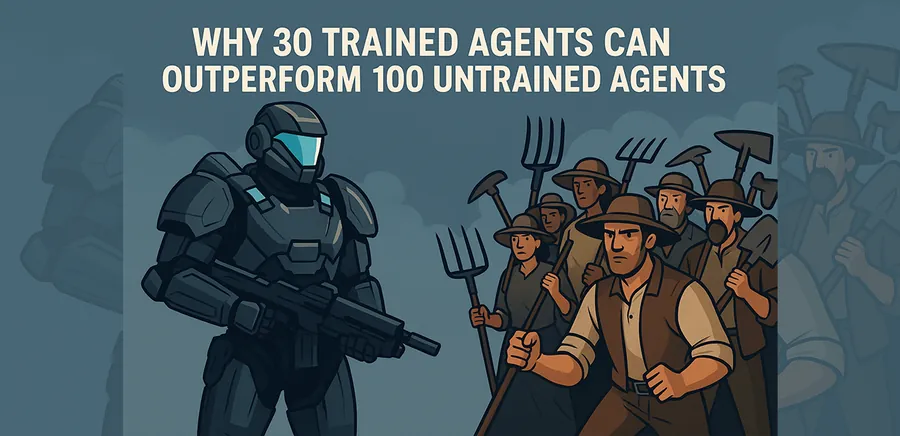
Agencies with fewer but better-trained agents can outperform large offices filled with inactive people. Competency density matters more than physical size or headcount.
And Why Network Growth Only Works After Standards Are Established
For decades, the real estate industry admired agencies that looked big.
Big offices, many branches, many uniforms, and long rows of desks symbolised power, reputation, and dominance.
That era is over.
A new competitive model is emerging — one where competency density will outperform office density, and where network strength is determined by skill quality, not headcount volume.
This article explains why.
For many years, the dominant belief was:
More offices → more agents → more listings → more closings → more revenue
This was logical in a time when:
In that era, size signalled capability, even if it wasn’t always true.
Modern market conditions have shifted dramatically:
| Old Advantage | New Reality |
|---|---|
| Physical offices | Digital workflows & remote work |
| Visibility through signboards | Visibility through platforms |
| Staff proximity | System + SOP + verification |
| Recruit first, train later | Train first, verify, then scale |
Therefore, physical size is no longer a winning advantage — operational strength is.
Competency Density =
The percentage of people in a team who can perform at professional standard independently, predictably, and verifiably.
In simple terms:
Competency = execution capability
Density = concentration within the team
Scale = amplified output without chaos
When competency density is high:
A common question is:
“If ACN is a network model, wouldn’t more agents automatically make it stronger?”
Yes — but only at the right stage and with the right foundation.
A large network with unverified skills and unverified listings becomes a chaos multiplier, not a success multiplier.
| Correct Sequence | Wrong Sequence | Right ACN Sequence |
|---|---|---|
| Recruit → Rush → Hope | Train → Verify → Expand | Anyone can join |
| Growth by headcount | Growth by professionalism | Big but unstable |
| Small, strong, then scalable |
Growth is only an advantage when quality scales with quantity.
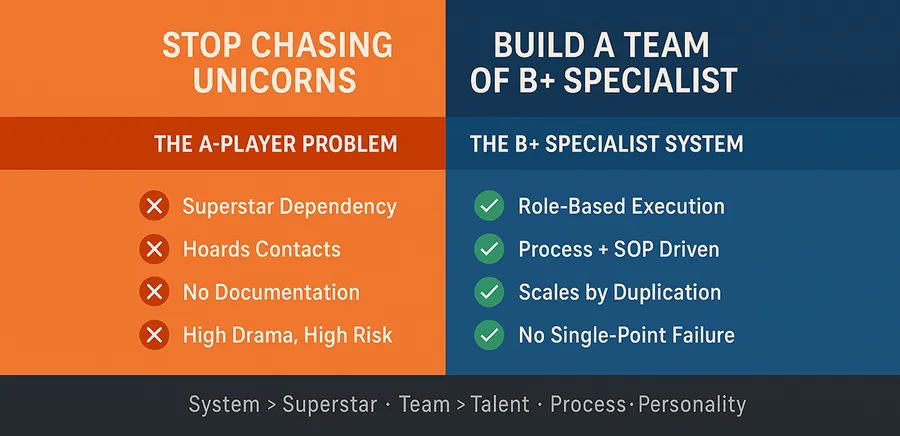
100 agents × 20% competency = 20 people who can truly perform
vs
30 agents × 70% competency = 21 people who can truly perform
Smaller, stronger teams beat larger weak teams.
This is why competency density is more important than agent count.
Once competency density is established, network size becomes a force multiplier — not a liability.
Output = (Skill × System × Verification) – Rework
Office space cannot reduce rework.
Competency + workflow standards can.
ACN becomes powerful when both are true:
Then, and only then, does network size become exponential.
Competence first.
Credibility second.
Connectivity third.
Stop asking:
“How many agents do you have?”
Start asking:
“How many agents can perform independently, consistently, and verifiably?”
This becomes the true commercial value of a modern real estate organisation.
Office density builds appearance.
Competency density builds performance.
Network density builds dominance — but only after competency comes first.

Founder of ListingMine and author of Agent for Life. Building ERP for Malaysian real estate agencies since 2008 — and writing to reshape how agencies grow.
More about Marvin Foong →More articles in this topic
This article is one of the sources behind this assessment. Take it to see what you already know and what to read next.
Educational self-assessment. Not a licensing examination or professional certification.