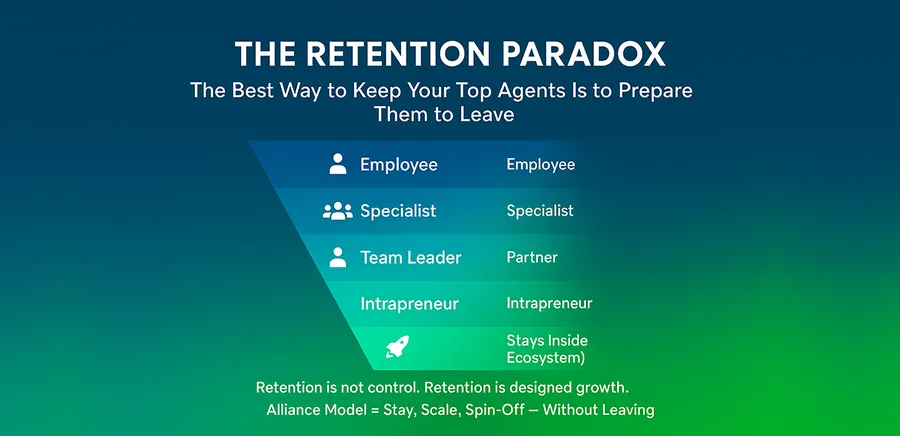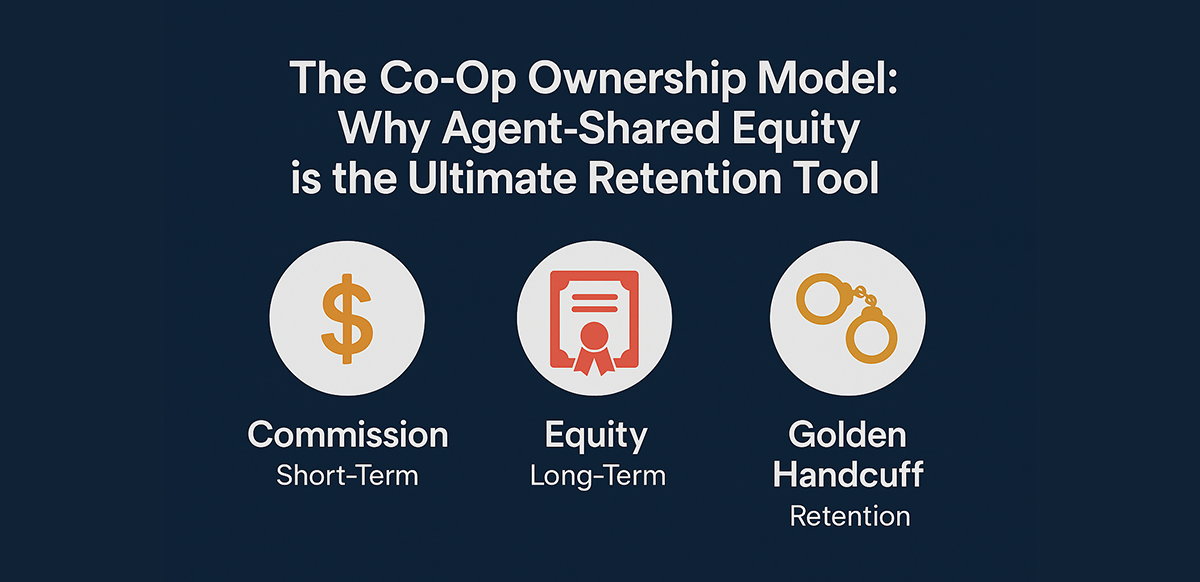
Shared equity can retain agents by turning them into stakeholders rather than temporary earners. Ownership alignment can be stronger than commission incentives.
Warning: Your top agents are already planning their exit—you just don't know it yet.
The biggest threat to your agency’s long-term Enterprise Value is not a market crash; it's the inevitable talent drain. Your revenue engines are perpetually one phone call away from leaving to start a rival firm or join a competitor for a marginal commission split.
The traditional fix—increasing commission percentages—is a losing strategy. It simply makes your agency a higher-cost version of itself, eroding profitability without solving the core problem: your best people have no real stake in the long-term success of the business itself.
The solution is not a better split; it's a better structure. Enter the Co-Op Ownership Model, where key agents transition from being mere fee-earners to genuine equity partners in the agency they help build.
This model replaces the unsustainable race of commission percentages with a hybrid structure:
This is a fundamental shift. Agents are no longer hunting solely for their next commission check; they are building an asset whose value compounds over time, directly benefiting them when the agency sells.
When an agent owns a piece of the business, their professional calculus changes entirely. The focus shifts from "My deal" to "Our market share."
| If Your Agent is a Commission-Only Freelancer | If Your Agent is an Equity-Owning Partner |
|---|---|
| Focus: Personal sales volume. | Focus: Gross profit, brand reputation, and operational efficiency. |
| View of New Hires: Competition for leads. | View of New Hires: Valuable teammates who increase the agency's overall valuation. |
| Behavior: Hoards knowledge and client lists. | Behavior: Shares best practices to elevate the entire team's performance. |
| Exit Trigger: Leaves easily for a 5% better split. | Exit Trigger: Stays and builds, as leaving means abandoning their hard-earned equity (The Golden Handcuff). |
This model is not theoretical. It has been successfully implemented globally by brokerages that focus on scale and retention.
The equity must be earned and deferred to function as the ultimate retention tool.
Time-Based Vesting: An agent is granted, say, 3% equity that vests over 4 or 5 years. They forfeit unvested shares if they leave prematurely.
Performance Grants: Additional equity is tied to hitting specific, measurable milestones: gross profit targets, leadership appointments, or successful mentorship.
Simple Math Example: An agent earns and vests 3% equity over five years. If the agency achieves a strategic RM10 million exit valuation, that agent receives RM300,000—a life-changing amount far exceeding a few years of extra commission splits.
The Co-Op Ownership Model transforms your agency from a high-cost service provider competing on commission splits into a wealth-creation platform. You turn a collection of individual freelancers into a formidable enterprise with a single, unifying mission: to build something valuable, together.
If you don't offer equity, someone else will.

Founder of ListingMine and author of Agent for Life. Building ERP for Malaysian real estate agencies since 2008 — and writing to reshape how agencies grow.
More about Marvin Foong →More articles in this topic
This article is one of the sources behind this assessment. Take it to see what you already know and what to read next.
Educational self-assessment. Not a licensing examination or professional certification.